The demand for zero sugar energy drinks continues to grow as consumers look for convenient ways to support their active lifestyles without adding sugar to their daily diets. From fitness enthusiasts and young professionals to gamers and busy commuters, more consumers are exploring energy drinks that deliver flavour, refreshment and functional ingredients without traditional sugar content. However, developing a successful zero sugar energy drink requires more than removing sugar from a standard formula. Sugar contributes sweetness, body, flavour balance and mouthfeel. When manufacturers remove it without adjusting the remaining ingredients, the finished drink can develop bitterness, an artificial aftertaste, poor carbonation balance or an unpleasant texture.
Therefore, beverage brands must approach product development with a clear formulation strategy, suitable ingredients and consistent quality control. Understanding the most common Zero Sugar Energy Drink Development Mistakes helps brands avoid costly reformulations, improve product quality and prepare their beverages for commercial production.
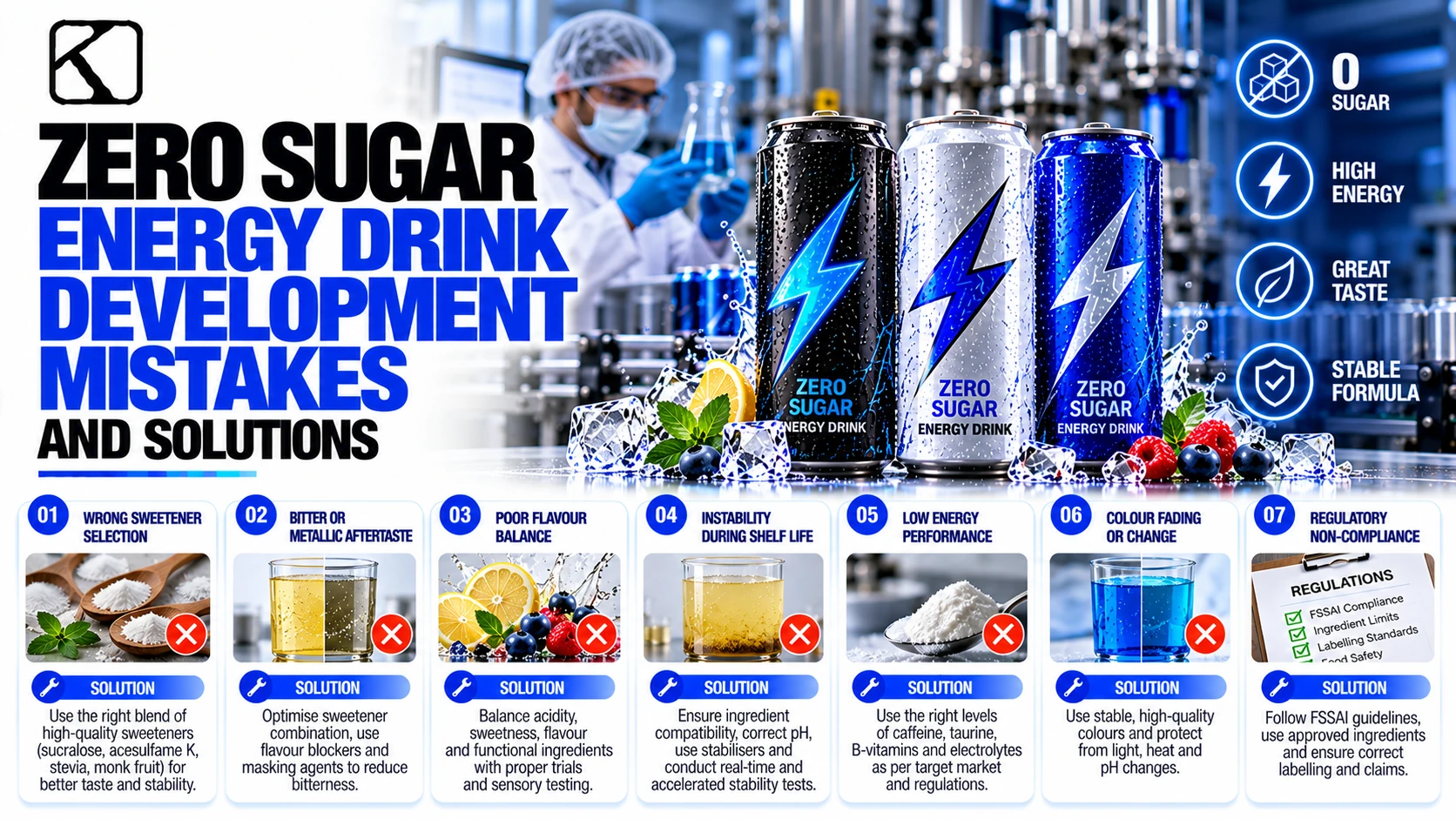
1. Zero Sugar Energy Drink Development Mistakes: Choosing the Wrong Sweeteners
Sweetener selection represents one of the most important decisions in zero sugar energy drink development. Traditional sugar provides a clean, familiar sweetness, whereas alternative sweeteners can produce different flavour profiles and lingering aftertastes.
For example, some formulations may develop a bitter or metallic note when manufacturers rely too heavily on a single high-intensity sweetener. Furthermore, the wrong sweetener combination can make citrus, berry and tropical flavours taste unbalanced.
Solution: Develop a Balanced Sweetener System
Manufacturers should evaluate different sweeteners and combinations according to the target flavour, sweetness intensity, regulatory requirements and intended market.
A practical development process includes:
- Testing different sweetener combinations at controlled concentrations.
- Evaluating sweetness onset, intensity and aftertaste.
- Matching the sweetener profile with the selected flavour.
- Conducting sensory evaluations with the target audience.
- Verifying ingredient suitability and permitted use in the intended market.
Ultimately, the best sweetener system delivers a pleasant taste throughout the drinking experience rather than creating excessive sweetness at the first sip.
2. Removing Sugar Without Rebuilding the Flavour Profile
Sugar does more than make an energy drink sweet. It also helps balance acidity, bitterness and the flavour intensity of ingredients such as caffeine, botanical extracts and certain vitamins.
Consequently, simply removing sugar from an existing energy drink formula can expose unpleasant flavour notes. Citrus drinks may taste excessively sharp, while berry and tropical varieties may lose their characteristic fullness.
Solution: Reformulate the Entire Beverage
Instead of treating sugar removal as a single ingredient substitution, manufacturers should reassess the complete flavour system.
They can adjust permitted acidulants, flavour concentrations, sweetener combinations and other suitable formulation components to create a balanced sensory profile.
For instance, a zero sugar lemon-lime energy drink may require a different sweetness-to-acidity balance than a mango or mixed-berry formulation. Each flavour needs its own development and testing process.
This approach helps brands preserve their intended taste while creating a genuinely enjoyable zero sugar beverage.
3. Ignoring Mouthfeel and Body
One common mistake in Zero Sugar Energy Drink Development is overlooking the texture of the finished product. Sugar contributes body and fullness, so its removal can make an energy drink feel thin or watery.
Although a beverage may achieve the desired sweetness, consumers might still reject it if the texture feels noticeably different from their expectations.
Solution: Improve the Sensory Experience
Developers should evaluate mouthfeel alongside sweetness, aroma, acidity and carbonation. Depending on the formulation, suitable permitted ingredients may help improve the overall drinking experience.
However, every ingredient must serve a clear functional purpose. Adding unnecessary ingredients can increase costs, complicate manufacturing and create additional stability challenges.
Therefore, manufacturers should test small formulation variations, compare samples through sensory panels and select the simplest system that meets the product’s quality objectives.
4. Overlooking Caffeine Levels and Ingredient Compatibility
Caffeine plays a central role in many energy drinks. However, excessive bitterness or poor ingredient integration can negatively affect the final flavour.
Energy drink formulations may also contain ingredients such as taurine, B vitamins and selected botanical extracts. These ingredients can introduce their own flavour characteristics and may interact with other formulation components under certain processing or storage conditions.
Solution: Validate the Complete Ingredient System
Brands should define their intended caffeine level and select every functional ingredient according to the product concept, target consumers and applicable regulations.
The development team should assess:
- Caffeine concentration and dosing accuracy.
- Ingredient compatibility within the finished beverage.
- Solubility and dispersion under intended processing conditions.
- Flavour changes after processing.
- Stability throughout the proposed shelf life.
Moreover, manufacturers should verify all ingredient specifications and ensure that the finished product meets applicable food safety and labelling requirements.
A well-designed energy drink balances its functional ingredients with taste, consistency and consumer expectations.
5. Neglecting Acidity and pH Control
Acidity influences the taste, stability and microbiological safety of many energy drinks. However, an incorrect acid balance can make a zero sugar beverage taste too sour, flat or harsh.
Furthermore, pH can influence ingredient stability, preservative performance and processing requirements. A formula that tastes acceptable during initial development may still require adjustments after production trials.
Solution: Establish Clear Formulation and Quality Targets
Manufacturers should define appropriate pH and acidity targets for the specific beverage rather than applying one standard across every flavour.
During development, the team should measure pH, assess titratable acidity where relevant and evaluate the sensory impact of formulation changes.
They should also validate the appropriate processing and preservation system. A low pH alone does not guarantee microbiological safety, so the finished product requires a suitable, validated food safety approach.
Consistent measurements and documented specifications help maintain product quality across production batches.
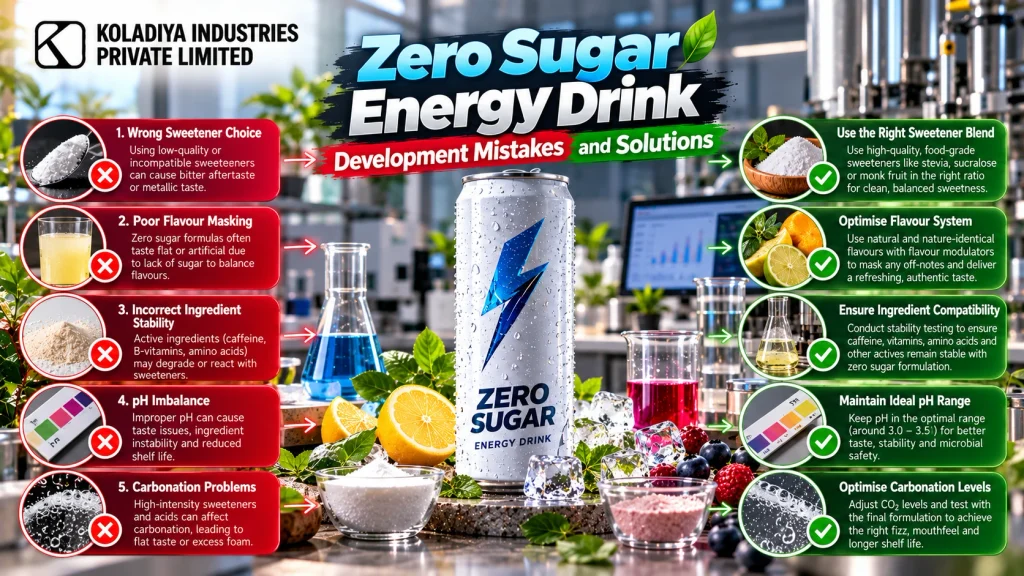
6. Failing to Test Carbonation and Flavour Balance
Carbonation can enhance the refreshing character of an energy drink, but it also changes how consumers perceive acidity, sweetness and aroma.
Too much carbonation may create an overly sharp drinking experience, while insufficient carbonation can make the beverage feel flat. In addition, carbonation levels may affect filling operations, packaging performance and consumer satisfaction.
Solution: Optimise Carbonation During Pilot Trials
Brands should evaluate carbonation levels using the intended formulation and packaging system.
Pilot trials should examine the interaction between carbonation, acidity, sweetness and flavour intensity. Manufacturers should also assess filling conditions, package integrity and consistency throughout the production process.
By testing these factors together, brands can establish a carbonation profile that supports the intended drinking experience without compromising manufacturing performance.
7. Skipping Shelf-Life and Stability Testing
A zero sugar energy drink may taste excellent immediately after production but develop quality problems during storage. Flavour deterioration, colour changes, ingredient precipitation and packaging interactions can affect the product’s appearance and taste.
Moreover, certain vitamins, flavour compounds and other ingredients may respond differently to heat, light, oxygen and storage conditions.
Solution: Conduct Structured Stability Studies
Manufacturers should establish a shelf-life testing programme that reflects the product’s formulation, packaging and intended distribution environment.
The programme should evaluate:
- Flavour and aroma retention.
- Colour and visual appearance.
- pH and other relevant quality parameters.
- Ingredient solubility and sediment formation.
- Carbonation retention, where applicable.
- Microbiological quality and packaging integrity.
Accelerated testing can help identify potential issues early, but it does not automatically replace appropriate real-time studies or validated shelf-life evidence.
Consequently, brands should confirm their proposed shelf life using suitable testing methods before making commercial claims.
8. Choosing Ingredients Without Considering Regulations
A formulation that works in one market may not meet the requirements of another. Sweeteners, caffeine levels, additives, nutritional claims and labelling requirements can vary according to the applicable jurisdiction and product category.
For example, a brand may plan to advertise a beverage as sugar-free without confirming the relevant legal conditions for that claim.
Solution: Review Compliance Before Finalising the Formula
Regulatory review should begin during product development, not after manufacturing.
The team should verify permitted ingredients, maximum use levels where applicable, mandatory declarations, caffeine-related labelling and nutritional claim requirements.
Additionally, claims such as zero sugar, low calorie, energy boosting or functional benefits must comply with applicable rules and have appropriate supporting evidence.
Early compliance checks help prevent expensive reformulations, packaging changes and delays during product launch.
9. Scaling Up Without Proper Pilot Production
A successful laboratory sample does not guarantee successful commercial production. Larger batches introduce differences in mixing, ingredient addition, temperature control, carbonation and filling conditions.
As a result, a beverage may taste consistent in a small development batch but perform differently during high-volume manufacturing.
Solution: Validate the Formula at Every Production Stage
Brands should follow a structured scale-up process that moves from laboratory samples to pilot batches and then to commercial production.
At each stage, manufacturers should document ingredient quantities, mixing procedures, processing parameters and quality results.
Pilot production also helps identify equipment limitations, filling challenges and potential packaging issues before the business commits to a larger production run.
This approach reduces avoidable waste and improves the chances of achieving consistent quality at commercial scale.
10. Focusing on Formula Cost Instead of Total Product Value
Reducing formulation costs may appear attractive during the early stages of development. However, choosing ingredients solely because they are inexpensive can compromise flavour, stability and consumer acceptance.
Similarly, a complicated formula may increase sourcing challenges, production time and quality control requirements.
Solution: Balance Cost, Quality and Market Positioning
Manufacturers should evaluate ingredient costs alongside sensory performance, supply availability, processing requirements and shelf-life expectations.
Brands should also define their target retail price, intended consumer segment and desired product positioning before finalising the formula.
A commercially successful zero sugar energy drink does not necessarily require the most expensive ingredients. Instead, it needs a reliable formulation that meets consumer expectations while supporting sustainable production costs.
How Koladiya Industries Can Support Zero Sugar Energy Drink Development
Developing a market-ready zero sugar energy drink requires coordinated work across formulation, flavour development, ingredient selection, production planning, quality control and packaging.
Koladiya Industries Private Limited supports beverage brand development through its focus on beverage manufacturing and product development solutions. For businesses exploring a new energy drink, working with an experienced beverage manufacturing partner can help organize the development process and prepare the product for commercial evaluation.
Depending on the project’s requirements and available manufacturing capabilities, brands should discuss:
- Product formulation: Developing a zero sugar concept around the intended flavour, sweetness and functional ingredients.
- Flavour development: Evaluating citrus, berry, tropical and other flavour profiles.
- Ingredient selection: Reviewing suitability, compatibility and regulatory requirements.
- Pilot production: Assessing the formula under practical manufacturing conditions.
- Quality control: Establishing relevant specifications and testing requirements.
- Packaging considerations: Selecting suitable packaging and evaluating product compatibility.
Before starting a project, businesses should confirm the manufacturer’s current capabilities, minimum order quantities, testing arrangements, lead times and commercial terms.
By addressing formulation challenges early, brands can make better development decisions, reduce avoidable production risks and build a stronger foundation for their energy drink launch.
Conclusion
Zero sugar energy drink development involves much more than replacing sugar with an alternative sweetener. Brands must manage flavour balance, mouthfeel, caffeine levels, acidity, carbonation, ingredient compatibility, stability, regulatory compliance and commercial production.
The most effective approach combines systematic formulation trials, sensory evaluation, appropriate laboratory testing and pilot-scale validation. Furthermore, early collaboration with a suitable beverage manufacturing partner can help brands identify potential challenges before they become costly production problems.
Ultimately, a successful zero sugar energy drink delivers consistent taste, reliable quality and a clear product proposition that meets the expectations of its intended consumers.
Develop Your Zero Sugar Energy Drink with Koladiya Industries
Planning to launch your own zero sugar energy drink brand? Koladiya Industries Private Limited can be a starting point for discussing your beverage manufacturing and product development requirements. Connect with the team to discuss your product concept, target flavour, packaging preferences and production goals. Turn your beverage idea into a practical development plan built around quality, consistency and commercial readiness. Start your zero sugar energy drink development journey with Koladiya Industries today.
How can manufacturers improve the taste of zero sugar energy drinks?
Manufacturers can improve taste by selecting suitable sweeteners, balancing acidity, refining flavour profiles, and conducting sensory evaluations during product development.
How can you reduce the bitter aftertaste in zero sugar energy drinks?
Choose appropriate sweetener combinations, adjust flavoring agents, and test different formulations to reduce bitterness and lingering aftertaste.
Why is ingredient selection important in zero sugar energy drink formulation?
Ingredient selection affects sweetness, flavour, stability, mouthfeel, and product quality. Manufacturers should evaluate ingredient compatibility before finalising the formula.
How can manufacturers improve the shelf life of zero sugar energy drinks?
Manufacturers should validate the formulation, follow suitable processing and packaging procedures, and conduct appropriate shelf-life and microbiological testing.
Can startups develop a customized zero sugar energy drink in India?
Yes. Startups can work with beverage manufacturers offering formulation, flavour development, pilot batches, packaging options, and commercial production support.
How can Koladiya Industries help with zero sugar energy drink development?
Koladiya Industries can support beverage brands with product formulation, R&D, flavour development, and manufacturing solutions. Startups can discuss their product concept, packaging preferences, and production requirements to explore suitable development options.