Launching a juice brand in India offers an exciting opportunity for entrepreneurs, startups, retailers, and established beverage businesses. As consumers explore fruit-based drinks, refreshing beverages, and convenient ready-to-drink products, brands can enter the market with unique flavours, attractive packaging, and competitive pricing. However, starting a juice business requires more than a good product idea. You need to understand manufacturing costs, minimum order quantities (MOQs), product formulation, packaging options, quality standards, and the overall production process. Choosing the right juice manufacturer in India can help you manage these requirements and build a beverage brand with a clear growth strategy.
In this guide, we explain how juice manufacturing works, what influences production costs, how MOQs affect your investment, and how to select the right manufacturing partner for your business.
What Does a Juice Manufacturer in India Do?
A juice manufacturer in India helps businesses develop and produce juice beverages for commercial sale. Depending on the manufacturer’s capabilities, its services may include product development, ingredient sourcing, formulation, processing, filling, packaging, quality testing, and production planning. Furthermore, manufacturers may support different business models, including contract manufacturing and private-label production.
For example, an entrepreneur who wants to launch a mango juice brand can work with a manufacturer to develop the product, select a suitable package, and produce commercial batches under the entrepreneur’s brand name. Similarly, an established beverage company can partner with a manufacturer to expand its product portfolio without investing immediately in its own production facility.
Types of Juice Manufacturing Services
Businesses can explore several manufacturing options depending on their budget and requirements.
- Contract juice manufacturer: A manufacturing partner produces beverages according to your product specifications and agreed requirements.
- Private-label juice manufacturer: A manufacturer offers suitable existing formulations or product options that businesses can market under their own brand.
- Custom juice formulation: A manufacturer develops or adjusts a beverage’s flavour, sweetness, ingredients, and other characteristics to match your target market.
- Bulk juice production: Businesses order larger quantities to support distribution, retail supply, food service, or other commercial channels.
Therefore, identify your product requirements and business goals before selecting a manufacturing model.
Juice Manufacturer in India: Understanding Manufacturing Costs
Manufacturing costs directly affect your selling price, profit margins, and investment requirements. However, there is no single price for every juice product because each beverage has different ingredients, processing requirements, packaging materials, and order volumes.
For this reason, request a customised quotation instead of relying on a general per-bottle estimate.
1. Ingredients and Raw Materials
Ingredients form an important part of your total production cost. Depending on the product, manufacturers may use fruit juice, fruit pulp, concentrates, water, sweeteners, acidity regulators, stabilisers, flavours, and other permitted ingredients.
For instance, a beverage made with a higher proportion of fruit juice may have a different ingredient cost from a fruit-flavoured drink.
Moreover, seasonal fruit availability, ingredient specifications, supplier prices, and formulation complexity can influence the final quotation.
2. Packaging and Branding
Packaging plays a major role in both manufacturing expenses and product positioning. Your options may include PET bottles, glass bottles, cans, or other suitable food-grade packaging formats.
Each option has different material, filling, transportation, storage, and equipment requirements.
Additionally, custom labels, printed cans, bottle designs, cartons, and secondary packaging can increase the initial investment. Some packaging formats also require minimum purchase quantities, even when your beverage order remains relatively small.
Therefore, select packaging that suits your target customers, distribution channels, budget, and brand identity.
3. Production Volume and Processing
The size of your order can influence the manufacturing cost per unit. Larger production runs may distribute certain setup and processing expenses across more units. However, the actual savings depend on the manufacturer’s pricing structure and production requirements.
Processing methods also affect the quotation. Different juice products may require pasteurisation, hot filling, aseptic processing, or other suitable preservation techniques.
Consequently, discuss your product’s formulation, required shelf life, packaging format, and storage conditions with the manufacturer before finalising your budget.
4. Quality Testing and Compliance
Commercial juice production requires appropriate quality controls and compliance with applicable food safety regulations. Depending on the product, testing may cover microbiological quality, acidity, ingredient specifications, stability, and other relevant parameters.
Manufacturers may also account for production documentation, quality checks, sanitation, and shelf-life validation in their quotations.
Although these activities contribute to overall costs, they help businesses maintain product consistency and protect consumer confidence.
5. Additional Business Expenses
Manufacturing is only one part of your launch budget. You should also consider expenses such as:
- Product development and sample preparation
- Artwork and label design
- Packaging development or setup
- Transportation and warehousing
- Regulatory and label-compliance requirements
- Marketing, distribution, and sales
- Taxes and applicable commercial charges
As a result, calculate your complete launch investment rather than focusing exclusively on the factory price.
What Is the MOQ for Juice Manufacturing in India?
MOQ stands for Minimum Order Quantity. It represents the smallest quantity a manufacturer accepts for a particular production order or packaging format.
For new beverage brands, MOQ is an important consideration because it determines how much stock you must purchase before launching your product.
Factors That Influence Juice Manufacturing MOQ
Production equipment: Some production lines operate most efficiently with larger batches. As a result, the manufacturer may require a minimum production volume.
Packaging requirements: Standard bottles and cans may offer different minimum quantities from customised packaging. Printed materials can also require advance purchasing.
Product formulation: A specialised formulation may require separate preparation, ingredient procurement, or production setup.
Manufacturing schedule: Production planning, changeover time, and equipment availability can affect the minimum practical batch size.
Ingredient availability: Certain ingredients may require bulk purchasing, which can influence the manufacturer’s minimum order requirements.
How Can Startups Manage MOQ?
Startups can reduce unnecessary investment by planning their first production run carefully.
First, choose one or two core flavours instead of launching a large product range immediately. Next, explore standard packaging options that avoid unnecessary customisation expenses. You can also ask manufacturers whether they offer smaller initial batches or flexible production arrangements.
Furthermore, test your product concept with potential customers before committing to a large order.
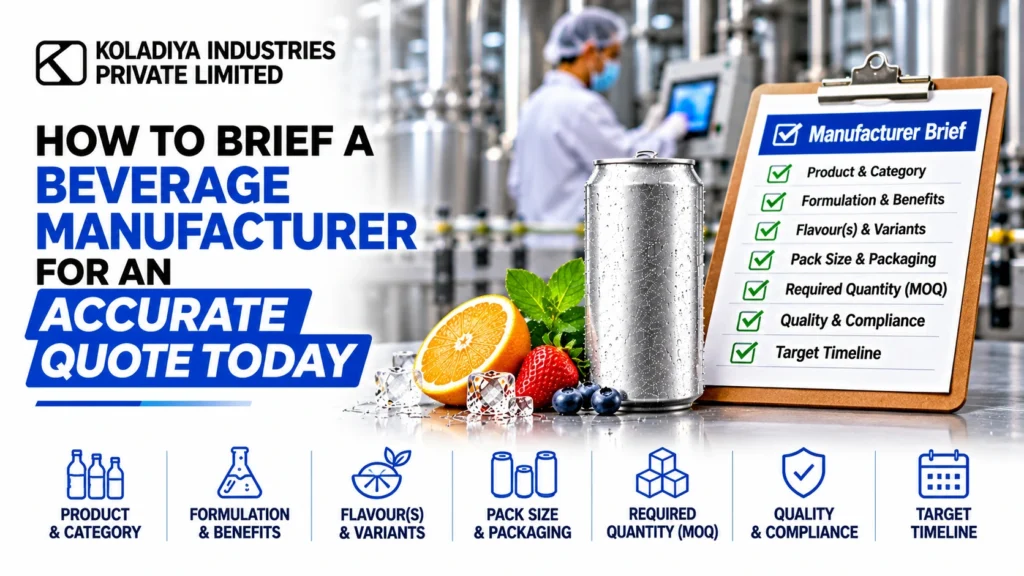
Always request written confirmation of the MOQ for each flavour, packaging format, and production specification. Do not assume that every manufacturer offers the same minimum quantity.
Juice Manufacturer in India: Step-by-Step Production Process
Understanding the manufacturing process helps you plan your launch more effectively. Although individual procedures vary by product, a typical commercial project follows several stages.
Step 1: Define Your Juice Product
Start by identifying your target audience, product category, flavour profile, sweetness level, packaging preferences, and intended selling price.
For example, your brand might focus on mango juice, mixed-fruit beverages, orange juice, or other fruit-based drinks.
At this stage, define your business objectives and expected sales channels.
Step 2: Develop and Finalise the Formulation
Next, work with the manufacturer to establish a suitable product formulation. The development process may include selecting ingredients, adjusting sweetness and acidity, refining flavour, and evaluating product stability.
Depending on your requirements, you may need several sample rounds before approving the final product.
Importantly, confirm the ingredients and product specifications before commercial production begins.
Step 3: Select Packaging and Branding
Choose a packaging format that supports your product positioning and distribution strategy.
For example, bottles may suit certain retail and convenience channels, while cans may appeal to brands seeking a modern beverage presentation.
Your packaging must also suit the product’s processing requirements and storage conditions. In addition, ensure that your label follows applicable requirements for ingredient declarations, nutritional information, net quantity, manufacturer details, and other mandatory particulars.
Step 4: Approve the Production Plan
After you finalise the formulation and packaging, confirm the order quantity, pricing, production schedule, payment terms, and delivery arrangements.
The manufacturer should clarify which services the quotation includes and which expenses require separate payment.
Consequently, you can plan your working capital and avoid misunderstandings during production.
Step 5: Manufacture and Package the Juice
The manufacturer prepares the ingredients and processes the beverage according to the approved formulation and applicable food safety procedures.
Depending on the product, production may involve blending, filtration, thermal processing, filling, sealing, and coding. The manufacturer then completes the required packaging and batch identification procedures.
Appropriate processing methods depend on the beverage’s composition, packaging, and intended shelf life.
Step 6: Conduct Quality Checks
Quality teams evaluate the product against agreed specifications and applicable safety requirements. Depending on the product, these checks may include ingredient verification, sensory evaluation, packaging integrity, microbiological testing, and shelf-life assessment.
Therefore, discuss the manufacturer’s quality assurance procedures before placing your order.
Step 7: Arrange Delivery and Distribution
Once the manufacturer completes the agreed production and release procedures, you can arrange delivery to your warehouse, distributor, or other approved destination.
Finally, coordinate inventory, marketing, retail onboarding, and replenishment according to your launch plan.
How to Choose the Best Juice Manufacturer in India
Selecting a manufacturing partner requires more than comparing quotations. You should evaluate the manufacturer’s technical capabilities, quality systems, commercial terms, and ability to support your long-term growth. Consider the following factors before making your decision.
1. Manufacturing capabilities: Confirm that the facility can produce your chosen juice category and packaging format.
2. Quality and compliance: Review applicable licences, food safety practices, quality documentation, and testing procedures.
3. Formulation support: Ask whether the manufacturer can develop a new formulation or adapt an existing product to your requirements.
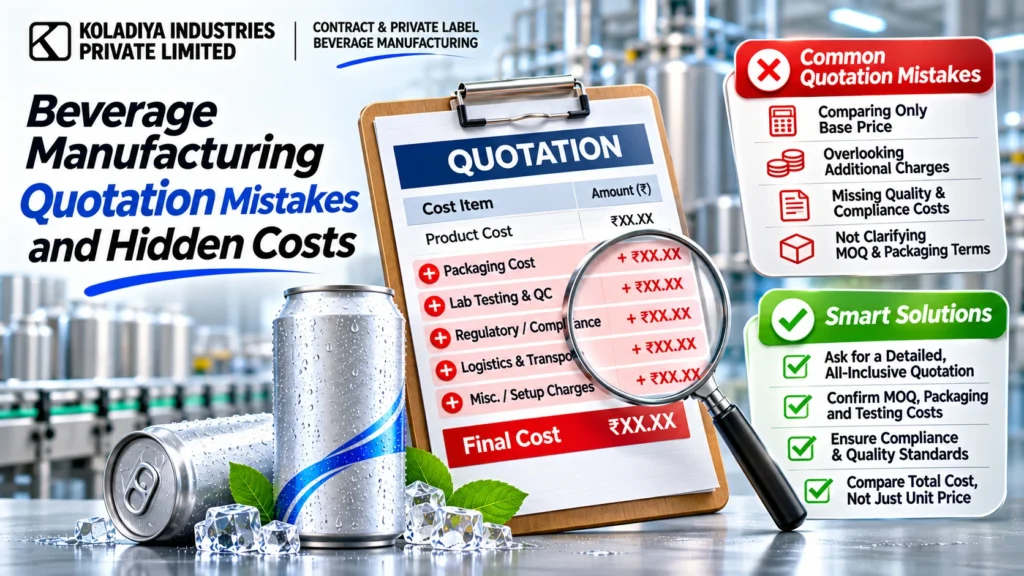
4. Transparent pricing: Request a detailed quotation covering ingredients, packaging, production, testing, and other applicable charges.
5. MOQ flexibility: Check whether the minimum order fits your launch budget and sales forecast.
6. Production capacity: Confirm that the manufacturer can accommodate your initial order and future demand.
7. Communication and timelines: Establish clear expectations for sampling, approvals, manufacturing, and dispatch.
8. Packaging options: Ensure the manufacturer can support your preferred container, label, and branding requirements.
By comparing these factors, you can identify a partner that aligns with your product strategy and commercial goals.
Common Mistakes to Avoid When Starting a Juice Brand
New beverage businesses often focus heavily on product design and marketing while overlooking operational details. However, a few early decisions can significantly affect profitability.
- Choosing a manufacturer based only on price: A low quotation may exclude important services or quality checks.
- Ignoring packaging MOQs: Custom packaging can create additional inventory and working capital requirements.
- Underestimating distribution costs: Transportation, storage, and retailer margins can affect your final profit.
- Launching too many flavours: Multiple products can increase formulation expenses and complicate inventory management.
- Overlooking shelf-life validation: Your product needs suitable processing, packaging, and evidence supporting its intended shelf life.
- Skipping market research: Customer preferences and price sensitivity should inform your formulation and positioning.
- Failing to confirm specifications: Document the approved formulation, packaging, quality requirements, and commercial terms before production.
Instead, start with a clearly defined product, a realistic budget, and a manufacturing partner that understands your objectives.
Why Work With a Beverage Contract Manufacturer Like Koladiya Industries?
For entrepreneurs and established businesses, working with a suitable beverage manufacturing partner can simplify the process of developing and launching a new product.
Koladiya Industries Private Limited, based in Surat, Gujarat, can be considered when evaluating beverage manufacturing solutions for your brand. Before proceeding, discuss your specific juice product requirements, formulation needs, packaging preferences, production quantity, and quality expectations with the company.
A detailed discussion helps you determine whether the available capabilities match your project.
Furthermore, clarify the production MOQ, sampling process, estimated costs, lead times, documentation, and delivery arrangements before placing an order. This approach allows you to assess the commercial suitability of the partnership without making assumptions about pricing or manufacturing capabilities.
Whether you are developing your first beverage product or expanding an existing portfolio, careful planning can help you build a stronger foundation for growth.
Conclusion
Choosing the right juice manufacturer in India requires a clear understanding of manufacturing costs, minimum order quantities, product formulation, packaging, quality controls, and production timelines. Although costs vary by product and order size, you can manage your investment more effectively by comparing detailed quotations, selecting practical packaging, and starting with a focused product range. Most importantly, evaluate manufacturing partners on quality, transparency, flexibility, and long-term suitability rather than price alone. With a well-planned product strategy and the right manufacturing arrangement, your business can move from an initial juice concept to a commercially viable beverage brand.
Frequently Asked Questions
What is the MOQ for juice manufacturing in India?
The MOQ varies by manufacturer, production line, formulation, and packaging format. Ask for the minimum quantity for your specific product and container.
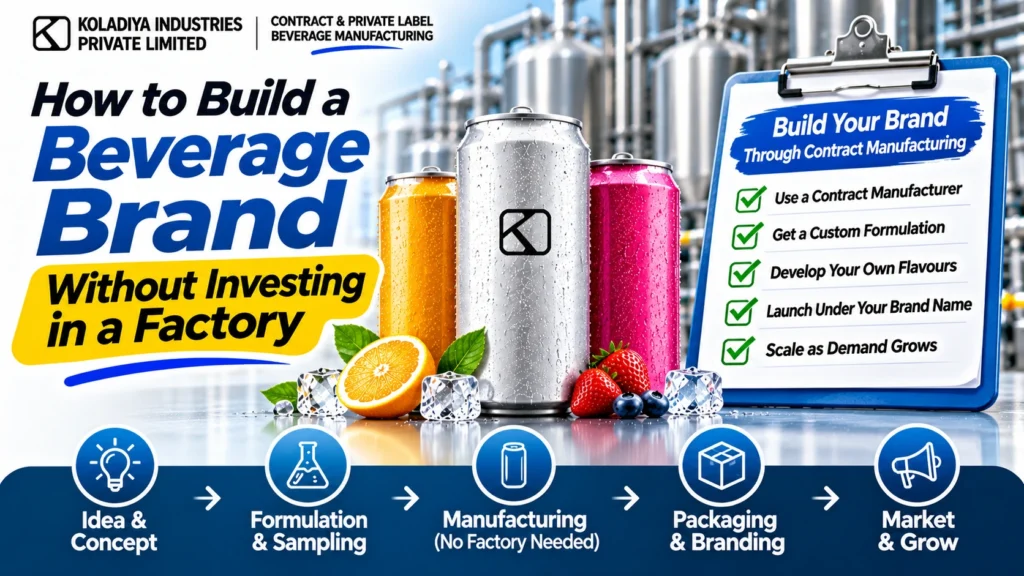
Can I start a juice brand without owning a factory?
Yes. You can explore contract or private-label manufacturing, where a suitable manufacturing partner produces the beverage under your brand, subject to agreed terms and applicable requirements.
Can a manufacturer create a custom juice flavour?
Some manufacturers provide formulation development and customisation. Confirm their research and development capabilities, sample process, and related costs before proceeding.
Which packaging options are available for juice products?
Depending on the manufacturer's capabilities and product requirements, options may include PET bottles, glass bottles, cans, and other suitable food-grade packaging.
How long does juice manufacturing take?
The timeline depends on formulation development, sample approvals, ingredient availability, packaging procurement, production scheduling, and quality checks. Request an estimated schedule before confirming your order.
How do I choose a reliable juice manufacturer in India?
Compare manufacturing capabilities, quality systems, relevant licenses, MOQ, pricing transparency, formulation support, packaging options, and delivery timelines. Also, confirm all specifications and commercial terms in writing before placing an order.