India’s beverage market is expanding rapidly, creating new opportunities for entrepreneurs, startups, retailers, FMCG companies, and established brands. Among the most attractive categories are Ready-to-Drink (RTD) beverages and carbonated soft drinks (CSDs). Consumers increasingly look for convenient, refreshing, affordable, and ready-to-consume products, while brands are searching for reliable manufacturing partners that can help them launch and scale efficiently.
However, starting a beverage business is not simply a matter of buying a filling machine and producing drinks. Product formulation, water treatment, carbonation, processing, packaging, food-safety compliance, quality control, manufacturing capacity, logistics, and brand positioning must all be considered before commercial production begins.
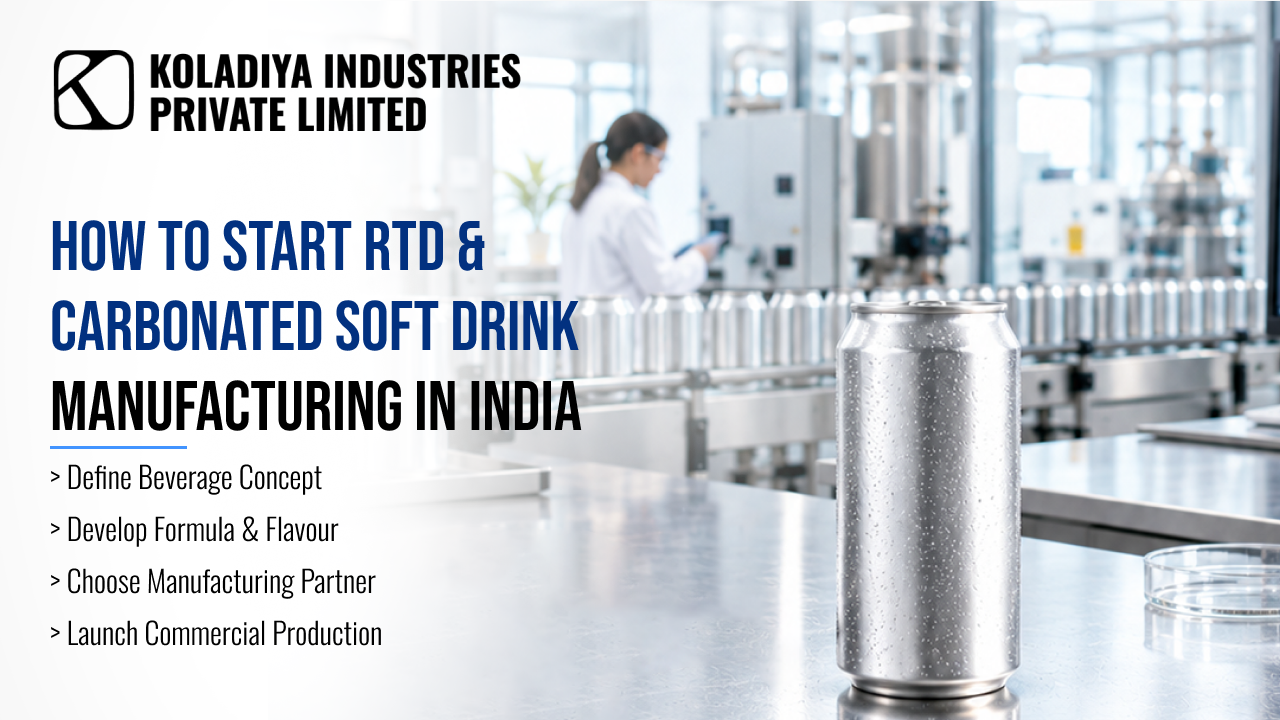
This guide explains how to start RTD and carbonated soft drink manufacturing in India, what equipment and processes are generally required, how to evaluate a manufacturing partner, and how businesses can reduce startup complexity while moving toward commercial-scale production.
What Are RTD and Carbonated Soft Drinks?
Ready-to-Drink beverages are formulated and packaged products that can be consumed directly without additional preparation. Depending on the formulation, RTD products may include flavored beverages, functional drinks, fruit-based beverages, energy or hydration-oriented products, tea-based drinks, and other packaged liquid beverages.
Carbonated soft drinks contain dissolved carbon dioxide, which creates their characteristic fizz and refreshing mouthfeel. They are commonly sold in PET bottles, cans, and other suitable beverage packaging formats.
Both categories can offer strong brand-building potential. Nevertheless, the manufacturing process varies according to the product formulation, ingredients, processing requirements, packaging format, shelf-life target, and desired production volume.
Why Start an RTD or Carbonated Beverage Business in India?
Several factors make the Indian beverage sector attractive for new brands.
First, convenience is becoming increasingly important. Consumers want products that are easy to carry, easy to store, and ready to drink. As a result, packaged beverages can serve multiple consumption occasions, including travel, work, foodservice, entertainment, and retail.
Second, product differentiation has become easier through innovative formulations, flavors, packaging, and positioning. A new brand does not necessarily have to compete solely on price. Instead, it can target a specific consumer segment with a clearly defined proposition.
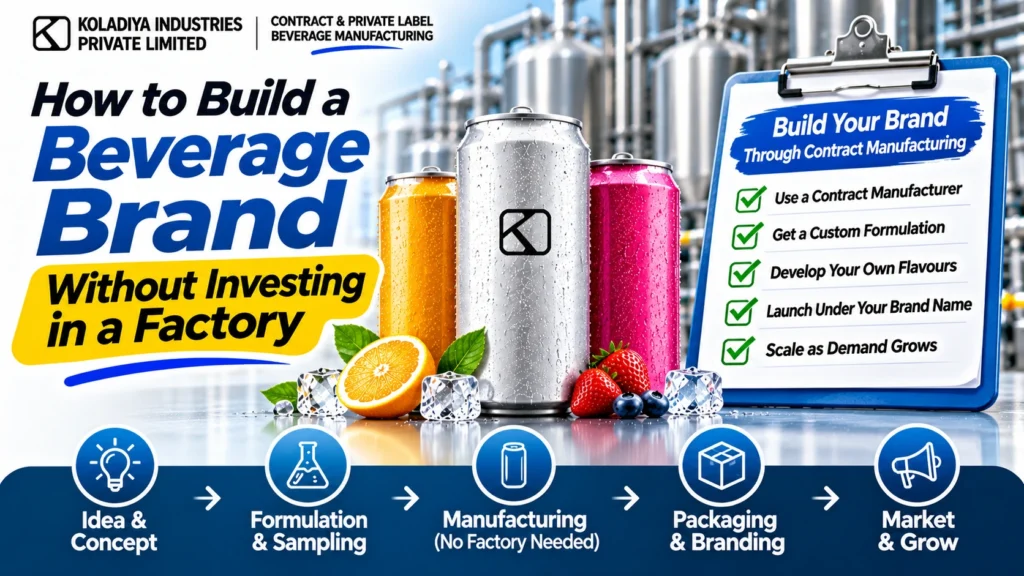
Third, businesses can choose between setting up their own manufacturing facility and working with a contract beverage manufacturer. Contract manufacturing can significantly reduce the complexity of entering the market because production infrastructure, technical expertise, and quality systems may already be available.
Step 1: Decide Your Beverage Product
Before approaching a manufacturer, define exactly what you want to produce.
Your product decision should cover:
- Beverage category
- Flavor profile
- Target consumer
- Pack size
- Packaging format
- Shelf-life objective
- Expected selling price
- Target market
- Positioning and brand proposition
For example, a startup may choose a flavored carbonated beverage in a PET bottle, while another business may develop a non-carbonated functional RTD drink in cans.
A clearly defined product brief helps the manufacturer understand your requirements and provide a more accurate quotation.
Step 2: Develop and Finalize the Formulation
Formulation is one of the most important stages in beverage manufacturing.
The recipe must deliver the desired taste, appearance, aroma, texture, stability, and shelf life. Ingredients may include treated water, sweeteners, flavors, acids, colors, functional ingredients, preservatives where permitted and required, carbonation, or other formulation-specific components.
However, a formulation should not be selected purely on taste. It should also be evaluated for:
- Ingredient compatibility
- Processing stability
- Shelf-life performance
- Packaging compatibility
- Cost per unit
- Regulatory requirements
- Batch-to-batch consistency
A professional beverage manufacturer can assist with formulation development, pilot trials, product testing, and process validation. This is particularly valuable for new brands that do not have an in-house R&D team.
Step 3: Choose the Right Manufacturing Model
There are generally two major approaches.
In-House Manufacturing
In-house production provides greater control over manufacturing, production scheduling, equipment, and operational processes. However, it requires substantial investment in infrastructure, utilities, equipment, manpower, quality systems, maintenance, compliance, and inventory.
For a new business, this model can increase both capital requirements and operational responsibility.
Contract Manufacturing
With contract manufacturing, the brand owner works with an established beverage manufacturer that produces the product according to agreed specifications.
This approach may offer advantages such as:
- Lower initial infrastructure investment
- Faster market entry
- Access to established manufacturing systems
- Technical and formulation support
- Quality-control capabilities
- Scalable production
- Reduced operational complexity
For startups and brands testing a new product, contract manufacturing can therefore be an efficient way to validate market demand before investing in a dedicated plant.
Step 4: Understand the RTD & Carbonated Beverage Manufacturing Process
Although the exact process varies by product, a typical beverage production workflow may include several key stages.
1. Water Treatment
Water quality is fundamental to beverage quality. Raw water is treated according to the required specifications through appropriate purification and treatment systems.
The objective is to obtain water with consistent quality, suitable for the beverage formulation and production process.
2. Ingredient Preparation
The required ingredients are accurately weighed, prepared, and mixed according to the approved formulation. Controlled dosing is important because small variations can affect taste, consistency, and product performance.
3. Syrup or Beverage Base Preparation
For many soft drinks, a concentrated syrup or beverage base is prepared before final dilution. Mixing parameters are controlled to achieve the desired formulation.
4. Blending
The beverage base is combined with treated water and other required components. Parameters such as concentration, acidity, temperature, and other product-specific characteristics are monitored.
5. Carbonation
For carbonated beverages, carbon dioxide is introduced into the beverage under controlled conditions. Proper carbonation is essential for achieving the required sensory experience and maintaining product consistency.
6. Processing
Depending on the beverage, suitable thermal or non-thermal processing methods may be used to achieve the required microbiological stability and shelf life. The processing method should be validated for the specific formulation and packaging format.
7. Filling and Packaging
The finished beverage is filled into the selected packaging, such as PET bottles, cans, glass bottles, or other approved formats.
Filling parameters must be carefully controlled, particularly for carbonated products, because pressure, temperature, and filling conditions can influence product quality and packaging performance.
8. Coding, Inspection, and Secondary Packaging
Bottles or cans are coded with the required manufacturing and traceability information. Finished packs are then inspected and packed into cartons, shrink packs, trays, or other secondary packaging systems.
9. Storage and Dispatch
Finished goods are stored under appropriate conditions before distribution. Inventory control and transport planning become increasingly important as sales volumes grow.
Step 5: Select the Right Beverage Manufacturing Equipment
The equipment required depends on the product and production scale. A typical beverage manufacturing line may include:
- Water treatment system
- Mixing and blending tanks
- Syrup preparation system
- Storage tanks
- Filtration systems
- Carbonation system
- Beverage processing equipment
- Bottle or can rinsing equipment
- Filling and sealing machine
- Capping or seaming equipment
- Labeling system
- Batch coding system
- Inspection equipment
- Packaging equipment
- CIP system
- Quality-control instruments
The right equipment should be selected based on production capacity, beverage type, packaging, automation level, hygiene requirements, and future expansion plans.
Buying equipment solely on the basis of the lowest price can create problems later. Instead, manufacturers should be evaluated based on production reliability, technical support, maintenance, process control, quality systems, and scalability.
Step 6: Complete Regulatory and Food-Safety Requirements
Food and beverage manufacturing in India requires appropriate regulatory compliance. Businesses should identify the licenses, registrations, labeling requirements, food-safety controls, and other applicable approvals before commercial production begins.
The exact requirements can vary depending on the product, manufacturing model, ingredients, facility, packaging, and business structure. Therefore, regulatory requirements should be reviewed with the relevant authorities and qualified professionals before launch.
A competent manufacturing partner should also have documented procedures for hygiene, sanitation, quality control, traceability, raw-material management, and finished-product testing.
Compliance should not be treated as a final checklist. Instead, it should be incorporated into the product-development and manufacturing process from the beginning.
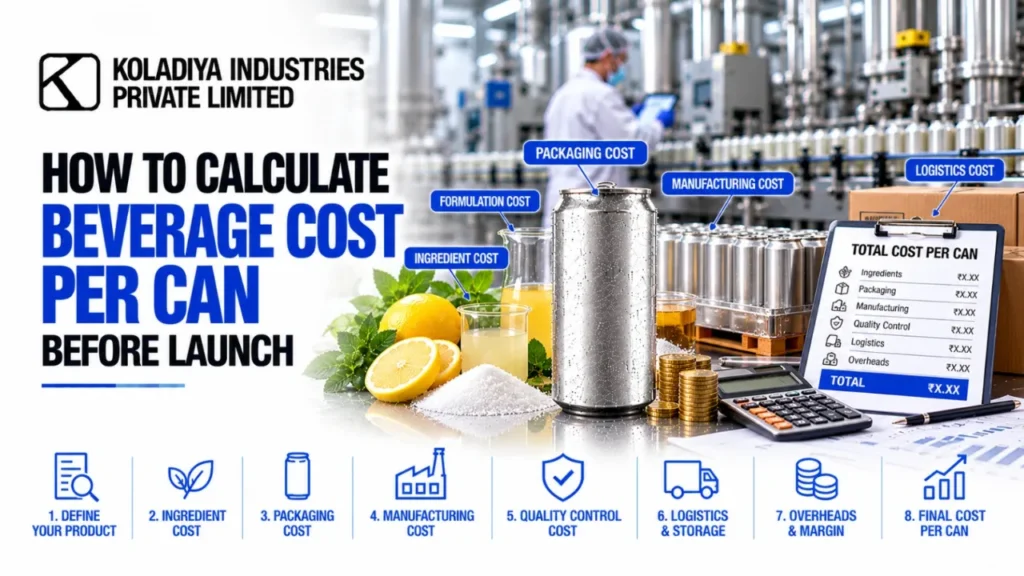
Step 7: Calculate Your Beverage Manufacturing Cost
Understanding the complete cost structure is critical before placing a production order.
The total cost can be influenced by:
Raw materials + packaging + manufacturing + quality testing + labor + utilities + logistics + warehousing + wastage + taxes and applicable commercial costs
Packaging can represent a significant portion of the overall product cost. Therefore, bottle size, material, closure, label, carton, and secondary packaging should be selected carefully.
Businesses should also distinguish between manufacturing cost and total product launch cost. Branding, design, certifications, marketing, distribution, warehousing, sales commissions, and promotional activities may create additional expenses.
A professional manufacturer should be able to provide a clear commercial quotation based on the actual product specification, packaging format, order quantity, and manufacturing requirements.
Step 8: Understand MOQ and Production Scale
Minimum Order Quantity, or MOQ, is an important factor for new beverage brands.
A startup may not need the same volume as an established FMCG company. Therefore, it is useful to identify a manufacturing partner whose production model matches your current requirements.
Before finalizing an order, ask about:
- Minimum order quantity
- Trial-batch availability
- Production lead time
- Packaging MOQ
- Ingredient procurement requirements
- Capacity per batch
- Monthly production capacity
- Scalability for future orders
A flexible manufacturing partner can make it easier for a new brand to start commercially and increase volumes as demand develops.
Step 9: Test Product Quality Before Full-Scale Launch
Before committing to a large commercial order, product validation should be completed.
Depending on the product, evaluation may include sensory testing, physicochemical testing, microbiological analysis, packaging compatibility, stability or shelf-life studies, and transportation simulation.
Pilot or trial production can be particularly useful because it allows the brand to identify formulation, packaging, or process issues before a larger production run.
This stage can save significant time and cost while improving the probability of a successful market launch.
Step 10: Choose the Right Beverage Manufacturer in India
Your manufacturing partner can directly affect product quality, delivery timelines, and long-term profitability.
When comparing beverage manufacturers, do not focus only on the quoted per-unit price. Examine the complete manufacturing capability.
Look for a partner with:
✔ Beverage formulation and R&D support
✔ Modern production infrastructure
✔ Strong quality-control systems
✔ Appropriate food-safety practices
✔ Suitable filling and packaging capabilities
✔ Transparent MOQ and commercial terms
✔ Reliable production planning
✔ Technical support
✔ Scalability for future growth
It is also important to verify the manufacturer’s experience with your specific beverage category and packaging format.
Contract Manufacturing: A Smarter Route for New Beverage Brands
For many entrepreneurs, the biggest challenge is not creating the beverage idea but converting that idea into a commercially viable product.
Contract beverage manufacturing can bridge this gap.
Instead of building a complete facility from the ground up, brands can work with an experienced manufacturer that already has production infrastructure, technical capabilities, and established manufacturing processes.
This can allow the brand owner to concentrate more heavily on branding, sales, distribution, retail expansion, and customer acquisition while production is handled by a specialized partner.
For businesses entering the RTD or carbonated beverage segment for the first time, this model can be particularly attractive because it may reduce the operational burden associated with setting up a complete manufacturing facility.
Common Mistakes to Avoid
New beverage businesses often make avoidable mistakes during launch.
One common mistake is selecting a formulation before considering its commercial manufacturing requirements. A product may taste excellent in a laboratory trial but behave differently during large-scale production.
Another mistake is choosing packaging without evaluating cost, availability, filling compatibility, transportation requirements, and shelf-life performance.
Underestimating MOQ, working capital, inventory, and distribution costs can also put pressure on cash flow.
Finally, selecting a manufacturer based only on price can create quality or delivery challenges. A lower quotation is not necessarily a lower total cost when delays, rejected batches, wastage, or inconsistent quality are considered.
How to Start With a Beverage Manufacturing Partner
A successful manufacturing project usually begins with a clear product brief.
Share the following information with your potential manufacturing partner:
Product category: RTD or carbonated beverage
Flavor: Desired flavor or formulation concept
Pack size: For example, small, medium, or family-size formats
Packaging: PET, can, glass, or another suitable format
Target quantity: Initial and expected future volume
Market: Target region or distribution channel
Brand positioning: Mass market, premium, functional, youth-focused, etc.
The manufacturer can assess the formulation, production process, packaging requirements, estimated MOQ, and commercial feasibility.
Conclusion
Starting an RTD or carbonated soft drink business in India can be a promising opportunity, but commercial success depends on much more than having a good beverage idea.
The product must be formulated correctly, manufactured consistently, packaged effectively, tested thoroughly, and produced through a reliable and compliant process.
For startups and growing brands, contract manufacturing can provide an efficient path to market by offering access to beverage production infrastructure and technical expertise without requiring the immediate investment of building a complete manufacturing facility.
The best time to involve a manufacturing partner is early in the development process. By discussing formulation, packaging, MOQ, production capacity, quality requirements, and commercial targets from the beginning, businesses can build a more practical route from concept to market.
Looking for RTD or Carbonated Soft Drink Manufacturing in India?
Koladiya Industries can help businesses explore beverage manufacturing requirements, from product development and formulation support to scalable production and packaging solutions.
Whether you are launching a new beverage brand, expanding an existing product portfolio, or searching for a reliable contract manufacturing partner, discuss your product requirements with the team and evaluate the right manufacturing approach for your business.
Ready to take your beverage idea from concept to commercial production?
Contact Koladiya Industries today to discuss your RTD or carbonated soft drink manufacturing requirements and get started with your beverage project.
Frequently Asked Questions
What machinery is required for RTD and carbonated soft drink manufacturing?
A typical production line may include water treatment, syrup preparation, blending, carbonation, filling, sealing, labeling, coding, and secondary packaging equipment.
What is the carbonated soft drink manufacturing process?
The process generally involves water treatment → syrup preparation → ingredient blending → carbonation → filling → sealing → labeling → quality testing → packaging.
What licenses are required for soft drink manufacturing in India?
Depending on the product and facility, manufacturers may need applicable FSSAI registration/licensing, GST registration, local approvals, pollution-related permissions, factory-related approvals, and other regulatory compliances.
How can I start an RTD beverage manufacturing business in India?
Start by selecting the beverage category, developing the formulation, defining packaging and production capacity, preparing the business plan, choosing a manufacturing facility or contract manufacturer, and completing the required compliance process.
Can I use contract manufacturing for RTD and carbonated drinks?
Yes. Contract manufacturing can allow brands to launch RTD and carbonated beverages without investing immediately in their own complete manufacturing facility. The manufacturer can support production, filling, packaging, and related manufacturing requirements.
How do I choose the right beverage manufacturer in India?
Compare manufacturers based on production capacity, beverage categories, formulation capabilities, quality systems, packaging options, MOQ, certifications, lead times, scalability, and overall manufacturing support.