Selecting the right ingredients plays a crucial role in developing a stable, flavorful, and commercially successful canned beverage. Although an attractive flavour and product concept can attract customers, ingredient quality and compatibility determine how well a beverage performs during manufacturing, storage, transportation, and consumption. A canned beverage formula must maintain its taste, colour, aroma, texture, carbonation, and overall quality throughout its intended shelf life. Therefore, beverage brands must evaluate every ingredient carefully before finalizing a commercial formula. Even a minor ingredient mismatch can create challenges such as sedimentation, flavour changes, colour instability, carbonation loss, or reduced product consistency. Moreover, energy drinks, sparkling beverages, functional drinks, and flavoured carbonated beverages require different formulation approaches. Each category has specific requirements for acidity, sweetness, flavour balance, functional ingredients, and processing compatibility.
This guide explains how to select suitable ingredients for a stable canned beverage formula, avoid common formulation problems, and prepare a beverage for commercial manufacturing with the right technical support.
Why Ingredient Selection Matters for a Canned Beverage Formula
Ingredient selection directly influences beverage quality, manufacturing efficiency, and long-term product stability. A formulation may taste excellent during initial sampling; however, it must also retain its original characteristics after processing and storage. Furthermore, canned beverages undergo manufacturing processes that can influence ingredient performance. Heat treatment, carbonation, filling conditions, and packaging interactions may affect the final product.
The right ingredients help beverage brands achieve:
- Consistent flavour, aroma, and sweetness.
- Better ingredient compatibility and formulation stability.
- Suitable acidity and pH levels.
- Improved colour and appearance retention.
- Controlled carbonation in sparkling beverages.
- Consistent quality across production batches.
- Better shelf-life performance.
Consequently, brands should evaluate ingredients according to their complete formulation requirements rather than selecting them based on price or initial taste alone.
1. Understand Your Product Concept Before Selecting Ingredients
Before choosing ingredients, define the beverage category, target audience, desired flavour profile, and functional positioning. For example, an energy drink requires a different ingredient combination from sparkling water, fruit-based beverages, tonic water, or ready-to-drink tea.
Start by establishing the following product specifications:
- Beverage category and product positioning.
- Target flavour and sweetness level.
- Desired colour and appearance.
- Carbonated or non-carbonated format.
- Functional ingredients, where applicable.
- Intended packaging size and format.
- Target shelf life and storage conditions.
Additionally, consider the target market and expected consumer preferences. A premium energy drink may require a distinctive flavour profile and carefully balanced sweetness, whereas a fruit-based sparkling beverage may need suitable fruit components and acidity control.
A clearly defined product concept makes ingredient selection more systematic and reduces unnecessary formulation changes.
2. Choose High-Quality Ingredients for a Canned Beverage Formula
Ingredient quality forms the foundation of a reliable beverage formulation. Even when a manufacturer uses the correct processing conditions, inconsistent raw materials can create variations in the final product.
Therefore, evaluate ingredient suppliers according to quality specifications, consistency, documentation, and suitability for beverage applications.
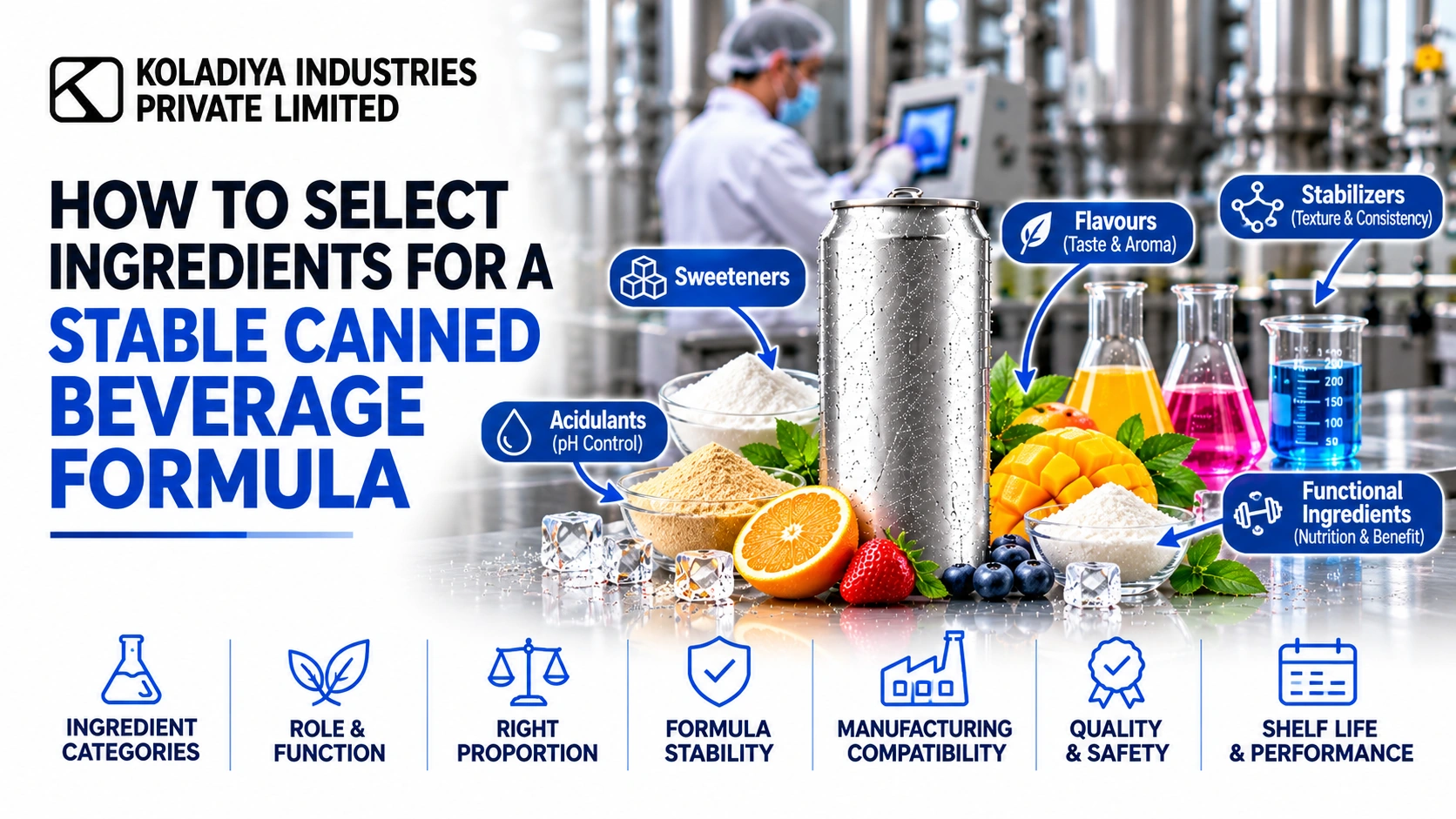
Important ingredient groups include:
Sweeteners: Sugar, glucose-based sweeteners, and permitted alternative sweeteners help establish the desired sweetness profile. Select them according to taste, solubility, formulation compatibility, and nutritional positioning.
Acidulants: Citric acid, malic acid, and other suitable food-grade acidulants help establish acidity and flavour balance. Choose the appropriate system based on the beverage category and required pH.
Flavours: Natural and nature-identical or artificial flavour systems, where permitted, help create the intended product character. Evaluate their compatibility with acidity, sweeteners, and processing conditions.
Colours: Suitable food-grade colours help maintain the product’s visual identity. Check colour stability under the intended formulation and processing conditions.
Stabilisers: Certain beverage-compatible stabilising ingredients can help manage suspension, mouthfeel, and physical consistency. Select them according to the beverage’s composition.
Above all, verify food-grade specifications and applicable regulatory requirements before approving any raw material.
3. Evaluate Ingredient Compatibility in a Canned Beverage Formula
Ingredient compatibility is one of the most important factors in beverage development. Two ingredients may perform well individually but create problems when combined.
For instance, certain flavour systems may show poor compatibility with acidic environments. Similarly, some functional ingredients may interact with minerals, sweeteners, or other formulation components.
To prevent these problems, evaluate:
- Solubility and dispersion characteristics.
- Ingredient interactions under different pH conditions.
- Compatibility between flavours and acidulants.
- Potential precipitation or sediment formation.
- Colour changes during processing and storage.
- Stability under expected temperature conditions.
Furthermore, assess the complete formula rather than approving ingredients individually. A formulation trial helps identify interactions before the product enters commercial production.
This approach can reduce reformulation costs and improve consistency during manufacturing.
4. Select the Right Sweeteners for Taste and Stability
Sweeteners influence taste, mouthfeel, formulation balance, and consumer acceptance. Consequently, selecting an appropriate sweetener system requires more than achieving a particular sweetness level.
Traditional sugar-based beverages may offer familiar taste and body. However, brands developing reduced-sugar or zero-sugar beverages must evaluate alternative sweeteners carefully.
For energy drinks, sweetness must complement the flavour profile and balance the taste of caffeine and other functional ingredients.
When selecting sweeteners, consider:
- Sweetness intensity and aftertaste.
- Solubility in the beverage system.
- Stability under processing conditions.
- Interaction with flavours and acidulants.
- Desired nutritional positioning.
- Applicable food safety and labelling requirements.
Moreover, conduct sensory trials with different sweetener combinations before finalising the formulation. This helps brands achieve a pleasant taste without compromising product consistency.
5. Select Suitable Acids and Control pH Levels
Acidity plays an essential role in beverage taste, microbial control strategy, and formulation performance. However, every beverage requires a suitable pH range based on its ingredients, processing method, and regulatory requirements. Citric acid often provides a familiar sharp taste, while malic acid can contribute a different acidity profile. Beverage developers may evaluate other suitable food-grade acidulants depending on the product concept. For energy drinks, acidity must complement the flavour and sweetness system. Excessive acidity may create an unpleasant sour profile, whereas insufficient acidity may affect the intended taste and preservation strategy.
Therefore, beverage developers should:
- Establish a target pH based on product specifications.
- Evaluate acidulant combinations through formulation trials.
- Measure pH using calibrated equipment.
- Check taste balance after adjusting acidity.
- Validate the complete formula through appropriate stability and microbiological testing.
Importantly, pH alone does not establish product safety. Brands must validate an appropriate preservation and processing system for the specific beverage.
6. Choose Functional Ingredients for Energy Drink Formulation
Energy drinks require additional consideration because their formulations often combine flavour systems, sweeteners, caffeine, and other functional ingredients.
Common formulation components may include:
Caffeine: Caffeine contributes to the characteristic positioning of many energy drinks. Formulators must control its concentration, verify ingredient specifications, and follow applicable regulations for permitted levels and product labelling.
Taurine: Some energy drink formulations include taurine. Its compatibility, dosage, quality specifications, and regulatory suitability require evaluation.
B Vitamins: Ingredients such as selected B vitamins may support the product’s nutritional positioning. Formulators should consider their stability and applicable nutrient declaration requirements.
Electrolytes: Certain formulations include minerals such as sodium and potassium. However, formulators must evaluate their impact on taste, solubility, and ingredient compatibility.
Flavour Systems: Citrus, berry, tropical fruit, and other flavour profiles can help create distinctive energy drink products. The selected flavour must complement the functional ingredient system.
Additionally, brands developing zero-sugar energy drinks should evaluate sweetener aftertaste, acidity, and flavour masking requirements.
A successful energy drink formula balances functionality, flavour, ingredient stability, processing requirements, and regulatory compliance.
7. Consider Carbonation and Packaging Compatibility
For carbonated canned beverages, ingredient selection must support carbonation retention and packaging performance.
Carbon dioxide creates the characteristic sparkling sensation. However, unsuitable formulation characteristics, filling conditions, or packaging defects can affect carbonation quality.
Therefore, evaluate:
- Carbonation requirements and target levels.
- Beverage acidity and flavour balance.
- Ingredient behaviour during carbonation.
- Filling temperature and filling conditions.
- Can and end compatibility.
- Seaming quality and package integrity.
Aluminium cans offer a practical packaging format for energy drinks, sparkling beverages, and carbonated soft drinks. Nevertheless, manufacturers must validate the complete packaging system, including suitable internal coating compatibility where applicable.
Proper can seaming and packaging inspections also help protect product quality during transportation and storage.
8. Test the Canned Beverage Formula Before Commercial Production
Ingredient selection should never end with a successful laboratory sample. A beverage must perform consistently under realistic manufacturing and storage conditions.
Consequently, pilot trials and stability evaluations play an important role in product development.
Important testing activities include:
Sensory Evaluation: Assess flavour, aroma, sweetness, colour, mouthfeel, and carbonation.
pH and Acidity Testing: Monitor pH and acidity to confirm that the beverage meets its defined specifications.
Physical Stability Testing: Check for sedimentation, separation, precipitation, and changes in appearance.
Microbiological Testing: Evaluate the product using an appropriate microbiological testing plan.
Shelf-Life Testing: Monitor changes in flavour, colour, carbonation, and other quality parameters under defined storage conditions.
Packaging Evaluation: Inspect can integrity, seam quality, and packaging compatibility.
Furthermore, compare results across different production batches. This helps identify ingredient variations and manufacturing issues before commercial launch.
9. Avoid Common Ingredient Selection Mistakes
Poor ingredient decisions can increase development costs, delay product launches, and create manufacturing challenges.
Some common mistakes include:
- Selecting ingredients based only on their purchase price.
- Ignoring compatibility between ingredients.
- Choosing unsuitable flavours for acidic beverages.
- Overlooking sweetener aftertaste in zero-sugar drinks.
- Adding functional ingredients without stability evaluation.
- Ignoring packaging compatibility.
- Skipping pilot production and shelf-life testing.
- Failing to maintain consistent raw material specifications.
Instead, establish clear ingredient specifications, conduct formulation trials, and evaluate the finished beverage before approving the final recipe.
As a result, brands can improve product consistency and reduce avoidable reformulation expenses.
10. How Koladiya Industries Supports Beverage Formulation and Manufacturing
Selecting the right ingredients becomes easier when beverage brands work with an experienced manufacturing partner.
Koladiya Industries Private Limited supports beverage businesses with formulation and R&D, private-label manufacturing, and third-party beverage manufacturing solutions.
With an approach that connects product development and commercial production, Koladiya Industries helps brands explore beverage concepts across categories such as energy drinks, carbonated soft drinks, sparkling water, and tonic water.
Its beverage development support focuses on important areas such as:
- Beverage formulation and flavour development.
- Ingredient selection and compatibility evaluation.
- Energy drink and carbonated beverage development.
- Sweetener and flavour system considerations.
- Product development and manufacturing coordination.
- Aluminium slim can packaging solutions.
- Commercial production planning.
For startups, established beverage brands, and businesses entering new categories, the right manufacturing partnership can simplify the journey from an initial beverage concept to a production-ready product.
Ultimately, the goal is to develop a formula that meets the brand’s taste expectations while also addressing quality, stability, packaging, and manufacturing requirements.
Conclusion: Build a Stable Canned Beverage Formula for Commercial Success
Selecting ingredients for a stable canned beverage formula requires careful consideration of quality, compatibility, acidity, sweetness, flavour, functional ingredients, and packaging performance.
Moreover, beverage brands must validate their formulations through laboratory testing, pilot production, and shelf-life evaluation before commercial manufacturing.
Energy drinks require additional attention because caffeine, taurine, vitamins, electrolytes, sweeteners, and flavours must work together within a suitable formulation.
Therefore, choosing the right ingredients and manufacturing partner can help reduce development challenges, improve product consistency, and create a stronger foundation for commercial success.
Develop Your Canned Beverage Formula with Koladiya Industries
Planning to launch an energy drink, carbonated soft drink, sparkling water, or another canned beverage?
Partner with Koladiya Industries Private Limited for beverage formulation, R&D, private-label manufacturing, and third-party manufacturing support.
Contact Koladiya Industries today to discuss your beverage concept, ingredient requirements, flavour preferences, and commercial manufacturing goals. Turn your beverage idea into a production-ready product with the right formulation and manufacturing support.