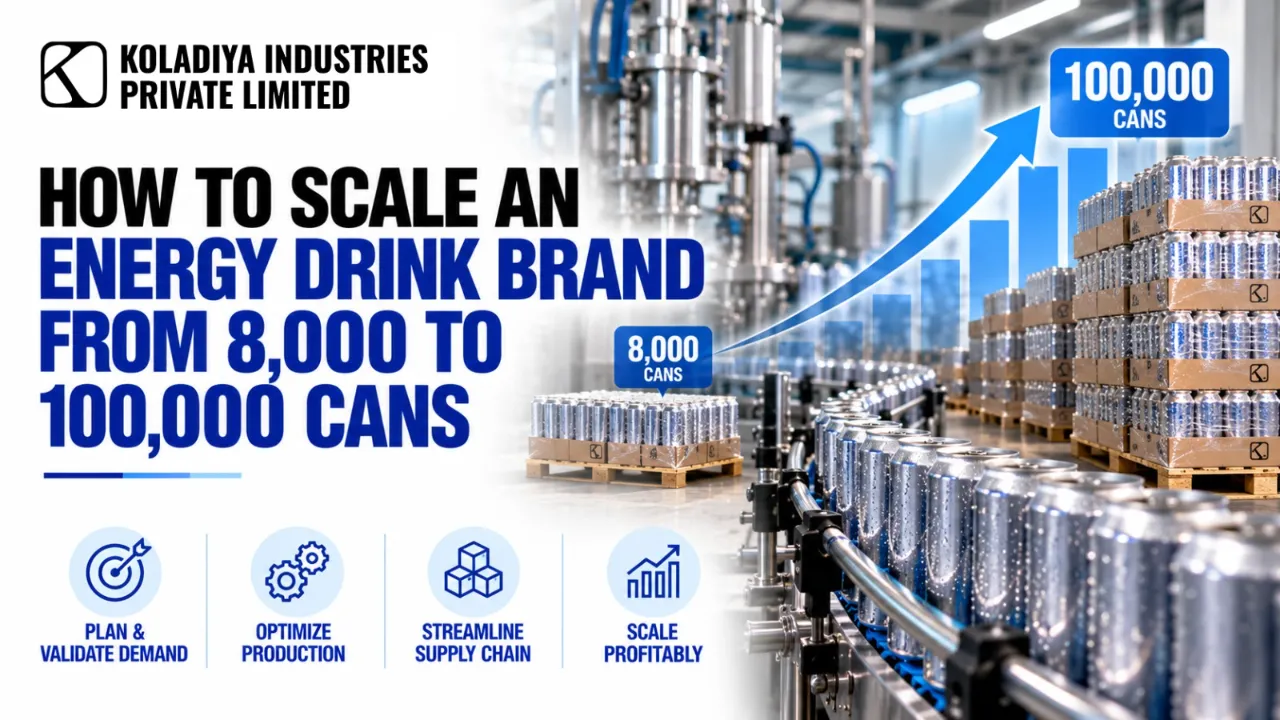
Scaling an energy drink brand from 8,000 to 100,000 cans requires more than increasing production. It demands a clear growth strategy, consistent product quality, reliable manufacturing, effective packaging, and a strong distribution network. Although a successful initial launch proves that customers may want your product, the next stage requires a system that can support higher demand without compromising quality or profitability. For emerging beverage businesses, partnering with an experienced contract manufacturer such as Koladiya Industries can help simplify production planning, improve operational efficiency, and prepare the brand for sustainable growth.
We explain how to scale an energy drink brand from 8,000 to 100,000 cans through practical manufacturing, marketing, and supply chain strategies.
Why Scaling an Energy Drink Brand Requires a Strategic Approach
Moving from 8,000 to 100,000 cans represents a 12.5-fold increase in production volume. Consequently, businesses must prepare their manufacturing processes, ingredient sourcing, packaging operations, and sales channels before increasing output. At a smaller scale, founders can often manage production through direct coordination with suppliers and distributors. However, larger production volumes require better forecasting, documented procedures, inventory management, and quality control. Therefore, brands should establish a scalable operating model that supports current demand while creating room for future expansion.
Energy Drink Brand Growth Starts With Market Validation
Before increasing production, evaluate the performance of your existing 8,000 cans. Sales figures alone do not provide a complete picture of market demand. Instead, analyze customer feedback, repeat purchases, retailer interest, product pricing, and sales performance across different locations. These insights help identify which markets offer the strongest growth opportunities. Furthermore, review your customer acquisition costs and profit margins. Strong sales become more valuable when the business can generate repeat orders without spending excessively on promotions.
Key actions include:
- Identify the best-performing sales channels.
- Collect feedback on flavour, sweetness, carbonation, and packaging.
- Track repeat purchases and retailer reorders.
- Evaluate customer demand at different price points.
- Forecast demand before committing to a larger production run.
This approach helps an energy drink brand expand based on measurable demand rather than assumptions.
1. Build a Scalable Production Plan for Your Energy Drink Brand
Production planning becomes increasingly important as order volumes grow. A brand that successfully sells 8,000 cans may encounter operational challenges when preparing for 25,000, 50,000, or 100,000 cans.
For example, ingredient shortages, packaging delays, insufficient production capacity, and inaccurate demand forecasts can disrupt growth.
To avoid these issues, create a phased production roadmap.
Increase Energy Drink Brand Production in Phases
Rather than moving directly to 100,000 cans, consider breaking the expansion into manageable milestones.
- Phase 1: 8,000–15,000 cans. Validate demand, refine the formulation, and identify production bottlenecks.
- Phase 2: 15,000–30,000 cans. Expand distribution and improve purchasing arrangements with suppliers.
- Phase 3: 30,000–60,000 cans. Strengthen inventory planning, manufacturing coordination, and sales forecasting.
- Phase 4: 60,000–100,000 cans. Prepare for larger purchase orders, wider distribution, and more structured quality management.
These milestones provide a planning framework rather than fixed production requirements. Actual batch sizes should reflect sales velocity, shelf life, available working capital, and minimum order quantities.
Moreover, review production performance after every stage. This allows your team to address problems before they affect larger orders.
2. Partner With the Right Beverage Contract Manufacturer
Choosing a suitable manufacturing partner can significantly influence the growth of an energy drink brand. As production volumes increase, businesses need a manufacturer that understands formulation requirements, ingredient handling, packaging specifications, and production scheduling.
Building an in-house facility may require substantial investment in equipment, premises, staffing, and compliance systems. By comparison, contract manufacturing can provide access to established production capabilities without requiring the brand to own every part of the manufacturing operation.
How Koladiya Industries Can Support Energy Drink Brand Growth
Koladiya Industries can be a relevant manufacturing partner for beverage businesses evaluating their next stage of growth. When assessing a potential partnership, brands should discuss production capacity, formulation support, packaging options, quality procedures, lead times, and minimum order quantities.
Additionally, clarify the manufacturer’s capabilities before finalizing your expansion plan.
Consider the following factors:
- Production capacity: Confirm whether the facility can accommodate your current and projected volumes.
- Product consistency: Establish clear formulation and product specifications.
- Quality management: Understand how the manufacturer manages raw materials, production checks, and finished-product testing.
- Packaging capabilities: Confirm compatibility with your selected cans, closures, labels, and coding requirements.
- Production scheduling: Agree on realistic lead times and delivery expectations.
- Commercial terms: Review minimum orders, payment schedules, and cost structures.
A well-defined manufacturing partnership helps an energy drink brand focus more effectively on marketing, customer acquisition, and distribution.
3. Maintain Consistent Product Quality at Higher Volumes
Product consistency becomes more challenging when production increases. Small differences in ingredients, mixing conditions, carbonation, filling, or storage can affect the final beverage.
Consequently, quality control must remain central to every stage of expansion.
Establish Quality Control Standards for Your Energy Drink Brand
Develop written specifications for the formulation, ingredient quantities, product characteristics, and finished packaging. These specifications give production teams clear standards to follow.
Depending on the product, your quality plan may include:
- Ingredient identity and supplier documentation.
- Water quality and formulation checks.
- pH, sweetness, and other relevant product measurements.
- Carbonation and filling checks, where applicable.
- Microbiological testing appropriate to the beverage and process.
- Can sealing, coding, and packaging inspections.
- Shelf-life validation and storage requirements.
- Batch records and traceability procedures.
Furthermore, confirm that the product meets applicable food safety, labelling, and regulatory requirements in every target market.
An energy drink brand should never treat quality checks as an optional expense. Consistent quality protects customer confidence and reduces the risk of costly product complaints or recalls.
4. Optimize Ingredient Sourcing and Packaging Costs
Higher production volumes create opportunities to negotiate better supplier terms. However, bulk purchasing only makes sense when the business can use the materials before they expire or become obsolete.
Therefore, evaluate the total cost of ingredients and packaging rather than focusing exclusively on the unit price.
Reduce Energy Drink Brand Production Costs
Start by reviewing your major cost components, including ingredients, cans, labels, secondary packaging, manufacturing, transportation, storage, and quality testing.
Next, identify opportunities to improve purchasing efficiency.
For example, consolidating orders may reduce transportation costs, while accurate forecasts can help prevent emergency purchases. Standardizing packaging components may also simplify inventory management when the product range allows it.
Nevertheless, avoid reducing costs by compromising ingredient quality, packaging integrity, or product safety.
Before placing large orders, compare supplier reliability, payment terms, minimum order quantities, lead times, and material shelf life. A slightly higher unit price may offer better overall value when the supplier delivers consistently and reduces production delays.
5. Expand Distribution Before Increasing Inventory
Producing 100,000 cans does not guarantee that customers will buy them. For this reason, an energy drink brand should develop its distribution strategy before committing to a major production run.
Depending on the target audience, suitable channels may include local retailers, supermarkets, gyms, cafés, convenience stores, online marketplaces, and direct-to-consumer sales.
Build Reliable Sales Channels for Your Energy Drink Brand
Begin with the channels that demonstrate the strongest demand. Once sales become predictable, expand into new locations and retail partnerships.
For retail distribution, prepare a professional sales presentation that explains the product’s positioning, pricing, flavour options, packaging, and commercial benefits.
Additionally, provide retailers with clear ordering procedures and realistic replenishment schedules. Consistent product availability helps maintain shelf presence and encourages repeat purchases.
Online channels can also help brands test new markets. However, calculate shipping, marketplace fees, discounts, and customer acquisition costs before estimating profitability.
Most importantly, track sell-through rather than measuring success only by the number of cans shipped to distributors. Actual consumer purchases provide a clearer indication of sustainable demand.
6. Strengthen Marketing and Brand Positioning
A larger production capacity creates an opportunity for growth, but marketing determines whether the business can generate enough demand to use that capacity effectively.
Therefore, develop a clear brand identity and communicate the product’s value consistently.
Create a Marketing Strategy for Your Energy Drink Brand
Start by defining your target audience. Your positioning might focus on sports and fitness enthusiasts, students, young professionals, or consumers looking for convenient beverage options.
Once you establish your audience, align your messaging, packaging, promotional activities, and distribution channels with their preferences.
Useful marketing initiatives include:
- Social media campaigns featuring consistent brand messaging.
- Sampling programs at suitable events and retail locations.
- Collaborations with relevant creators and fitness communities.
- Retail promotions that encourage product trials.
- Email and messaging campaigns for customer retention.
- Educational content explaining flavours, ingredients, and product features.
Furthermore, measure campaign performance through repeat purchases, conversion rates, customer acquisition costs, and sales growth.
Avoid relying entirely on discounts to drive demand. Instead, build a brand experience that gives customers a reason to choose your beverage again.
7. Manage Inventory, Cash Flow, and Demand Forecasting
Scaling production increases the amount of money tied up in ingredients, packaging, finished goods, and distribution. Even when demand looks promising, poor cash flow management can slow expansion.
Consequently, prepare a financial forecast before increasing production.
Plan Energy Drink Brand Inventory for 100,000 Cans
Estimate demand by sales channel and production period. Then compare those estimates with current inventory, supplier lead times, and expected retailer orders.
Maintain enough inventory to support realistic demand without accumulating excessive stock. Consider product shelf life, storage conditions, and the risk of packaging changes when calculating purchasing quantities.
Your financial plan should include:
- Ingredient and packaging costs.
- Manufacturing and testing expenses.
- Warehousing and transportation.
- Distributor and retailer payment terms.
- Marketing and promotional budgets.
- Contingency funds for unexpected expenses.
Additionally, monitor gross margin, inventory turnover, outstanding receivables, and cash conversion cycles.
A phased production strategy can help an energy drink brand control financial risk while building the capacity to fulfil larger orders.
8. Use Data to Measure Scaling Success
As the business grows, informal decision-making becomes less effective. Instead, use a consistent set of performance indicators to understand what works and where improvements are necessary.
Track monthly sales, repeat purchase rates, production yield, product rejection rates, manufacturing costs per can, on-time deliveries, and channel-level profitability.
For example, increasing production while experiencing declining repeat purchases may indicate that inventory is growing faster than genuine demand.
Similarly, rising manufacturing costs may highlight supplier issues, production inefficiencies, or packaging waste.
Review these indicators regularly with your manufacturing and sales teams. Then adjust purchasing, production schedules, and marketing investments based on the results.
This disciplined approach allows your energy drink brand to scale without losing control of quality, service, or profitability.
Conclusion: Scale Your Energy Drink Brand With the Right Strategy
Growing an energy drink brand from 8,000 to 100,000 cans requires coordinated planning across manufacturing, quality control, ingredient sourcing, packaging, distribution, marketing, and cash flow management.
Rather than increasing production immediately, validate demand, establish reliable sales channels, strengthen operational systems, and expand in manageable stages. Furthermore, work with manufacturing partners that understand your product requirements and future production goals.
For beverage businesses planning their next stage of growth, Koladiya Industries can be a potential partner to discuss manufacturing requirements and production planning. The right preparation can help your brand move towards higher volumes while maintaining product consistency and customer confidence.
Ready to Scale Your Energy Drink Brand?
Planning to grow from 8,000 to 100,000 cans? Connect with Koladiya Industries to discuss your beverage manufacturing requirements, production goals, packaging needs, and expansion plans. Build a practical manufacturing strategy that supports your next stage of growth and helps you bring your energy drink brand to a wider market.
FAQ’s
When should an energy drink brand increase its production volume?
Increase production when customer demand grows consistently, sales channels expand, and inventory data shows that your current production capacity cannot meet future orders.
How does contract manufacturing help scale an energy drink brand?
Contract manufacturing helps brands access production facilities, technical expertise, quality control systems, and packaging capabilities without investing heavily in their own manufacturing infrastructure.
What factors affect the cost of scaling an energy drink brand?
Key factors include ingredients, formulation, packaging materials, production volume, quality testing, storage, transportation, and distribution expenses.
How can brands maintain quality when increasing energy drink production?
Maintain consistent ingredient specifications, follow approved formulations, conduct quality testing, monitor production processes, and implement effective traceability and hygiene practices.
What packaging options are suitable for large-scale energy drink production?
Aluminium cans remain a popular option because they offer convenient storage, portability, and strong shelf appeal. Brands should select can sizes, closures, labels, and packaging designs that match their target market and distribution requirements.
How can Koladiya Industries support energy drink brand growth?
Koladiya Industries can be a potential manufacturing partner for brands exploring beverage production and scaling opportunities. Businesses should discuss formulation requirements, production capacity, packaging options, quality standards, and project timelines to determine the right manufacturing solution.