The functional beverage market continues to create opportunities for brands that offer distinctive flavours, innovative ingredients, and alternative drink experiences. Among these emerging categories, Kombucha Drinks have gained attention because of their fermented tea base, refreshing taste, and potential functional beverage positioning. For beverage startups and established companies, kombucha offers an opportunity to expand beyond conventional carbonated soft drinks, fruit beverages, and traditional energy drinks. However, commercial kombucha development requires more than combining tea, sugar, and a fermentation culture. Manufacturers must carefully manage fermentation, ingredient compatibility, acidity, flavour consistency, carbonation, microbiological safety, and packaging.
Moreover, brands need a manufacturing process that delivers consistent results across production batches while supporting commercial demand. We explain how to develop Kombucha Drinks for commercial production, from initial product formulation to large-scale manufacturing, while exploring opportunities to combine kombucha innovation with energy drink concepts.
1. Understand the Commercial Potential of Kombucha Drinks
Before developing a kombucha product, businesses should identify their target consumers and market positioning. Different consumer groups prefer different flavour profiles, sweetness levels, carbonation levels, and ingredient combinations.
Kombucha can support several product concepts, including:
- Traditional kombucha: Fermented tea with a balanced sweet-and-sour flavour.
- Fruit kombucha: Blends featuring mango, orange, berries, pineapple, or other fruit ingredients.
- Botanical kombucha: Formulations featuring ginger, mint, hibiscus, or selected herbal extracts.
- Low-sugar kombucha: Products developed with carefully controlled sweetness and fermentation.
- Sparkling kombucha: Refreshing beverages with a controlled carbonation profile.
Furthermore, brands should evaluate their intended price point, packaging format, distribution channels, and target market before selecting a formulation.
A clear product concept helps manufacturers make better decisions during ingredient selection and production planning.
2. Select the Right Ingredients for Kombucha Drinks
Ingredient selection plays an essential role in product quality, flavour development, and fermentation performance. Therefore, manufacturers should evaluate every ingredient for its functional properties and compatibility with the fermentation process.
Tea Selection for Kombucha Drinks
Tea provides the foundation for traditional kombucha. Black tea and green tea offer different flavour characteristics, aroma profiles, and fermentation substrates.
Manufacturers should evaluate tea quality, consistency, extraction performance, and availability. Consistent raw materials help maintain the same flavour profile across multiple production batches.
Sugar and Sweetener Selection
Sugar supports fermentation by providing a food source for the culture. However, the manufacturer must control the initial sugar concentration and fermentation process to achieve the desired final sweetness and acidity.
For reduced-sugar products, brands should carefully assess sweetener compatibility and understand how fermentation affects the final formulation.
Functional and Botanical Ingredients
Brands can explore ginger, hibiscus, lemon, mint, berries, fruit concentrates, and botanical extracts to create distinctive kombucha variations.
Nevertheless, manufacturers should evaluate ingredient interactions before adding them to a production formula. Certain extracts and flavour ingredients can influence acidity, fermentation behaviour, colour, and product stability.
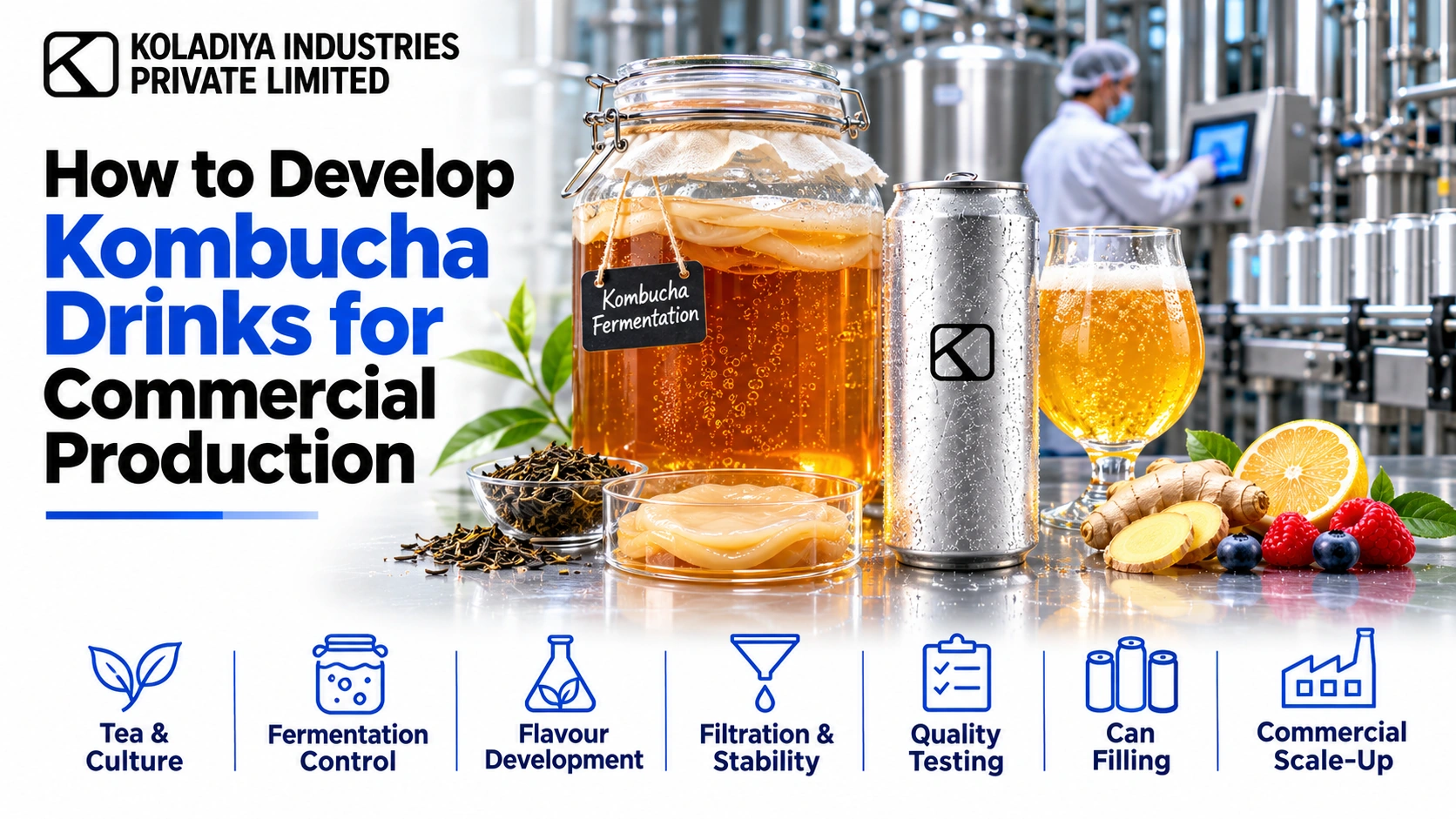
3. Develop a Controlled Kombucha Fermentation Process
Fermentation represents one of the most important stages in commercial kombucha production. It requires consistent control because changes in temperature, time, sugar concentration, and microbial activity can influence the final beverage.
Prepare the Tea Base
First, manufacturers prepare the tea base using suitable tea, water, and sugar. They then control the preparation process to achieve consistent extraction and ingredient distribution.
The tea base must reach a suitable temperature before the fermentation culture enters the process.
Introduce the Starter Culture
Traditional kombucha fermentation commonly uses a symbiotic culture of bacteria and yeast, often called SCOBY, together with an appropriate starter liquid.
Manufacturers must manage culture quality, hygiene, and inoculation conditions to maintain predictable fermentation performance.
Monitor Fermentation Conditions
During fermentation, manufacturers should monitor:
- Temperature and fermentation duration.
- pH and titratable acidity.
- Sugar consumption and residual sweetness.
- Taste, aroma, and flavour development.
- Microbial quality and batch consistency.
Importantly, pH alone does not describe the complete acidity profile. Therefore, manufacturers should also evaluate titratable acidity and other relevant quality parameters.
A controlled fermentation process helps brands achieve a repeatable taste profile and reduces unwanted batch variations.
4. Focus on Kombucha Drinks Flavour Development
Flavour development strongly influences consumer acceptance. Traditional kombucha can offer a naturally acidic, slightly sweet, and distinctive fermented taste. However, brands can improve its commercial appeal through carefully selected flavour combinations.
Popular Kombucha Flavour Combinations
Some potential commercial flavour concepts include:
- Mango and ginger.
- Lemon and mint.
- Strawberry and hibiscus.
- Pineapple and passion fruit.
- Green apple and cinnamon.
- Orange and botanical extracts.
Balance Sweetness and Acidity
A successful kombucha formulation needs a balanced relationship between sweetness, acidity, aroma, and aftertaste.
Excessive acidity can create an unpleasant drinking experience. Conversely, excessive sweetness may reduce the distinctive character of fermented kombucha.
Therefore, product developers should conduct multiple formulation trials and sensory evaluations before finalising the commercial recipe.
5. Explore Energy Drink Innovation with Kombucha Drinks
Energy drinks and kombucha represent different beverage categories. Nevertheless, both offer opportunities for brands interested in functional beverage innovation.
Traditional energy drinks typically focus on energy-oriented ingredients such as caffeine, B vitamins, and selected functional ingredients. Kombucha, by comparison, builds its identity around fermented tea and its distinctive flavour profile.
Consequently, brands can explore innovative concepts that combine kombucha-inspired fermentation with energy beverage positioning.
Potential development opportunities include:
Caffeinated Kombucha Concepts: Manufacturers can explore caffeine-containing tea bases and carefully selected caffeine ingredients to develop a distinctive beverage concept.
Low-Sugar Energy Kombucha: Brands can investigate reduced-sugar formulations that balance acidity, sweetness, caffeine levels, and flavour.
Botanical Energy Beverages: Ginger, citrus, and selected botanical ingredients can contribute to distinctive flavour combinations in energy-oriented beverages.
Sparkling Functional Drinks: Controlled carbonation can create a refreshing drinking experience across both kombucha and energy beverage categories.
However, combining fermentation with caffeine, vitamins, sweeteners, or other functional ingredients requires additional formulation work. Manufacturers must evaluate ingredient compatibility, caffeine concentration, stability, microbial safety, sensory quality, and applicable regulatory requirements.
A kombucha-based concept should not automatically claim probiotic or energy benefits without appropriate product evidence and regulatory review.
6. Manage Kombucha Drinks Quality Control and Safety
Commercial beverage production demands consistent quality at every manufacturing stage. This requirement becomes particularly important for fermented drinks because microbial activity can continue after fermentation.
Manufacturers should establish quality control procedures for raw materials, fermentation, blending, filling, packaging, and finished products.
Key quality control considerations include:
- Microbiological testing: Evaluate relevant microorganisms and establish suitable safety controls.
- Acidity monitoring: Track pH and titratable acidity throughout production.
- Ingredient inspection: Check incoming tea, sugar, flavours, extracts, and water quality.
- Sensory evaluation: Compare taste, aroma, colour, and mouthfeel against approved product specifications.
- Batch documentation: Maintain production records, ingredient traceability, and quality results.
- Shelf-life evaluation: Assess changes in flavour, acidity, carbonation, microbial quality, and packaging performance.
Additionally, manufacturers must determine whether the product will contain live cultures or undergo a stabilisation process. These choices affect storage conditions, shelf life, distribution, and product positioning.
7. Select Suitable Packaging for Kombucha Drinks
Packaging plays an important role in protecting beverage quality and creating a strong market presence.
Kombucha may generate carbon dioxide during fermentation. Therefore, manufacturers must carefully control residual fermentation and carbonation before selecting the final packaging system.
Potential packaging options include:
- Aluminium cans: Suitable for convenient, single-serve beverage formats when the formulation and packaging system demonstrate compatibility.
- Glass bottles: Offer a premium presentation and allow consumers to see the beverage.
- PET bottles: Can support selected beverage formats when the material and closure meet product requirements.
For canned kombucha, manufacturers should evaluate can lining compatibility, seam integrity, internal pressure, carbonation, and storage conditions.
Koladiya Industries also has beverage packaging experience with 250 ml aluminium slim cans, making this format relevant to discussions around premium beverage concepts.
8. Scale Kombucha Drinks from Pilot Batches to Commercial Production
A successful laboratory formulation does not automatically deliver the same results at commercial scale. Therefore, businesses should follow a structured scale-up process.
Start with Pilot Production
Pilot batches help manufacturers evaluate ingredient ratios, fermentation behaviour, flavour consistency, and processing requirements before commercial production.
They also help identify potential problems with mixing, temperature management, carbonation, and packaging.
Standardise the Manufacturing Process
After successful pilot trials, manufacturers should establish clear production specifications covering ingredient quantities, processing conditions, fermentation controls, blending procedures, and filling requirements.
Evaluate Commercial Production Costs
Brands should calculate the cost of tea, sugar, cultures, flavours, packaging, manufacturing, quality testing, storage, and distribution.
A detailed cost assessment helps businesses establish realistic product pricing and production volumes.
Conduct Shelf-Life and Packaging Trials
Before launching the product, manufacturers should validate the intended shelf life under relevant storage and distribution conditions. They should also evaluate packaging performance and product stability throughout the proposed shelf-life period.
This stage helps reduce commercial risks and supports more reliable product launches.
9. How Koladiya Industries Supports Beverage Product Development
Choosing the right beverage manufacturing partner can help brands move from an initial concept to a commercially viable product. Koladiya Industries Private Limited works in the beverage manufacturing space, supporting businesses exploring private-label and third-party beverage production.
Its beverage development and manufacturing positioning includes:
- Beverage Formulation and R&D: Support for developing customised beverage concepts and flavour profiles.
- Private-Label Manufacturing: Opportunities for brands looking to develop their own beverage products.
- Energy Drink Manufacturing: Beverage development opportunities for brands entering the energy drink category.
- Carbonated Beverage Production: Experience across carbonated soft drink concepts.
- Sparkling Water and Tonic Water: Additional beverage categories for product portfolio expansion.
- Packaging Expertise: Experience with 250 ml aluminium slim can formats.
For businesses exploring Kombucha Drinks, the next step involves discussing the proposed formulation, fermentation requirements, production process, packaging compatibility, and commercial specifications with the Koladiya Industries team.
A clear technical brief helps manufacturers evaluate project requirements and identify suitable development and production approaches. Brands should confirm specific kombucha fermentation and manufacturing capabilities directly with the company before finalising their production plans.
Conclusion
Developing Kombucha Drinks for commercial production requires a combination of product innovation, fermentation control, ingredient selection, flavour development, quality assurance, and suitable packaging. From traditional fermented tea to fruit-based, botanical, low-sugar, and sparkling concepts, kombucha creates opportunities for businesses looking to expand their beverage portfolios. Furthermore, the growing interest in functional beverages creates opportunities to explore new concepts that connect kombucha-inspired formulations with energy drink innovation.
However, successful commercial production depends on consistent formulation, validated processing conditions, microbiological safety, shelf-life testing, and reliable manufacturing practices. Working with an experienced beverage development and manufacturing partner can help businesses evaluate these requirements and plan their product launch more effectively.
Develop Your Next Beverage Product with Koladiya Industries
Planning to launch a kombucha beverage, functional drink, or innovative energy drink brand? Koladiya Industries Private Limited can help you explore beverage formulation, R&D requirements, private-label manufacturing, and commercial production opportunities. Connect with Koladiya Industries to discuss your beverage concept, product specifications, packaging preferences, and manufacturing requirements. Turn your beverage idea into a market-ready product with the right development and manufacturing partner.