India has a rich heritage of traditional beverages, with regional recipes, distinctive flavours, and ingredients that reflect the country’s diverse food culture. From aam panna and jaljeera to kokum sharbat, nimbu pani, buttermilk, and sattu drinks, these beverages offer exciting opportunities for brands looking to introduce familiar flavours to modern consumers. However, transforming a Indian Traditional Drink recipe into a successful retail product requires more than simply preparing a beverage and selecting attractive packaging. Brands must refine the formulation, maintain consistent taste, establish food safety standards, validate shelf life, and select packaging that supports distribution and consumer convenience.
Consequently, entrepreneurs entering the beverage industry can combine traditional Indian flavours with contemporary product development and commercial manufacturing practices. This approach can help create beverages that appeal to consumers seeking regional flavours, convenient refreshments, and new drinking experiences. Koladiya Industries can be considered as a manufacturing partner for businesses exploring beverage development and contract manufacturing opportunities. With careful planning, brands can transform traditional beverage concepts into commercially viable products for retail markets.
What Is an Indian Traditional Drink?
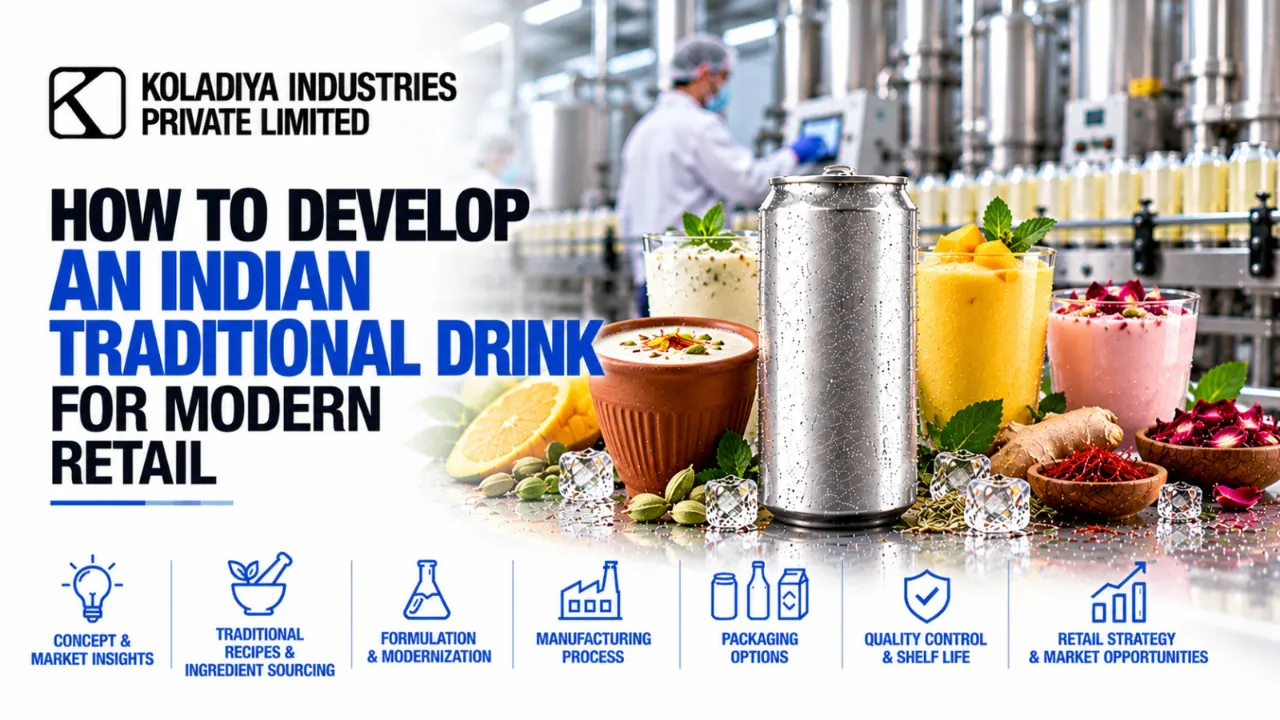
An Indian traditional drink is a beverage rooted in regional culinary practices, local ingredients, and established preparation methods. These drinks often feature ingredients such as fruits, herbs, spices, dairy, grains, and natural flavoring components.
Popular examples include:
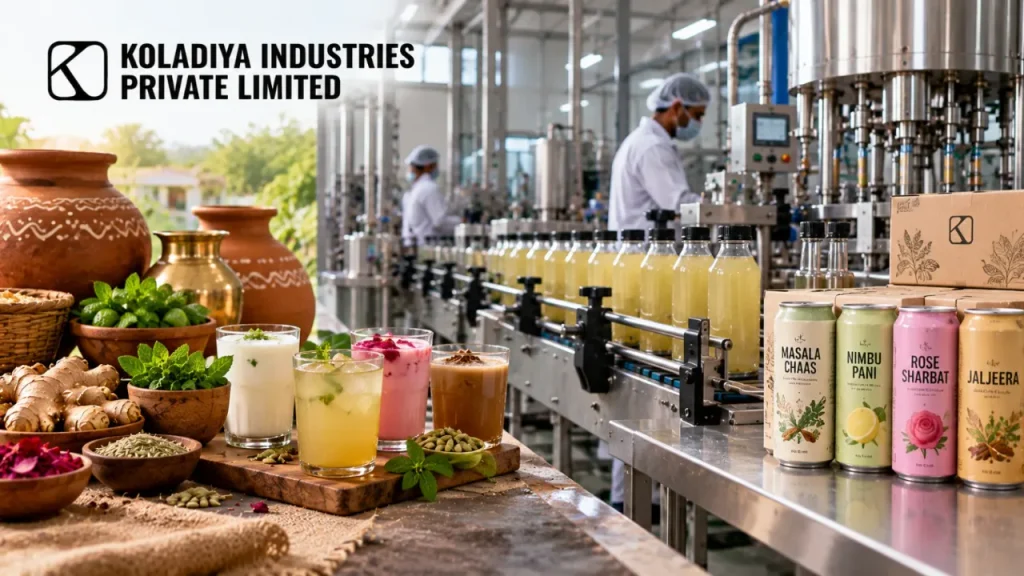
- Aam panna: A tangy raw mango beverage with a distinctive sweet-and-sour flavour.
- Jaljeera: A refreshing drink featuring cumin, mint, and complementary spices.
- Kokum sharbat: A fruit-based beverage known for its tart flavour and deep colour.
- Nimbu pani: A lemon-based refreshment that combines citrus flavour with sweetness and acidity.
- Masala chaas: A savoury buttermilk beverage with herbs and spices.
- Sattu drink: A traditional beverage made using roasted gram flour, often associated with regional food traditions.
Each beverage presents different formulation and manufacturing requirements. For example, dairy-based drinks require specific processing controls, whereas acidic fruit beverages may need different preservation and packaging strategies.
Therefore, brands should identify the product’s ingredients, intended storage conditions, target consumers, and distribution channels before beginning commercial development.
Why Develop an Indian Traditional Drink for Modern Retail?
Modern retail creates opportunities for beverage brands to introduce regional flavours in convenient, consistent, and professionally packaged formats. Nevertheless, success depends on matching the product concept with consumer expectations and practical manufacturing requirements.
1. Growing Interest in Regional Flavours
Consumers may look for beverages that reflect familiar tastes, regional food traditions, and distinctive ingredient combinations. Brands can explore traditional recipes while adapting sweetness, acidity, spice intensity, and flavour balance to suit their intended audience.
For instance, a brand could develop a contemporary kokum beverage, a packaged jaljeera refreshment, or a modern aam panna drink for supermarkets, convenience stores, cafés, and online retail platforms.
2. Convenient Ready-to-Drink Formats
Traditional beverages often require preparation at home or in food-service settings. A ready-to-drink (RTD) format can make these flavours more accessible to consumers who prefer convenient, ready-to-serve products.
However, manufacturers must validate the formulation and processing method before assigning a shelf life or recommending storage conditions.
3. Opportunities for Product Differentiation
Traditional Indian ingredients can help brands establish a recognisable product identity. Instead of competing only through price, businesses can develop distinctive flavour combinations, packaging formats, and brand stories rooted in regional inspiration.
Moreover, a focused product range can help new brands test consumer demand before expanding into additional flavours.
Step 1: Select the Right Indian Traditional Drink Concept
The first step involves choosing a beverage concept with a clear consumer proposition and realistic commercial potential.
Start by evaluating traditional drinks according to ingredient availability, flavour appeal, manufacturing complexity, expected production volume, and target market.
For example, a company targeting urban retail consumers might consider kokum sharbat, sparkling nimbu pani, or a packaged jaljeera beverage. Meanwhile, a brand focused on traditional refreshments could explore aam panna or selected regional fruit drinks.
During this stage, research competing products, review retail pricing, identify the target audience, and assess the product’s potential distribution channels.
Most importantly, choose a concept that balances cultural authenticity with consumer convenience and scalable production.
Step 2: Develop the Indian Traditional Drink Formulation
Formulation determines the beverage’s flavour, appearance, texture, stability, and overall consumer experience. Therefore, brands should work with qualified beverage development professionals to translate the original concept into a repeatable commercial formulation.
Ingredient Selection and Flavour Balance
Depending on the beverage, the formulation may include fruit concentrates, juices, spices, herbs, sweeteners, water, dairy ingredients, or other permitted food ingredients.
The development team should evaluate:
- Sweetness and acidity.
- Spice intensity and flavour consistency.
- Colour, aroma, and mouthfeel.
- Ingredient compatibility.
- Ingredient availability and cost.
- Microbiological safety and product stability.
Traditional recipes may vary between households and regions. Consequently, commercial production requires defined ingredient specifications and precise formulation controls.
Indian Traditional Drink Formulation for Contemporary Preferences
Some consumers prefer less sweetness, while others enjoy bold spices, pronounced fruit flavours, or sparkling textures. Brands can explore these preferences through structured product trials and consumer feedback.
For example, a conventional nimbu pani concept could inspire a sparkling lemon beverage, while kokum could provide the foundation for a modern fruit-based refreshment.
Nevertheless, innovation should complement the drink’s original identity rather than obscure its defining characteristics.
Step 3: Explore Energy Drinks Alongside Traditional Beverages
Energy drinks offer a separate opportunity for brands seeking to enter India’s competitive beverage market. Although traditional refreshments and energy drinks serve different product purposes, both can benefit from distinctive flavour development, convenient packaging, and clear brand positioning.
For instance, brands may explore Indian-inspired flavour profiles such as kokum, lemon, ginger, or selected spice combinations when developing an energy drink concept.
However, an energy drink requires its own formulation strategy. Its ingredients, caffeine content, flavour system, acidity, processing requirements, and regulatory considerations differ from those of a conventional traditional beverage.
Indian Traditional Drink vs Energy Drink Development
A traditional beverage generally focuses on its regional flavour identity and refreshment experience. An energy drink, by contrast, may use caffeine and other permitted ingredients to support its intended product positioning, subject to applicable regulations.
Brands should therefore avoid treating these categories as interchangeable.
A business could develop a traditional beverage range and a separate energy drink range under the same parent brand, provided that each product has a clear identity, suitable formulation, compliant labelling, and appropriate manufacturing controls.
Koladiya Industries may be a relevant partner for businesses evaluating beverage manufacturing options across different product categories. Before proceeding, brands should confirm the manufacturer’s capabilities for their specific beverage type, formulation, packaging, and production volume.
Step 4: Conduct Pilot Batches and Product Testing
Once the formulation reaches a suitable stage, a pilot batch helps determine whether the beverage can perform consistently under practical production conditions.
Pilot production allows brands and manufacturers to evaluate the mixing process, ingredient dispersion, flavour uniformity, filling performance, and product appearance.
During this phase, the team should assess:
- Taste and aroma consistency.
- pH and other relevant quality parameters.
- Ingredient stability and potential sedimentation.
- Microbiological quality.
- Compatibility with the selected processing method.
- Packaging performance and filling suitability.
Furthermore, pilot testing can identify problems before a brand commits to larger production volumes.
A successful trial does not automatically establish commercial shelf life. Instead, brands should conduct appropriate shelf-life studies and validate the intended manufacturing and storage conditions.
Step 5: Choose Suitable Packaging for an Indian Traditional Drink
Packaging affects product protection, convenience, transport, shelf presentation, and manufacturing costs. Therefore, brands should select a format that matches the beverage’s characteristics and commercial objectives.
PET Bottles
PET bottles can suit selected still beverages and convenient single-serve formats. They offer practical handling and can support distribution through retail stores and food-service outlets.
However, the brand must verify compatibility with the formulation, processing method, storage conditions, and required shelf life.
Aluminium Cans
Aluminium cans can suit sparkling traditional-inspired beverages, modern lemon refreshments, and selected energy drink concepts. They offer a compact format and support contemporary retail positioning.
Nevertheless, manufacturers should confirm carbonation compatibility, internal coating suitability, filling requirements, and product stability.
Glass Bottles
Glass bottles can support premium positioning for selected fruit beverages, traditional-inspired refreshments, and specialty drinks. However, brands should evaluate weight, breakage risk, transport costs, and distribution requirements.
Ultimately, the best packaging choice depends on the beverage formulation, target market, production capabilities, and intended storage conditions.
Step 6: Establish Food Safety and Shelf-Life Controls
Food safety must remain a central priority throughout beverage development. Traditional ingredients can introduce formulation and processing challenges, particularly when products contain fruit, spices, dairy, or other sensitive components.
Depending on the beverage, manufacturers may need to evaluate heat treatment, hygienic processing, filtration, permitted preservatives, or other validated preservation approaches.
Brands should also establish ingredient specifications, supplier verification procedures, batch records, cleaning protocols, and finished-product quality checks.
Shelf-life testing should assess relevant physical, chemical, sensory, and microbiological characteristics throughout the proposed storage period.
In India, businesses must also consider applicable FSSAI requirements, ingredient permissions, labelling rules, and category-specific standards. Products containing caffeine or other regulated ingredients require additional attention to applicable composition and declaration requirements.
Consequently, brands should obtain suitable regulatory guidance before finalising the formulation, label, and manufacturing process.
Step 7: Calculate Manufacturing Costs and Minimum Order Quantities
Commercial viability depends on more than the cost of ingredients. Brands must evaluate the complete production and distribution economics before setting a retail price.
Typical cost components include:
- Ingredients and formulation development.
- Pilot trials and product testing.
- Packaging materials and printed labels.
- Manufacturing, processing, and filling.
- Quality assurance and regulatory compliance.
- Warehousing, transportation, and distribution.
- Marketing and retail channel expenses.
Minimum order quantities (MOQs) depend on factors such as packaging format, production equipment, ingredient procurement, batch size, and manufacturing schedules.
Therefore, businesses should request a detailed quotation based on their specific formulation, packaging requirements, expected volumes, and commercial timeline.
For startups, a phased launch can reduce initial risk. A limited product range allows the business to assess consumer response before investing in broader distribution or additional flavours.
Step 8: Build a Retail Positioning and Marketing Strategy
A strong retail strategy communicates what makes the beverage distinctive and why consumers should consider purchasing it.
Brands can highlight the drink’s regional inspiration, signature ingredients, flavour profile, convenient format, and intended consumption occasion.
Packaging should communicate essential product information clearly while maintaining a consistent visual identity. Product descriptions and advertising claims must also comply with applicable regulations.
Furthermore, businesses should identify suitable retail channels, such as supermarkets, local grocery stores, cafés, restaurants, convenience stores, and e-commerce platforms.
Consumer sampling, retailer feedback, and small-scale market testing can help identify the flavours, pack sizes, and price points that perform best.
Once the brand establishes reliable demand, it can expand its distribution and production volumes in line with manufacturing capacity.
How Koladiya Industries Can Support Beverage Brand Development
Koladiya Industries can be considered by businesses exploring contract beverage manufacturing for traditional-inspired refreshments, fruit-based beverages, and other beverage concepts.
For brands planning a new product, discussions with a potential manufacturing partner should cover formulation requirements, ingredient sourcing, pilot production, packaging options, quality controls, production capacity, and commercial quantities.
Businesses should also clarify which development services the manufacturer provides directly and which activities require separate technical or regulatory support.
A structured manufacturing partnership can help brands understand the practical requirements of moving from a product concept to commercial production. However, the final approach should reflect the specific beverage category, validated formulation, packaging requirements, and intended market.
Whether a business plans to launch a traditional Indian refreshment or a separate energy drink range, early coordination between product development, manufacturing, quality assurance, and marketing can support a more organised launch process.
Conclusion: Turn an Indian Traditional Drink Concept into a Retail Product
Developing an Indian traditional drink for modern retail requires a thoughtful combination of regional flavour inspiration, commercial formulation, product testing, suitable packaging, food safety, and market positioning.
By selecting the right concept, refining the recipe, validating production processes, and calculating manufacturing costs, brands can build a stronger foundation for commercial growth.
Additionally, energy drinks represent a separate opportunity for businesses exploring modern beverage categories and Indian-inspired flavour profiles. Each product, however, requires its own development process and appropriate regulatory assessment.
With a clear strategy and a suitable manufacturing partner, beverage entrepreneurs can transform promising ideas into products designed for contemporary retail markets.
Start Your Beverage Manufacturing Journey with Koladiya Industries
Are you planning to launch an Indian traditional drink, a modern fruit-based refreshment, or a separate energy drink brand? Begin by defining your product concept, target audience, formulation requirements, and packaging preferences.
Contact Koladiya Industries to discuss your beverage manufacturing requirements and explore the next steps toward commercial production.
FAQ’s:
Which Indian traditional drinks can brands develop commercially?
Brands can explore aam panna, jaljeera, kokum sharbat, nimbu pani, buttermilk, sattu drinks, and other regional beverages. The final choice depends on consumer demand, formulation feasibility, ingredient availability, and processing requirements.
Can traditional Indian flavours be used in energy drinks?
Yes. Brands can explore flavours inspired by kokum, lemon, ginger, and selected spices for energy drink concepts. However, energy drinks require a separate formulation, appropriate ingredient controls, and compliance with applicable food regulations.
What packaging works best for traditional Indian beverages?
PET bottles, aluminium cans, and glass bottles may suit different beverage types. The choice depends on the formulation, carbonation, processing method, shelf-life requirements, distribution strategy, and target price.
How do manufacturers determine the shelf life of a traditional beverage?
Manufacturers assess the formulation, processing conditions, packaging, storage environment, and relevant quality parameters. Appropriate shelf-life studies and safety validation help establish a defensible use-by or best-before period.
What affects the cost of manufacturing an Indian traditional drink?
Key factors include ingredients, formulation development, testing, packaging, batch size, processing requirements, production volume, and distribution costs. A manufacturer can estimate costs more accurately when the product specifications and expected quantities are clear.
How can Koladiya Industries help with beverage manufacturing?
Businesses can contact Koladiya Industries to discuss their beverage concept, manufacturing requirements, packaging preferences, and expected production volumes. They should confirm the availability of the specific formulation, development, testing, and manufacturing services their product requires.