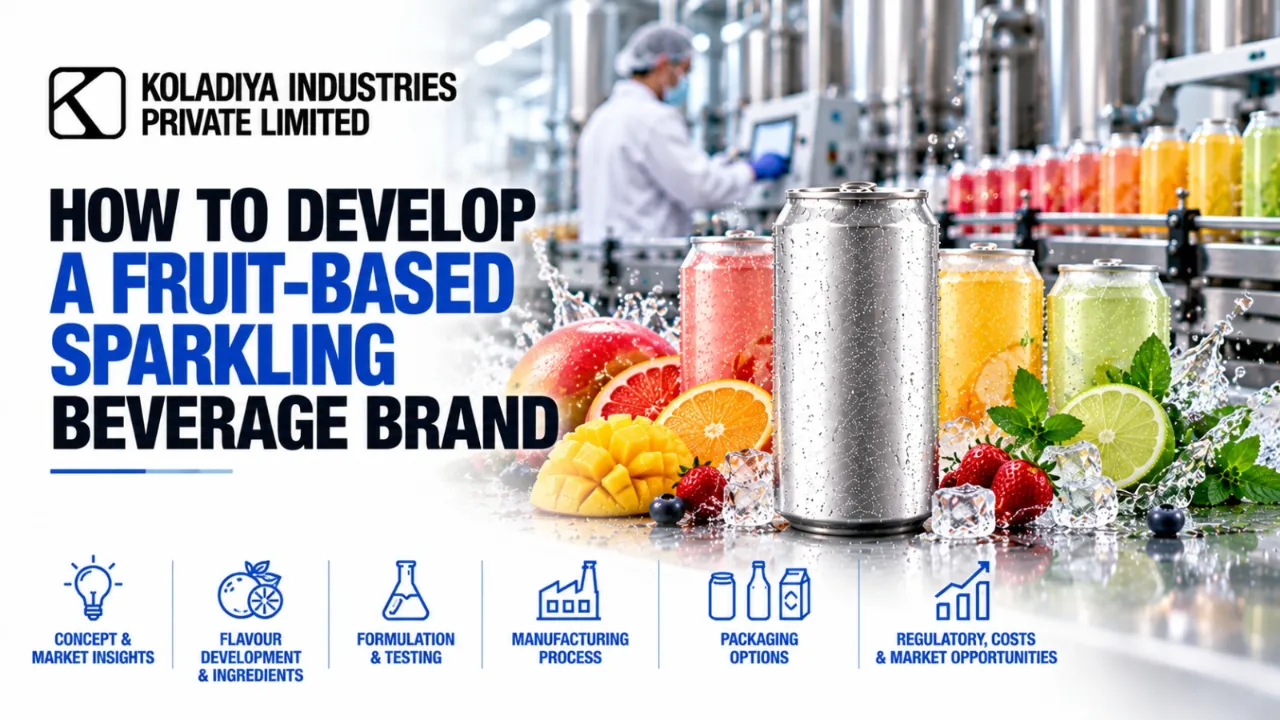
Launching a successful beverage brand requires more than an attractive label and a refreshing flavour. Brands must develop a distinctive product, understand consumer preferences, select suitable ingredients, maintain consistent quality, and build an effective manufacturing strategy. A fruit-based sparkling beverage offers an exciting opportunity for entrepreneurs who want to enter the growing market for refreshing, flavour-focused drinks. However, turning an initial idea into a commercially viable product requires careful planning. From fruit selection and carbonation to packaging and large-scale production, every decision influences the final beverage experience.
We explain how to develop a Fruit-Based Sparkling Beverage brand, covering product development, formulation, manufacturing, packaging, quality control, and commercialization. We also explore how working with an experienced beverage manufacturing partner such as Koladiya Industries can help brands organize their journey from concept to production.
What Is a Fruit-Based Sparkling Beverage?
A fruit-based sparkling beverage combines fruit juice, fruit concentrates, or fruit flavours with carbonated water to create a refreshing drink with a lively fizz. Depending on the formulation, brands can develop beverages with different sweetness levels, fruit intensities, colours, and carbonation profiles.
For example, a brand might develop a sparkling mango drink for consumers who enjoy tropical flavours or introduce a lemon-and-berry blend for a more vibrant flavour experience. Moreover, combinations such as pineapple and lime, peach and passion fruit, or strawberry and citrus can help establish a distinctive product identity.
Unlike conventional soft drinks that often focus on sweetness, a fruit-based sparkling beverage can emphasise fruit character, balanced acidity, refreshing carbonation, and a carefully designed ingredient profile.
Why Choose a Fruit-Based Sparkling Beverage?
Fruit-based sparkling drinks provide brands with flexibility in flavour development and positioning. Brands can use popular fruit flavours, develop unique flavour combinations, or create premium sparkling drinks tailored to the preferences of specific customers.
Furthermore, carbonation adds texture and a refreshing sensation that distinguishes these drinks from still fruit beverages. Brands can also explore different packaging formats and serving occasions, including everyday refreshment, social gatherings, food-service settings, and on-the-go consumption.
Nevertheless, product success depends on more than flavour innovation. A strong concept must also meet consumer expectations, production requirements, pricing targets, and applicable food regulations.
Step 1: Define Your Fruit-Based Sparkling Beverage Concept
Before developing a formulation, establish a clear direction for your brand. A focused concept helps you make better decisions about ingredients, packaging, pricing, and marketing.
Start by identifying your intended customer group. For instance, you might target young adults seeking new flavour experiences, families looking for refreshing drinks, or premium beverage consumers interested in distinctive fruit combinations.
Next, identify the problem or preference your product will address. Perhaps consumers in your target market want less sweetness, bolder fruit flavours, convenient single-serve packaging, or an alternative to familiar carbonated drinks.
Then define your product positioning. You could build a brand around tropical refreshment, sophisticated fruit blends, accessible everyday enjoyment, or a carefully selected ingredient profile.
Fruit-Based Sparkling Beverage Market Research
Market research helps you understand which concepts deserve further development. Examine competing products, retail pricing, package sizes, flavour combinations, ingredient descriptions, and the channels where similar drinks appear.
In addition, gather feedback from potential customers through surveys, tasting sessions, or small concept tests. Ask which flavours appeal to them, how sweet they prefer their drinks, and what price they consider reasonable.
Use these findings to establish your initial product specifications. Rather than launching numerous flavours immediately, consider developing one or two promising options, testing their performance, and expanding the range once you understand customer preferences.
Step 2: Select the Right Fruit Ingredients and Flavours
Fruit selection plays a central role in the taste, aroma, colour, and overall character of a sparkling beverage. Therefore, choose ingredients according to your product concept rather than selecting flavours solely because they appear popular.
Common options include mango, orange, lemon, lime, pineapple, apple, grape, strawberry, peach, and passion fruit. Each ingredient contributes different sweetness, acidity, aroma, and flavour intensity.
For example, mango can provide a rounded tropical flavour, while lemon and lime offer a sharper citrus profile. Meanwhile, pineapple introduces tropical sweetness and acidity, and berries can help create a more complex fruit character.
How to Choose Ingredients for a Fruit-Based Sparkling Beverage
First, decide whether your formulation will use fruit juice, fruit concentrate, natural or nature-identical flavouring where permitted, or a combination of suitable ingredients. Each option has different formulation, handling, cost, and labelling implications.
Second, evaluate the fruit ingredients for consistency. Seasonal variations can affect sweetness, acidity, colour, and aroma. A suitable ingredient specification can help your manufacturing team manage these differences.
Third, consider how the fruit profile interacts with carbonation. Carbon dioxide can influence perceived acidity and flavour intensity. Consequently, a blend that tastes balanced before carbonation may require further adjustment after the team carbonates it.
Finally, establish ingredient sourcing criteria that address quality, supply reliability, documentation, and traceability. Consistent sourcing supports repeatable production and helps protect your product identity as demand increases.
Step 3: Develop and Refine the Beverage Formulation
Once you select your ingredients, translate the concept into a workable formulation. This stage involves balancing fruit character, sweetness, acidity, carbonation, and mouthfeel while considering manufacturing feasibility and the intended shelf life.
A typical formulation may include treated water, fruit juice or concentrate, flavouring ingredients, a sweetening system, acidity regulators, and carbon dioxide. Depending on the product, the formula may also require other permitted ingredients to achieve its intended stability and sensory profile.
However, no single formulation suits every product. The appropriate ingredient combination depends on the fruit content, product category, processing method, packaging format, and applicable regulations.
Fruit-Based Sparkling Beverage Sweetness and Acidity
Sweetness and acidity strongly influence how consumers perceive a beverage. Too much sweetness can overwhelm the fruit, whereas excessive acidity can make the drink taste harsh. Therefore, developers must evaluate these elements together rather than adjust them independently.
Begin with small formulation trials. Create several variations with controlled differences in sweetness, acidity, and fruit intensity. Then compare the samples through structured tasting sessions.
Furthermore, test the formulation after carbonation and chilling because serving temperature and carbonation can change flavour perception. Record the results carefully so the development team can reproduce successful versions.
If your brand plans to offer a reduced-sugar or sugar-free option, treat that as a distinct formulation challenge. Alternative sweeteners can create different taste profiles, aftertastes, and stability considerations. The team must test these characteristics before finalising the product.
Step 4: Test, Validate, and Finalise the Product
A promising sample does not automatically qualify for commercial production. Before launch, you need to confirm that the beverage consistently meets its sensory, microbiological, chemical, and packaging requirements.
First, conduct sensory evaluations to assess flavour, aroma, sweetness, acidity, carbonation, colour, and mouthfeel. Use consistent evaluation criteria so that your team can compare different batches objectively.
Next, assess the product’s stability and expected shelf life. The appropriate testing plan depends on the formulation, processing method, packaging material, and storage conditions. Qualified food-testing professionals can help determine suitable tests and acceptance criteria.
Quality Control for a Fruit-Based Sparkling Beverage
Fruit ingredients can introduce challenges involving natural variation, microbial quality, oxidation, colour stability, and flavour consistency. Meanwhile, carbonation and packaging can influence product performance throughout storage.
Consequently, establish measurable quality specifications for important characteristics such as ingredient composition, pH, carbonation level, fill volume, sensory profile, and package integrity.
Also, evaluate how the beverage performs under its intended storage and distribution conditions. Do not assign a shelf-life claim based only on early observations or assumptions. Use suitable evidence to support the final claim.
In India, review the food safety, labelling, packaging, ingredient, and licensing requirements that apply to your specific product. The correct classification and requirements depend on the formulation and how you plan to market the beverage.
Step 5: Choose Suitable Packaging for Your Brand
Packaging protects the beverage, supports convenient distribution, and communicates your brand identity. Therefore, select the format according to product requirements, budget, distribution channels, and customer expectations.
Aluminium cans offer a modern appearance and convenient single-serve formats. PET bottles provide lightweight packaging and allow consumers to see the product when the beverage’s appearance supports the brand concept. Glass bottles can suit premium positioning and selected hospitality or retail channels.
However, each option requires technical evaluation. Your chosen packaging must suit the beverage’s carbonation pressure, processing conditions, storage requirements, and distribution environment.
Fruit-Based Sparkling Beverage Packaging and Branding
Design your packaging to communicate the product’s main selling points clearly. A distinctive colour palette, readable typography, recognisable fruit imagery, and consistent brand elements can help customers identify the product.
In addition, make the key product information easy to understand. Ensure that ingredient declarations, nutrition information, net quantity, manufacturer details, and other required label information meet applicable regulations.
Before committing to a large packaging order, review the design on physical samples. Confirm legibility, print quality, closure performance, and compatibility with the selected container.
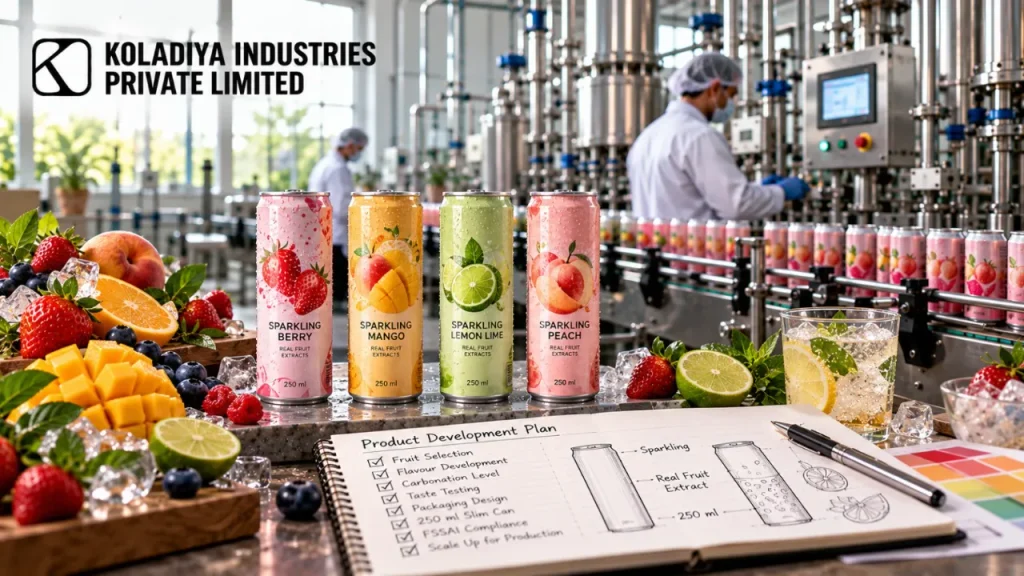
Step 6: Plan Beverage Manufacturing and Production Scale
Moving from product sampling to large-scale production requires a well-planned and efficient manufacturing strategy. You must consider production equipment, ingredient availability, quality systems, packaging requirements, batch size, and overall operating costs.
At the early stage, pilot-scale production can help you assess the formulation under conditions closer to commercial manufacturing. It also allows the team to identify potential problems before investing in a larger run.
Fruit-Based Sparkling Beverage Manufacturing Options
Entrepreneurs can explore in-house production or work with a contract beverage manufacturer. Building an in-house facility may offer greater direct control, but it also requires investment in equipment, trained personnel, quality systems, utilities, and regulatory compliance.
By contrast, contract manufacturing can help brands access established production capabilities without building an entire facility themselves. Choosing the right manufacturing option depends on your product requirements, production volume, budget, and the capabilities of your manufacturing partner.
When evaluating a manufacturing partner, discuss:
- Formulation development and product trials.
- Ingredient procurement and sourcing standards.
- Production capacity and minimum order quantities.
- Carbonation, filling, and packaging capabilities.
- Quality control and documentation procedures.
- Pricing, lead times, and options for future scale-up.
Additionally, request clear details about responsibilities, production specifications, quality acceptance criteria, and ownership of the formulation and brand assets. Transparent agreements can help prevent misunderstandings as the project develops.
Step 7: Calculate Costs and Set a Commercial Pricing Strategy
A commercially attractive product must also meet your financial objectives. Therefore, calculate the expected production cost before deciding on the retail price.
Key cost components include fruit ingredients, sweeteners, water treatment, carbonation, packaging, manufacturing, testing, storage, transport, and applicable taxes. Branding, marketing, distribution margins, and retailer requirements can also affect profitability.
For a more reliable estimate, request quotations based on your selected formula, package size, production volume, and order frequency.
Fruit-Based Sparkling Beverage Pricing Considerations
Avoid setting your price by looking only at ingredient costs. Your complete cost model should account for manufacturing charges, packaging, logistics, distributor margins, retail margins, promotional activity, and expected wastage.
Next, compare the proposed price with competing products and the value your drink offers. A premium formulation may support a different positioning from a mainstream sparkling fruit drink, but customers must understand the reason for the difference.
Finally, create realistic sales forecasts and cash-flow projections. Consider minimum order quantities, inventory holding, payment terms, and the time required to generate repeat purchases. These factors help determine whether your launch plan can support sustainable growth.
Step 8: Launch, Gather Feedback, and Expand Your Product Range
After product validation and manufacturing preparation, develop a launch plan that connects your brand with the right customers.
Start with suitable sales channels, such as local retailers, cafés, restaurants, direct-to-consumer platforms, or regional distributors. Choose channels that fit your target audience, distribution budget, and product shelf-life requirements.
Meanwhile, use clear product descriptions and appealing visual content to explain your flavour profile and brand positioning. Sampling campaigns can also help customers experience the drink before purchasing it.
Fruit-Based Sparkling Beverage Brand Growth Strategies
Track sales performance, customer feedback, repeat purchases, and product returns. These indicators can reveal whether your flavour, price, packaging, and distribution approach meet market expectations.
Moreover, use feedback to improve the existing product before expanding unnecessarily. Once you establish a reliable sales base, introduce additional flavours or package formats according to demonstrated demand.
Increase production step by step by estimating demand, securing a reliable supply of ingredients, ensuring sufficient manufacturing capacity, and maintaining consistent product quality as your business grows.
How Koladiya Industries Can Support Your Beverage Development Journey
Developing a fruit-based sparkling beverage involves several connected stages, from concept planning and formulation to production preparation and packaging decisions. Working with an appropriate manufacturing partner can help entrepreneurs coordinate these activities more effectively.
Koladiya Industries can be approached as a potential beverage manufacturing partner for brands exploring product development and commercial production. When evaluating the company for your project, discuss your concept, preferred fruit flavours, target price, packaging requirements, expected order volume, and launch timeline.
Confirm the specific services, equipment, production capabilities, minimum order quantities, and quality processes available for your product before finalising an arrangement.
With a clear product brief and a structured development plan, your team can make more informed decisions, reduce avoidable formulation changes, and prepare for a more organised route to market.
Conclusion
Building a successful fruit-based sparkling beverage brand requires a balance of flavour innovation, technical development, packaging, manufacturing, and commercial planning. Every stage contributes to the final customer experience, so a structured approach can help you identify potential challenges before launch.
Start by defining your target audience and product positioning. Then select suitable fruit ingredients, develop a balanced formulation, test the product thoroughly, and choose packaging that meets both technical and branding requirements. Finally, evaluate your manufacturing options, establish a realistic cost model, and use market feedback to guide future growth.
With the right planning and strategy, beverage entrepreneurs can turn their initial ideas into distinctive products and prepare them for successful commercial production.
Ready to develop your own fruit-based sparkling beverage brand?
Contact Koladiya Industries to discuss your beverage concept, flavour preferences, formulation requirements, packaging options, and manufacturing goals. Take the next step towards transforming your sparkling fruit drink idea into a market-ready beverage brand.
FAQ’s
Which fruit flavours work best for a sparkling beverage?
Popular options include mango, orange, lemon, lime, pineapple, strawberry, peach, and passion fruit. You can also experiment with combinations such as mango-lime, pineapple-mint, or strawberry-lemon to create a distinctive flavour profile for your brand.
How is a fruit-based sparkling beverage formulated?
Formulation typically involves selecting fruit juice or concentrate, treated water, a suitable sweetening system, acidity regulators, flavouring ingredients, and carbonation. The development team then tests sweetness, acidity, flavour balance, and carbonation to create a consistent product.
What packaging is suitable for a Fruit-Based Sparkling Beverage?
Aluminium cans, PET bottles, and glass bottles are common packaging options. The right choice depends on carbonation requirements, product stability, target customers, distribution channels, budget, and brand positioning. Discuss packaging compatibility with your manufacturing partner before finalising your design.
How much does it cost to develop a Fruit-Based Sparkling Beverage brand?
The cost depends on the formulation, ingredient selection, product testing, packaging format, branding, production volume, and distribution requirements. Request a detailed quotation based on your product concept and expected order quantity to estimate the investment more accurately.
Can I use contract manufacturing to launch a sparkling fruit drink brand?
Yes. Contract manufacturing can help entrepreneurs access beverage production capabilities without establishing their own manufacturing facility. Before choosing a partner, review its available services, production capacity, minimum order quantities, quality control procedures, pricing, and packaging options.
How can Koladiya Industries help with my Fruit-Based Sparkling Beverage project?
Koladiya Industries can be approached to discuss your fruit beverage concept, formulation requirements, packaging preferences, and manufacturing goals. Contact the company to confirm its current capabilities, production options, minimum order quantities, and project requirements before planning your launch.