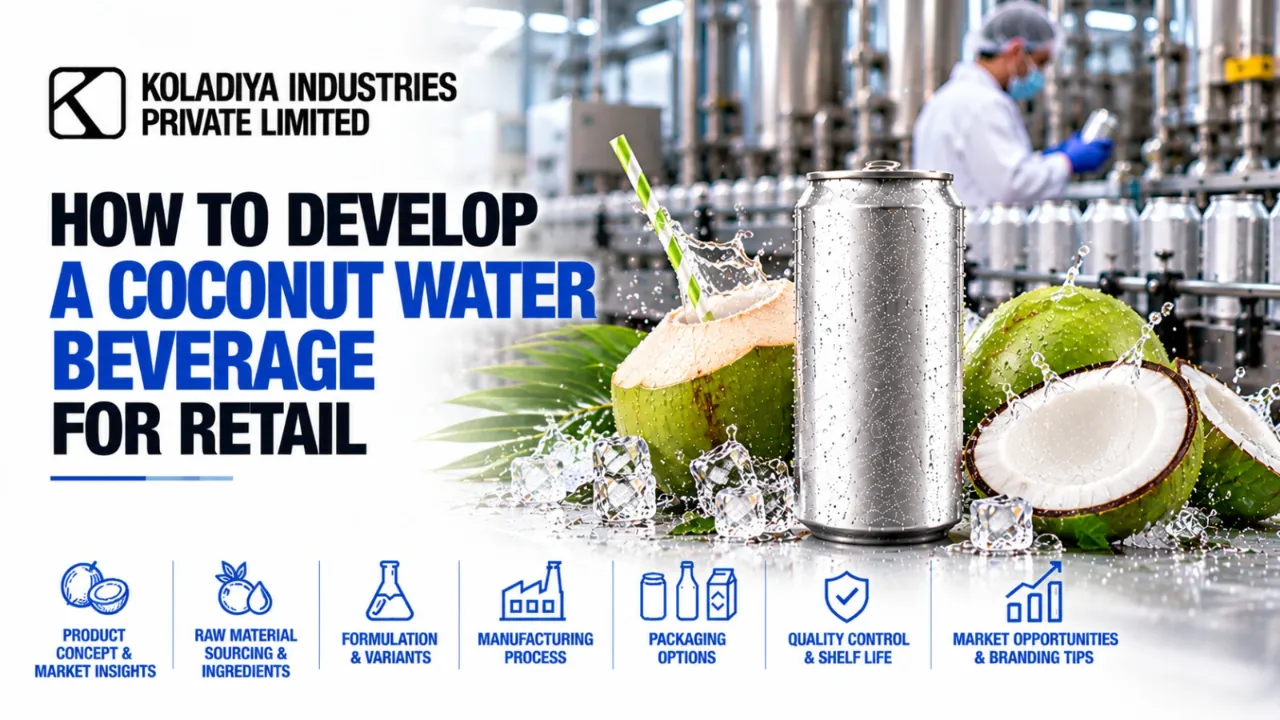
The demand for natural, refreshing, and convenient beverages continues to create opportunities for brands in the retail market. Among these options, coconut water has gained attention because of its refreshing taste, natural origin, and association with everyday hydration. Consequently, entrepreneurs and beverage companies are exploring ways to develop a Coconut Water Beverage that meets consumer expectations while maintaining consistent quality, competitive pricing, and a longer commercial shelf life.
However, launching a successful coconut water product requires more than sourcing fresh coconuts and selecting attractive packaging. Brands must carefully evaluate product formulation, ingredient quality, processing methods, packaging formats, shelf-life requirements, and manufacturing capacity. Moreover, they must establish a clear product identity that distinguishes their beverage from competing products.
For businesses interested in expanding their beverage portfolios, coconut water can also complement other categories, including energy drinks and functional beverages. With the right product development strategy and a reliable manufacturing partner such as Koladiya Industries, businesses can transform an initial concept into a retail-ready beverage.
What Is a Coconut Water Beverage?
A Coconut Water Beverage uses coconut water as its primary ingredient or as a central component of the formulation. Depending on the target market, brands can develop products that highlight the original taste of coconut water or introduce carefully selected flavours to create a distinctive drinking experience.
Furthermore, product positioning determines the ingredients, packaging, pricing, and marketing approach. For example, a premium brand might focus on a clean ingredient profile and minimalist packaging, whereas a mass-market product might prioritise affordability, convenience, and wider distribution.
Businesses should also distinguish between coconut water and coconut milk. Coconut water comes from the liquid inside a coconut, while coconut milk typically involves extracting liquid from coconut flesh. This distinction matters because the two products have different compositions, textures, and applications.
Coconut Water Beverage Product Opportunities
Brands can explore several product concepts, including:
- Natural coconut water: A product that emphasises the original coconut flavour.
- Flavoured coconut water: A beverage featuring complementary flavours such as lime, pineapple, or mango.
- Coconut water blends: Formulations that combine coconut water with selected fruit ingredients.
- Functional hydration beverages: Products designed around a defined hydration proposition, supported by suitable formulation and regulatory review.
- Premium retail beverages: Products differentiated through ingredient selection, branding, packaging, and convenience.
Nevertheless, every concept requires appropriate formulation, product testing, and compliance checks before commercial launch.
Step 1: Identify Your Target Market
Before developing a Coconut Water Beverage, define the audience you intend to serve. A clear understanding of consumer preferences helps determine the product’s flavour, price point, packaging, and distribution strategy.
For example, health-conscious shoppers may prefer a simple ingredient list, while younger consumers might respond to convenient packaging and fruit-inspired flavours. Meanwhile, gyms, cafés, supermarkets, convenience stores, and hospitality businesses may require different pack sizes and pricing structures.
Therefore, conduct market research to evaluate competing products, consumer feedback, retail prices, and potential distribution channels.
Consider these questions:
- Who will purchase the beverage?
- What price range suits the intended audience?
- Will the product compete in the premium or mass-market segment?
- Which packaging format fits the target sales channel?
- What differentiates the product from existing alternatives?
Once you answer these questions, you can establish a more focused product development strategy.
Step 2: Select High-Quality Coconut Water Ingredients
Ingredient quality directly influences flavour, consistency, and consumer acceptance. Therefore, brands should evaluate coconut water sources carefully and establish clear specifications for their manufacturing partners.
Freshness, taste, aroma, colour, and consistency all deserve attention. In addition, ingredient suppliers should provide appropriate documentation and traceability information to support quality assurance.
Depending on the product concept, the formulation may include coconut water, selected fruit ingredients, natural flavouring preparations, or other permitted ingredients. However, the final ingredient list should reflect the intended product positioning rather than unnecessary additions.
Coconut Water Beverage Formulation Considerations
During formulation, product developers should assess sweetness, acidity, aroma, flavour balance, and overall mouthfeel. Coconut water naturally varies in composition, so manufacturers need suitable controls to maintain consistency across production batches.
Furthermore, brands should evaluate whether the product requires additional ingredients to achieve the desired taste. Any additions must comply with applicable food regulations and match the product’s labelling claims.
For a straightforward coconut water product, preserving the characteristic coconut flavour may be the primary objective. Conversely, a flavoured version may require additional development to ensure that the fruit notes complement rather than overpower the coconut profile.
Step 3: Develop and Test the Beverage Formulation
A promising concept needs practical formulation trials before it can move into commercial manufacturing. During this stage, product developers create samples, assess flavour profiles, and refine the recipe according to the intended audience.
Initially, small-scale trials help identify issues with taste, aroma, colour, and ingredient compatibility. Subsequently, consumer feedback can reveal whether the formulation meets expectations.
Moreover, brands should assess the beverage under realistic storage conditions. A formula that tastes excellent immediately after preparation may change during storage, particularly if the product contains sensitive natural ingredients.
Coconut Water Beverage Quality Testing
Appropriate testing may include:
- Sensory evaluation of taste, aroma, and appearance.
- Relevant microbiological testing.
- Physicochemical testing, including pH and other product-specific parameters.
- Packaging compatibility assessments.
- Shelf-life studies under defined storage conditions.
- Verification of nutritional information and proposed label claims.
These evaluations help identify potential issues before the brand commits to larger production volumes. In addition, documented testing supports more consistent manufacturing decisions.
Step 4: Choose Suitable Processing Methods
Processing plays a critical role in beverage safety, stability, and shelf life. Because coconut water is sensitive to changes in handling and storage, manufacturers must select a processing method that suits the formulation, packaging format, and distribution requirements.
Depending on the product, possible approaches may include validated thermal processing or other suitable preservation technologies. The appropriate method depends on factors such as formulation, target shelf life, packaging, and required storage conditions.
Consequently, brands should work with experienced beverage manufacturers to establish the right processing parameters.
Coconut Water Beverage Manufacturing Controls
A reliable manufacturing process should address ingredient inspection, hygienic handling, process control, filling conditions, packaging integrity, and finished-product testing.
Furthermore, manufacturers should validate the chosen process rather than assume that a particular treatment will work for every formulation. This is especially important when developing products that contain fruit blends or additional functional ingredients.
Before retail distribution, confirm the required storage conditions and ensure that the product label communicates them accurately.
Step 5: Select Retail-Friendly Packaging
Packaging influences product protection, convenience, shelf presentation, and perceived value. Therefore, brands should choose a format that supports both their positioning and their distribution model.
Common packaging options include:
- PET bottles: Convenient for selected beverage formats and portable consumption.
- Aluminium cans: Suitable for compact packaging, modern retail presentation, and on-the-go use.
- Cartons: An option for beverage concepts that require suitable carton-based processing and filling systems.
However, not every package works with every processing method. Brands must evaluate material compatibility, product stability, filling requirements, transportation conditions, and storage needs before making a final decision.
In addition, packaging design should communicate the product’s identity clearly. Readable labels, suitable colours, and a distinctive brand name can help consumers recognise the product on crowded retail shelves.
Step 6: Combine Coconut Water With Energy Drink Opportunities
Coconut water can also support a broader beverage portfolio that includes energy drinks and functional hydration products. Nevertheless, these categories serve different consumer needs and require distinct formulation strategies.
A coconut water beverage generally focuses on refreshment and the characteristics of coconut water. By contrast, an energy drink typically centres on an energy-oriented proposition and may contain ingredients such as caffeine, subject to applicable regulations.
Coconut Water Beverage and Energy Drink Product Ideas
Brands exploring both categories can consider several approaches:
1. Coconut water with fruit flavours
A coconut water beverage featuring lime, mango, or pineapple can offer a distinctive flavour profile without positioning the product as an energy drink.
2. Coconut water-based functional beverages
Brands can investigate formulations that combine coconut water with selected functional ingredients. However, any electrolyte, vitamin, mineral, or performance-related claims must match the product’s composition and applicable regulatory requirements.
3. Separate energy drink product lines
Brands planning to enter the energy drink market can create a dedicated formulation with distinctive flavours, carefully selected ingredients, suitable packaging, and clear market positioning. This approach allows the brand to target a different consumption occasion while maintaining a clear distinction from its coconut water range.
4. A broader beverage portfolio
A company could offer coconut water, fruit-based drinks, and energy drinks under a unified brand strategy. However, each product requires its own development process, quality checks, manufacturing assessment, and compliant labelling.
Importantly, brands should not assume that coconut water automatically makes an energy drink more effective or healthier. Product benefits depend on the actual formulation, supporting evidence, and permitted claims.
Step 7: Establish Shelf Life and Quality Standards
Shelf life affects distribution planning, inventory management, retailer acceptance, and customer satisfaction. Therefore, brands must determine how long their Coconut Water Beverage remains safe and maintains its intended quality under specified storage conditions.
A suitable shelf-life programme should examine microbiological safety, sensory changes, packaging integrity, and relevant physicochemical characteristics over time.
Moreover, testing should reflect the intended processing method and packaging format. A refrigerated beverage may require a different distribution model from a product designed for ambient storage.
Manufacturers should also establish batch records, ingredient traceability, and procedures for handling quality deviations. These controls help businesses investigate problems and maintain consistent product standards as production volumes increase.
Step 8: Understand Manufacturing Costs and Minimum Order Quantities
Manufacturing costs influence pricing, profitability, and the feasibility of a retail launch. Although exact costs depend on the product and production arrangement, several factors typically determine the overall investment.
These include ingredient costs, formulation development, processing requirements, packaging materials, filling operations, quality testing, transportation, and order volume.
For example, premium packaging or specialised processing may increase the cost per unit. Similarly, smaller production runs may have higher unit costs because manufacturers distribute setup and production expenses across fewer units.
Therefore, request a detailed quotation that explains the relevant costs, minimum order quantity (MOQ), production timelines, packaging options, and testing requirements.
Planning a Scalable Coconut Water Beverage Business
Start with a realistic demand forecast rather than committing to excessive inventory. Next, evaluate retailer requirements, distribution costs, promotional expenses, and expected selling prices.
Once the product gains traction, review production capacity and ingredient availability before increasing order volumes. This gradual approach helps brands manage cash flow while protecting product quality.
Step 9: Build a Strong Retail Marketing Strategy
Even a well-developed beverage needs clear positioning to attract customers. Consequently, brands should communicate the product’s key characteristics through packaging, product descriptions, and retail marketing materials.
Highlight verifiable features such as flavour, ingredients, pack size, and appropriate storage instructions. Additionally, ensure that nutritional claims and any references to hydration or functional benefits comply with applicable requirements.
For energy drinks, communicate the product’s intended use and ingredient information accurately. Avoid unsupported health claims or language that could mislead consumers.
Meanwhile, brands can evaluate several sales channels, including supermarkets, local retailers, cafés, gyms, online grocery platforms, and direct-to-consumer websites. Testing different channels can reveal where the product performs best.
Why Choose Koladiya Industries for Beverage Manufacturing?
Developing a retail-ready beverage involves several connected stages, from initial formulation to packaging and commercial production. Working with a suitable manufacturing partner can help businesses coordinate these activities more effectively.
Koladiya Industries can be considered as a beverage manufacturing partner for businesses exploring coconut water beverages, energy drinks, and other beverage concepts. When evaluating a manufacturing arrangement, brands should discuss formulation requirements, ingredient sourcing, processing capabilities, packaging options, quality standards, and production capacity.
Furthermore, clear communication during product development helps align the finished beverage with the brand’s objectives and target market.
Before selecting a partner, confirm the specific services available, applicable MOQs, quality documentation, testing arrangements, production timelines, and regulatory responsibilities for your product.
Conclusion
Developing a successful Coconut Water Beverage for retail requires a structured approach to market research, ingredient selection, formulation, processing, packaging, shelf-life testing, and manufacturing costs. Each stage contributes to product quality and commercial viability.
Moreover, businesses can explore complementary opportunities in fruit-based beverages, functional hydration products, and energy drinks while maintaining clear distinctions between their formulations and product claims.
With careful planning, suitable quality controls, and an appropriate manufacturing partner, brands can build a stronger foundation for launching and scaling their beverage products. Ultimately, the goal is to create a beverage that meets consumer expectations, satisfies retail requirements, and supports sustainable business growth.
Start Your Beverage Development Journey With Koladiya Industries
Are you planning to launch a Coconut Water Beverage, develop a new energy drink, or expand your existing beverage portfolio? A clear product strategy and the right manufacturing arrangement can help you move from concept to commercial production.
Contact Koladiya Industries to discuss your beverage requirements, explore suitable manufacturing options, and plan the next steps towards developing a retail-ready product.
FAQ’s
Which ingredients can be used in a Coconut Water Beverage?
Coconut water serves as the main ingredient. Depending on the product concept, brands may also consider selected fruit ingredients, permitted flavours, or other suitable ingredients.
Can coconut water be combined with energy drink ingredients?
Yes, a brand can explore a coconut water-based beverage containing energy-oriented ingredients. However, the formulation, processing, labelling, and marketing claims must meet the applicable regulatory requirements.
Which packaging is suitable for coconut water?
PET bottles, aluminium cans, and cartons may suit different product formats. The final choice depends on processing compatibility, shelf-life requirements, target customers, and distribution conditions.
How can manufacturers determine coconut water shelf life?
Manufacturers conduct suitable shelf-life studies that evaluate microbiological safety, sensory quality, product stability, and packaging integrity under defined storage conditions.
What factors affect the cost of manufacturing coconut water beverages?
Ingredient selection, formulation development, packaging materials, processing requirements, quality testing, order quantity, and transportation all influence the overall cost.
Can Koladiya Industries help businesses explore coconut water and energy drink manufacturing?
Businesses can contact Koladiya Industries to discuss their beverage concepts and confirm available manufacturing capabilities, formulation support, packaging options, MOQs, and production requirements.