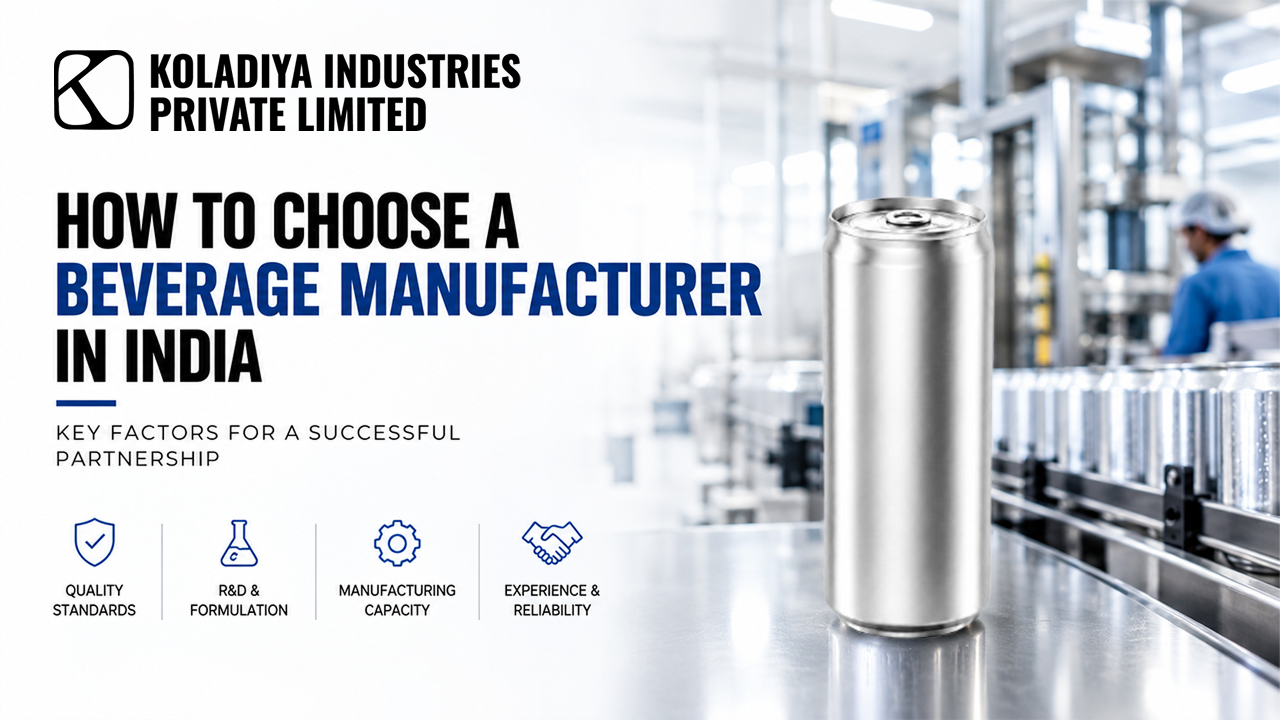
India’s beverage market is growing fast, driven by energy drinks, functional beverages, craft sodas, juices, and ready-to-drink teas. For new and established brands alike, that growth makes launching a product easier. It also makes it easier to pick the wrong production partner. The manufacturer you choose affects your product quality, margins, launch timeline, and brand reputation. A weak partner can mean inconsistent batches, missed deadlines, hidden costs, and compliance trouble. Learn how to select the right beverage manufacturer in India by evaluating costs, MOQs, quality, capabilities and production support.
Why Your Choice of Beverage Manufacturer Matters
Most brands don’t own a factory. They rely on a contract beverage manufacturer to handle formulation, production, filling, packaging, and quality control. That reliance carries real risk:
- Quality: Your customers will never see the factory. They only taste the product.
- Cost: A low quote can turn expensive once setup fees, minimums, and packaging surcharges appear.
- Speed: A slow or disorganized partner can delay your launch by months.
- Compliance: If your manufacturer cuts corners on licensing or labeling, your brand carries the consequences.
Taking the time to evaluate manufacturers up front is the cheapest risk management you can do.
Step 1: Define What You Need Before You Contact Anyone
Manufacturers can only give accurate quotes when you give them clear requirements. Before you reach out, decide:
- Product type: Carbonated soft drinks, energy drinks, juices, flavored water, iced tea, functional or sports drinks?
- Packaging format: PET bottles, glass bottles, aluminum cans, pouches, or cartons?
- Volume: What is your first order, and what do you expect in year one?
- Formulation status: Do you have a recipe, or do you need help developing one?
- Target market: Domestic, export, or both?
- Budget and timeline: What is your launch window, and what cost per unit works for your margins?
Having these answers ready also helps you spot manufacturers who ask good questions in return. That is usually a sign of experience.
Step 2: Verify Licenses, Certifications, and Compliance
This is the non-negotiable step. A professional beverage manufacturing company in India should be able to show you current documentation without hesitation.
Ask for:
- FSSAI license: A valid manufacturing license issued under India’s food safety authority.
- GMP and HACCP compliance: Good Manufacturing Practices and hazard analysis systems.
- ISO or food safety certifications: Standards such as ISO 22000 indicate structured quality management.
- Export-related documentation: If you plan to sell overseas, ask about experience with export labeling, documentation, and destination-market requirements.
- Water and lab testing practices: Water quality is the foundation of any beverage.
If a manufacturer is vague about compliance, move on. No price advantage is worth regulatory risk.
Step 3: Check Their Category Expertise
Not every factory is built for every beverage. Producing carbonated drinks, hot-fill juices, and energy drinks each requires different equipment, processes, and know-how.
Ask specific questions:
- Have you produced beverages in my category before?
- What filling technology do you use, such as carbonated lines, hot-fill, or aseptic?
- Can you handle my packaging format?
- Can you share references or examples of similar projects?
A manufacturer who claims they can make “everything” without detail deserves a closer look. Look for a partner whose strengths match your product.
Step 4: Evaluate Their R&D and Formulation Support
If you don’t have a finished recipe, a manufacturer’s development capability becomes critical. This is where the difference between contract manufacturing and true OEM/ODM partnership shows.
- OEM (Original Equipment Manufacturing): The manufacturer produces your formula to your specifications.
- ODM (Original Design Manufacturing): The manufacturer develops the formulation for you, often from a library of tested bases and flavors.
Good questions to ask:
- Do you have an in-house R&D team or food technologists?
- How many sample rounds are included, and what do additional rounds cost?
- Can you adjust sweetness, carbonation level, color, and functional ingredients?
- Who owns the final formula?
That last question matters more than most founders realize. Get the answer in writing.
Step 5: Understand MOQ and Pricing Transparency
Minimum order quantity (MOQ) is one of the biggest factors for startups and growing brands. MOQs vary widely by product type, packaging, and the manufacturer’s line setup.
Ask for a complete cost breakdown, not just a per-unit price. Make sure you understand:
- Cost of liquid or formulation
- Packaging materials (bottles, caps, labels, cartons)
- Filling and production charges
- One-time costs such as development, sampling, and label or mold setup
- Storage and logistics charges
- Payment terms and advance requirements
Beware of quotes that look dramatically cheaper than others. Low pricing often means lower-grade ingredients, thin packaging, or fees that appear later.
Step 6: Inspect Their Quality Control Process
Consistency is what builds a beverage brand. Customers need batch number 500 to taste exactly like batch number one.
Ask to see how the manufacturer manages quality at each stage:
- Incoming material checks: How are raw materials, sweeteners, flavors, and packaging inspected?
- In-process testing: Are Brix, pH, carbonation, and fill levels monitored during production?
- Finished product testing: Do they test for microbiological safety and shelf stability?
- Batch records and traceability: Can they trace any bottle back to its production batch?
- Retained samples: Do they keep samples from each batch?
A manufacturer with strong QC will describe their process confidently and show you the records.
Step 7: Look at Packaging and Supply Chain Capability
Packaging problems cause more production delays than most brands expect. Ask whether the manufacturer:
- Sources packaging themselves or requires you to supply it
- Has reliable relationships with bottle, can, and label suppliers
- Can support custom shapes, closures, and label designs
- Handles shrink wrapping, cartoning, and palletizing
A manufacturer with an established supplier network can save you weeks and help you avoid shortages.
Step 8: Assess Scalability
Your first order is rarely your last. Choose a partner who can grow with you.
- Can they increase capacity if demand doubles or triples?
- How many production lines do they run, and what is their monthly capacity?
- How do they prioritize clients during peak seasons like summer?
Switching manufacturers mid-growth is costly and risky. It is far better to start with a partner who can handle your future volume.
Step 9: Consider Location and Logistics
India’s beverage manufacturing hubs are spread across states, and location affects both your costs and your delivery times.
Gujarat, for example, offers a strong industrial base, good connectivity, and access to major ports, which is useful for brands that plan to export. Surat in particular benefits from road, rail, and port connectivity in the region.
When comparing locations, think about:
- Distance to your primary markets
- Access to ports for export shipments
- Freight and warehousing costs
- Local availability of raw materials and packaging suppliers
Step 10: Test Their Communication and Transparency
How a manufacturer behaves during the sales process is a preview of how they will behave once you are a client. Pay attention to:
- Response time: Do they answer questions promptly and clearly?
- Honesty: Do they say “no” when something isn’t possible, or promise everything?
- Documentation: Do you get written quotes, timelines, and specifications?
- Single point of contact: Is there someone accountable for your project?
A manufacturer who is hard to reach before you sign will be harder to reach after.
Step 11: Visit the Facility or Request a Virtual Tour
Nothing replaces seeing the operation yourself. During a visit, notice:
- Overall cleanliness and organization
- Condition of equipment and production lines
- Staff hygiene practices
- Storage conditions for raw materials and finished goods
- Whether the facility matches what was presented to you
If you can’t visit in person, ask for a live video walkthrough. A confident manufacturer will welcome the request.
Step 12: Review the Contract Carefully
Before you commit, make sure your agreement covers:
- Formula ownership and confidentiality: Your recipe should stay yours.
- Non-compete and exclusivity terms: Clarify whether the manufacturer can produce similar products for others.
- Quality specifications and rejection terms: What happens if a batch fails to meet standards?
- Lead times and delivery commitments
- Payment schedule and pricing review terms
- Liability and recall responsibility
Have a legal professional review the agreement before signing.
Red Flags to Watch For
Walk away or proceed with caution if a manufacturer:
- Refuses to share licenses or certifications
- Won’t allow a facility visit or tour
- Gives vague answers about MOQ, pricing, or timelines
- Pressures you to pay large advances quickly
- Claims expertise in every beverage category
- Has no clear process for sampling, QC, or batch records
- Is unclear about who owns the formulation
Quick Checklist: Evaluating a Beverage Manufacturer in India
| Criteria | What to Look For |
|---|---|
| Licensing | Valid FSSAI license, GMP/HACCP compliance |
| Category fit | Proven experience in your beverage type |
| R&D support | In-house formulation, clear sampling process |
| Pricing | Full cost breakdown, no hidden fees |
| MOQ | Realistic for your stage and growth plan |
| Quality control | Documented testing and batch traceability |
| Packaging | Established supplier network, format flexibility |
| Scalability | Capacity to grow with your demand |
| Communication | Clear, prompt, and honest |
| Contract terms | Formula protection and defined responsibilities |
Why Brands Choose Koladiya Industries
Koladiya Industries is a beverage manufacturing company based in Surat, Gujarat, working with brands as a white label, private label, and OEM/ODM partner. We support founders and established companies from first concept through production, helping them turn an idea into a market-ready beverage.
What working with us looks like:
- End-to-end support: Formulation, sampling, production, and packaging coordination under one roof.
- Flexible partnership models: Bring your own formula or develop one with our team.
- Startup-friendly approach: We help new brands plan realistic first orders and grow from there.
- Transparent communication: Clear quotes, defined timelines, and a dedicated point of contact.
- Domestic and export focus: Experience supporting brands in India and overseas markets.
We believe the best manufacturing relationships start with honest conversations, which is why we welcome your questions about our process, capabilities, and facility.
Ready to Start Your Beverage Project?
Choosing the right partner is the most important decision you will make when launching a beverage brand. If you’re comparing options, we’d be glad to help you think through your product, packaging, and production plan.
Talk to the team at Koladiya Industries. Share your product idea, target volume, and timeline, and we’ll respond with a clear, no-pressure plan for bringing your beverage to market.
[Request a Quote] | [Contact Us]
FAQs
How much does it cost to manufacture a beverage in India?
Cost depends on your product type, packaging, formulation, and order volume. The main components are the liquid or formulation, packaging materials, filling and production charges, and one-time setup costs. Ask for a full written cost breakdown so no fees surprise you later.
What is the minimum order quantity (MOQ) for beverage manufacturing in India?
MOQ varies by manufacturer, beverage type, and packaging format. Carbonated drinks, juices, and energy drinks each have different production requirements. Startups should look for manufacturers who offer realistic first-order quantities and a clear path to scale as sales grow.
What is the difference between OEM and ODM beverage manufacturing?
With OEM, the manufacturer produces your own formula to your specifications. With ODM, the manufacturer develops or supplies the formulation, and you put your brand on it. ODM is usually faster and easier for new brands without a recipe. OEM gives you more control over the formula.
Can a startup launch a beverage brand without owning a factory?
Yes. Most successful beverage brands start with a contract, private label, or white label manufacturer. You focus on branding, sales, and distribution, while the manufacturer handles formulation, production, filling, and packaging. This removes the heavy cost of building your own plant.
How long does it take to launch a beverage product with a manufacturer?
Timelines depend on whether you need custom formulation, new packaging, and label design. Using an existing formula and standard packaging is typically faster than building everything from scratch. Ask every manufacturer for a written timeline covering sampling, approval, production, and delivery.
How do I protect my beverage formula when working with a manufacturer?
Sign a confidentiality (NDA) agreement and a manufacturing contract that clearly states who owns the formula. Also clarify non-compete and exclusivity terms, so the manufacturer cannot make a similar product for others. Have a legal professional review the agreement before you sign.