Launching a beverage brand requires more than an attractive product concept and appealing packaging. Before investing in production, founders must understand how much each can will cost to manufacture, package, store, and distribute. Without an accurate cost estimate, even a promising beverage brand may struggle to maintain healthy profit margins. For energy drink startups, cost planning becomes especially important because formulations may include caffeine, taurine, vitamins, minerals, sweeteners, flavour systems, and carbonation. In addition, aluminium cans, quality testing, production volumes, and distribution requirements can significantly influence the final product cost.
Therefore, calculating Beverage Cost Per Can before launch helps founders establish suitable pricing, evaluate manufacturing partners, plan budgets, and determine whether their products can compete in the market. For startups working with a beverage contract manufacturer such as Koladiya Industries, a structured costing process can also support more informed decisions about formulation, packaging, minimum order quantities, and commercial production.
Why Beverage Cost Per Can Matters Before Launch
A beverage’s manufacturing cost directly influences its pricing strategy, profitability, and ability to scale. Consequently, founders should estimate production costs before confirming their launch budget. For example, a beverage that costs ₹15 per can to produce may appear profitable at a selling price of ₹30. However, distribution expenses, retailer margins, promotional discounts, taxes, and other business costs can reduce the actual profit considerably.
Moreover, energy drinks often require careful ingredient selection and specialised formulation decisions. A premium energy drink containing multiple functional ingredients may cost considerably more to produce than a standard carbonated soft drink.
Accurate costing helps beverage brands:
- Set realistic selling prices and target margins.
- Compare different formulations and packaging options.
- Evaluate contract manufacturing quotations.
- Estimate the investment required for the first production run.
- Identify opportunities to reduce costs without compromising product quality.
- Plan future production increases with greater confidence.
Ultimately, a detailed cost sheet gives founders a clearer picture of the financial requirements involved in launching a beverage brand.
Beverage Cost Per Can: Understand the Main Cost Components
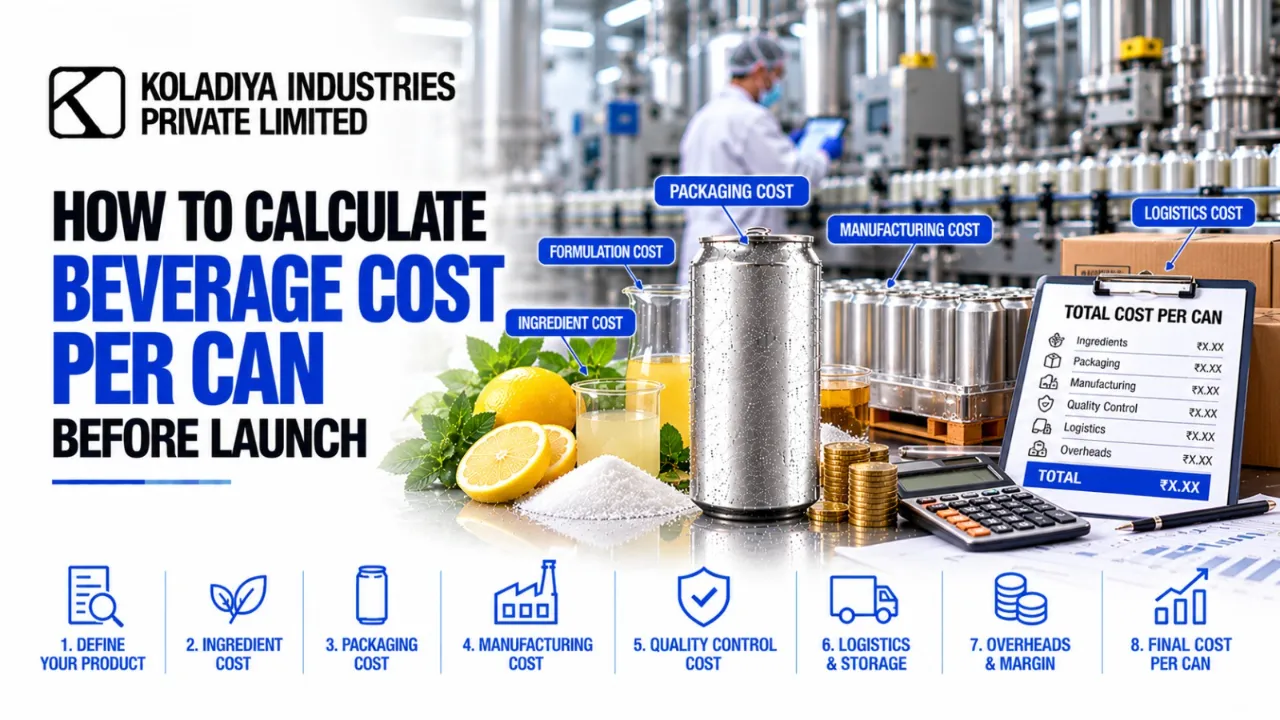
Before calculating the total cost, divide the expenses into clear categories. This approach makes it easier to identify the largest cost drivers and assess where savings may be possible.
1. Beverage Ingredients and Formulation
Ingredients represent a major component of beverage manufacturing costs. Depending on the product concept, an energy drink formulation may contain water, sugar or alternative sweeteners, acidity regulators, flavorings, caffeine, taurine, vitamins, and other functional ingredients.
However, ingredient prices vary according to quality, supplier, order quantity, specification, and availability.
For example, a zero-sugar energy drink may require a specialised sweetener system to achieve the desired taste without added sugar. Similarly, a premium energy drink with additional vitamins or botanical extracts may require more expensive ingredients.
Include the following in your ingredient estimate:
- Base ingredients and sweeteners.
- Flavours and acidity regulators.
- Caffeine and other permitted functional ingredients.
- Vitamins, minerals, and specialised ingredients.
- Ingredient handling and applicable preparation costs.
Furthermore, account for formulation trials and development expenses separately. You can either treat these as initial launch investments or allocate an appropriate portion to each can when calculating a fully loaded product cost.
2. Packaging Costs
Packaging can significantly influence the cost of each finished can, particularly for brands that use printed aluminium cans or specialised packaging formats.
Typical packaging expenses include:
- Aluminium cans and matching ends.
- Labels or printed packaging, where applicable.
- Cartons, trays, and shrink wrapping.
- Pallets and protective transport materials.
- Packaging setup charges or printing-related minimums.
For instance, a standard 250 ml aluminium can may have a different cost from a 330 ml can, depending on the specification, supplier, order quantity, and decoration method.
Therefore, obtain packaging quotations based on the intended can size and required order volume. Also, review minimum purchase quantities because unused packaging can tie up working capital even when it does not immediately increase the cost of the cans already produced.
3. Manufacturing and Processing Costs
Manufacturing expenses cover the activities required to turn ingredients and packaging into finished beverages.
These costs may include blending, water treatment, carbonation, filling, can seaming, line operation, cleaning, labour, utilities, and production equipment usage.
Energy drinks may require particular processing controls to maintain product consistency and meet the formulation’s quality requirements.
When assessing a contract manufacturer’s quotation, clarify which services the quoted rate includes. For example, a per-can manufacturing charge might cover filling and packing but exclude ingredients, packaging, testing, or transportation.
Consequently, compare quotations on a like-for-like basis rather than selecting a manufacturer solely because the initial per-can rate appears lower.
4. Quality Testing and Compliance
Quality assurance helps beverage brands evaluate product consistency, safety, stability, and suitability for the intended market.
Depending on the formulation and production process, testing expenses may include microbiological analysis, physicochemical testing, ingredient verification, shelf-life studies, and packaging-related checks.
Energy drink brands should also assess applicable requirements for caffeine content, ingredient declarations, nutritional information, and product labelling.
Some testing expenses occur once during development, whereas others apply to individual batches or production schedules. Therefore, separate one-time costs from recurring production expenses before including them in your cost calculation.
5. Logistics, Storage, and Additional Expenses
The cost of a beverage does not stop when the production line releases the finished product. Warehousing, transportation, handling, and damage during distribution can also influence the final commercial cost.
Additionally, consider production wastage, quality rejects, sample cans, and other losses associated with manufacturing.
If your business operates through multiple distribution channels, calculate channel-specific expenses separately. For example, the cost of delivering products directly to a distributor may differ from the cost of fulfilling smaller orders across multiple retail locations.
How to Calculate Beverage Cost Per Can: The Core Formula
Once you identify the relevant expenses, use a straightforward calculation to estimate the cost of each finished can.
Beverage Cost Per Can = Total Allocated Production Costs ÷ Saleable Cans Produced
Your total production costs should include all applicable ingredient, packaging, manufacturing, testing, and production-related expenses. Add allocated development costs or other launch expenses when you want to estimate a fully loaded cost rather than a production-only cost.
For example, suppose a production run costs ₹3,00,000 and produces 20,000 saleable cans.
Beverage cost per can = ₹3,00,000 ÷ 20,000
Estimated production cost = ₹15 per can
This calculation assumes that the ₹3,00,000 includes the expenses you intend to measure and that 20,000 cans meet your saleable-product criteria.
Importantly, use saleable output rather than the planned production quantity if rejects or losses reduce the number of cans available for sale.
Beverage Cost Per Can Example for a 250 ml Energy Drink
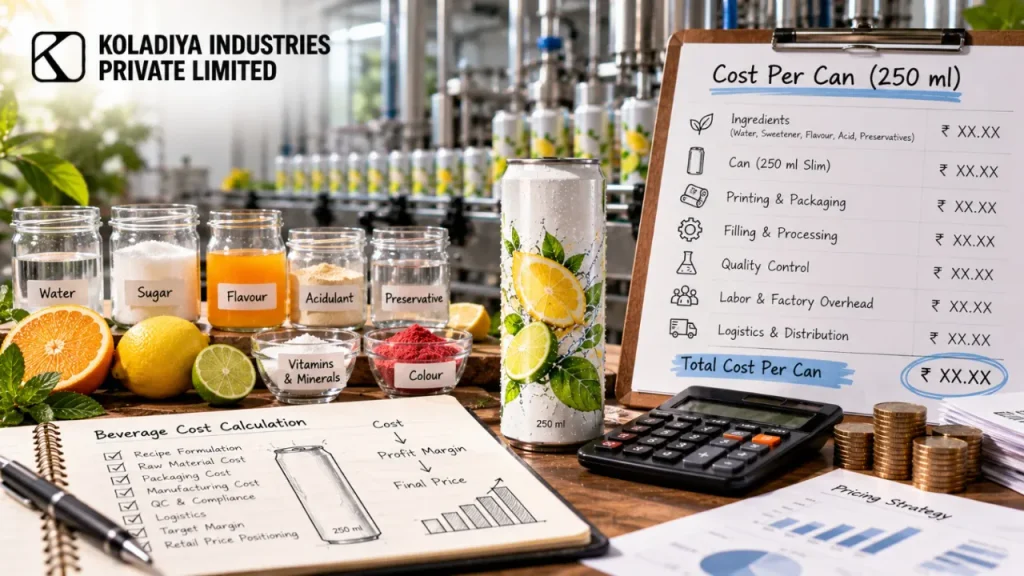
Consider a hypothetical startup developing a 250 ml energy drink in aluminium cans. The following example shows how different expenses contribute to its estimated production cost.
| Cost component | Illustrative cost per can |
|---|---|
| Ingredients and formulation inputs | ₹4.50 |
| Aluminium can and can end | ₹3.00 |
| Secondary packaging | ₹1.00 |
| Manufacturing and filling | ₹2.00 |
| Quality testing allocation | ₹0.50 |
| Wastage and production allowance | ₹0.75 |
| Total estimated production cost | ₹11.75 |
These figures are illustrative planning assumptions, not a supplier quotation or an estimate of Koladiya Industries’ actual rates. Actual costs can vary according to formulation, production volume, packaging specifications, testing requirements, and manufacturing arrangements.
In this example, the startup would budget approximately ₹11.75 per can for the listed production expenses.
However, the figure does not automatically include every expense required to sell the product. Freight, warehousing, sales commissions, advertising, applicable taxes, distributor margins, and retailer margins may need separate treatment.
Therefore, the founder should develop a complete commercial model before finalizing the retail price.
How Energy Drink Formulation Affects Beverage Cost Per Can
Energy drink brands often need to balance product differentiation, flavour, ingredient functionality, and manufacturing economics.
Choose Ingredients According to Your Product Positioning
A mainstream energy drink, a premium functional energy drink, and a zero-sugar energy drink can have different ingredient requirements.
For example, premium flavours, specialised sweeteners, botanical extracts, vitamins, and additional functional ingredients may increase formulation costs. Nevertheless, a higher ingredient cost can make commercial sense when it supports a clear product proposition and a suitable target market.
Compare alternative ingredient systems during product development instead of choosing ingredients solely by their purchase price.
Evaluate Can Size and Packaging Specifications
A 250 ml energy drink and a 500 ml energy drink have different liquid volumes and may require different packaging specifications. However, doubling the volume does not necessarily double the total cost because some packaging and production expenses vary differently with can size.
Therefore, assess ingredient consumption, can prices, filling requirements, and secondary packaging for every proposed format.
Review Minimum Order Quantities
Manufacturing volume can influence the cost per can. Larger production runs may spread certain setup, testing, and development expenses across more units. Nevertheless, larger orders also require more working capital and can increase storage requirements.
For a new energy drink brand, the best production quantity should balance unit economics with realistic sales forecasts, shelf life, and inventory risk.
How to Set a Selling Price After Calculating Beverage Cost Per Can
Once you estimate the production cost, build a pricing model that reflects the full business structure.
Suppose your production cost equals ₹15 per can. A selling price of ₹25 does not necessarily generate a ₹10 profit because other expenses may apply before the business earns a net profit.
First, estimate transportation, warehousing, marketing, commissions, and other costs that your business bears. Next, identify applicable taxes and the margins required by distributors and retailers. Finally, evaluate the price against your brand positioning and competitors.
Also, distinguish between markup and gross margin.
Markup measures profit relative to cost, whereas gross margin measures profit relative to selling revenue.
For example, if a product costs ₹15 and sells directly for ₹25 before other expenses and applicable taxes, the difference is ₹10. The gross margin on that sale is 40%, while the markup on cost is approximately 66.7%.
However, this simple calculation does not represent the final margin across a distribution chain. Always calculate margins using the actual selling price and costs at each stage.
Common Beverage Costing Mistakes to Avoid
Even a detailed estimate can become unreliable when founders overlook important expenses.
Ignoring wastage: Production losses, rejected cans, and samples can reduce saleable output. Include a realistic allowance based on production data or an agreed manufacturing estimate.
Comparing incomplete quotations: One manufacturer may quote for filling only, while another includes ingredients and packaging. Confirm the scope before comparing rates.
Overlooking development expenses: Formulation trials, pilot batches, and shelf-life testing may add to the launch investment. Decide whether to show these costs separately or allocate them across projected sales.
Ordering excessive packaging: Large packaging commitments can reduce the apparent unit price but tie up cash in inventory. Evaluate total purchasing requirements and realistic demand.
Setting retail prices using production cost alone: Distribution, retailer margins, promotional offers, and other selling expenses can materially reduce the amount your business retains.
By addressing these issues early, founders can develop a more realistic financial plan and reduce unexpected costs after launch.
How Koladiya Industries Can Support Beverage Cost Planning
For beverage startups, working with an experienced manufacturing partner can help clarify the practical requirements of product development and commercial production.
Koladiya Industries supports beverage brands in exploring manufacturing solutions and contract production options tailored to their product concepts and business requirements. When planning an energy drink launch, founders should discuss their formulation concept, target can size, expected order volume, packaging preferences, quality requirements, and projected launch schedule with their prospective manufacturing partner.
This discussion can help establish which activities the manufacturing quotation covers and which expenses require separate budgeting.
Furthermore, a structured costing review can help founders compare formulation options, assess production quantities, and identify the information they need before committing to a launch.
The final cost will depend on the actual product specification, supplier terms, production requirements, and commercial agreement. Therefore, use preliminary calculations as planning tools and confirm the final figures through detailed quotations.
Plan Your Beverage Launch With Confidence
Calculating Beverage Cost Per Can before launch helps you make informed decisions about formulation, packaging, manufacturing, and pricing. For energy drink startups, a detailed cost breakdown is especially valuable because functional ingredients, aluminium packaging, testing, and production volumes can all influence profitability.
Rather than relying on a single estimated rate, build a complete costing model, verify supplier quotations, and account for the costs involved in bringing the product to market.
Planning to launch an energy drink or another beverage brand? Contact Koladiya Industries to discuss your beverage manufacturing requirements, explore suitable production options, and take the next step towards turning your product concept into a market-ready beverage.
FAQ’s:
How do I calculate the cost of an energy drink per can?
Add the relevant production expenses and divide the total by the number of saleable cans. Include ingredients, aluminium cans, secondary packaging, filling, testing, and applicable production allowances.
What affects energy drink manufacturing costs?
Key factors include formulation, sweeteners, caffeine and other ingredients, can size, packaging specifications, production volume, quality testing, and manufacturing requirements.
Does beverage cost per can include transportation?
Not always. Some costing models include outbound freight and warehousing, while others calculate production cost separately. Define the scope clearly before comparing supplier quotations or setting prices.
How does production volume affect beverage cost per can?
Higher volumes may spread certain setup and development expenses across more units. However, larger orders require more capital and storage, so founders should balance unit costs against expected demand.
Should I include formulation and testing costs in my calculation?
Yes, when you want to understand the full cost of launching a product. You can list one-time development expenses separately or allocate them across a realistic projected sales volume.
Can Koladiya Industries help with energy drink manufacturing planning?
Koladiya Industries is a relevant manufacturing partner for beverage businesses exploring production requirements. Contact the company to discuss your energy drink concept, packaging preferences, expected order volume, and requirements for a production quotation.