Beverage can seaming plays a crucial role in protecting product quality, maintaining freshness, and ensuring packaging safety. For beverage brands, particularly energy drink manufacturers, a properly sealed can helps prevent leakage, contamination, and product deterioration throughout storage, transportation, and distribution. Even a small defect in the can seam can compromise packaging integrity and affect consumer confidence. As demand for canned energy drinks, functional beverages, sparkling drinks, and ready-to-drink products continues to grow, manufacturers must pay close attention to can seaming quality. Therefore, understanding the seaming process, identifying common defects, and implementing effective quality control measures can help beverage brands maintain consistent production standards.
For businesses working with a beverage manufacturing partner such as Koladiya Industries, understanding these technical requirements can support better decisions when developing and scaling canned beverage products.
What Is Beverage Can Seaming?
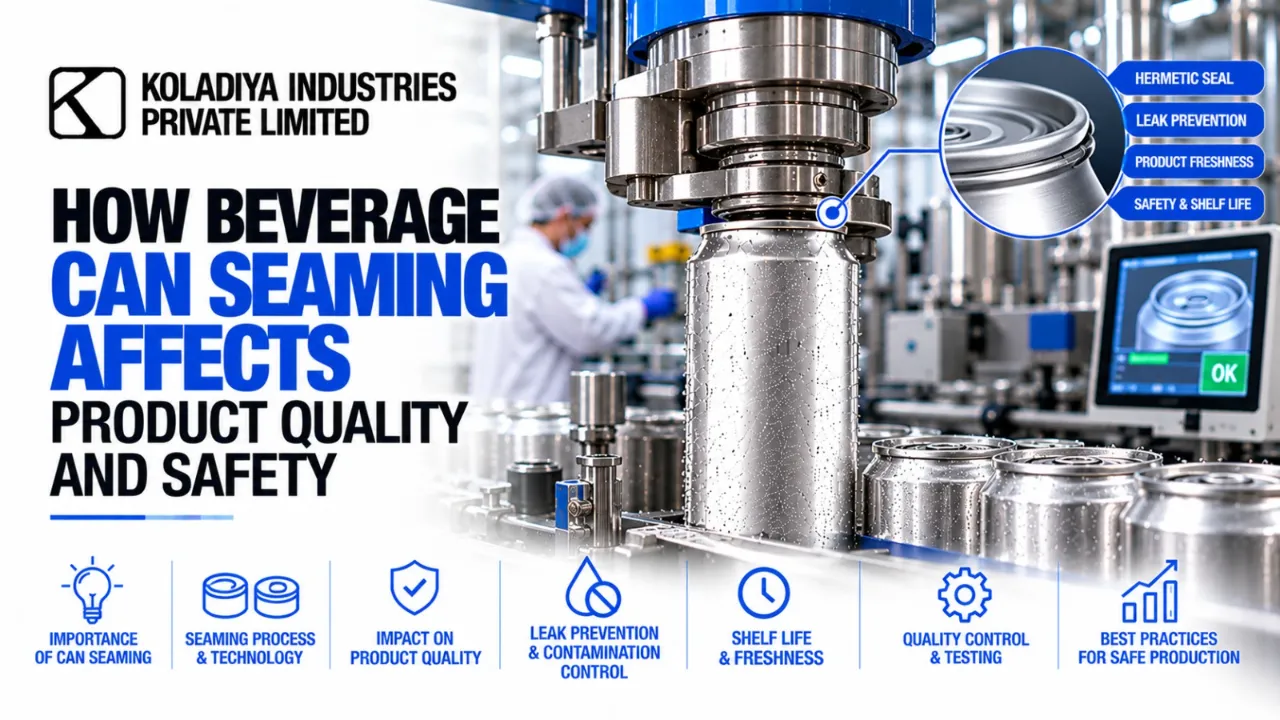
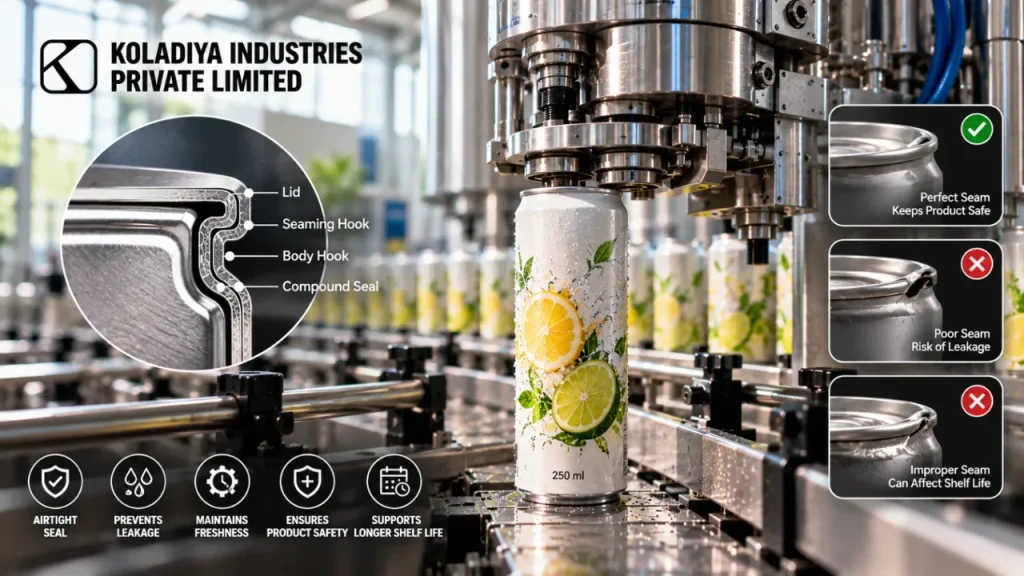
Beverage can seaming is the mechanical process of joining a can body to its end, commonly called the can lid or can end. The process forms a double seam by interlocking the metal layers of the can body and end. This connection creates a secure closure that helps protect the beverage from external contamination and product loss.
In beverage production, manufacturers use specialised seaming equipment to create consistent seams at high production speeds. However, achieving a reliable seal requires the correct machine settings, suitable packaging materials, and regular inspection.
For energy drinks, these requirements become particularly important because many formulations contain dissolved carbon dioxide, acids, sweeteners, caffeine, flavouring ingredients, or other functional components. Consequently, manufacturers must select compatible packaging and validate the seaming process for the specific product.
Beverage Can Seaming and Its Impact on Product Quality
1. Beverage Can Seaming Prevents Leakage
One of the primary purposes of beverage can seaming is to prevent leakage. A properly formed seam keeps the can securely closed during filling, handling, storage, and transportation.
Nevertheless, incorrect machine settings, worn tooling, or inconsistent can dimensions can produce defective seams. These defects may allow liquid to escape, creating product waste and increasing the risk of external contamination.
For energy drink brands, leakage can also damage cartons, shipping cases, retail displays, and other packaged products. Therefore, manufacturers should monitor seam quality throughout production rather than relying only on final packaging inspections.
2. Beverage Can Seaming Helps Preserve Freshness
A reliable seam helps maintain the intended packaging barrier and limits unwanted exposure to the external environment. This protection supports product freshness and helps manufacturers maintain consistent beverage characteristics.
For example, energy drinks may contain flavour compounds that gradually change when exposed to oxygen. A compromised closure can increase the risk of oxidation, which may affect flavour, aroma, and overall product quality.
However, seam integrity alone does not guarantee freshness. The final product’s quality and shelf life also depend on ingredient stability, oxygen exposure, processing methods, storage temperatures, and the protective coating inside the can.
3. Beverage Can Seaming Maintains Carbonation
Carbonated energy drinks and sparkling functional beverages depend on appropriate pressure retention. A defective seam may allow carbon dioxide to escape, reducing carbonation and changing the consumer’s drinking experience.
Consequently, manufacturers should pay particular attention to seam formation when packaging carbonated energy drinks. The packaging system must withstand the expected internal pressure under normal distribution and storage conditions.
Furthermore, manufacturers should evaluate carbonation levels, filling conditions, headspace, and packaging specifications together. This integrated approach helps maintain product consistency from the production line to the consumer.
4. Beverage Can Seaming Supports Product Safety
Packaging integrity plays an important role in beverage safety because a damaged closure may allow unwanted substances or microorganisms to enter under certain conditions.
The actual risk depends on the beverage formulation, acidity, processing method, storage conditions, and the nature of the defect. Therefore, manufacturers should never treat a visibly acceptable seam as the only evidence of product safety.
Instead, they should combine seam inspections with appropriate hygiene controls, validated processing procedures, ingredient management, and product-specific shelf-life testing.
Common Beverage Can Seaming Defects
Understanding common seam defects helps manufacturers identify potential problems before they affect large production batches.
1. Loose or Incomplete Seams
A loose or incomplete seam may fail to provide the required closure integrity. Incorrect settings, damaged tooling, or inconsistent material dimensions can contribute to this problem.
Manufacturers should inspect seam formation regularly and verify that the seam meets the specifications established for the selected can and end combination.
2. False Seams
A false seam occurs when the can body and end fail to interlock correctly in a section of the closure. Although the defect may appear difficult to identify visually, it can compromise the seal.
Therefore, operators should follow established inspection procedures and use suitable measurement methods to detect potential defects.
3. Wrinkled Seams
Wrinkles can develop when the metal layers fail to form the intended seam profile. Depending on their severity and location, these wrinkles may compromise closure integrity.
To reduce the risk, manufacturers should monitor seaming roll condition, machine alignment, and the consistency of incoming packaging components.
4. Sharp Seams and Mechanical Damage
Sharp edges, excessive seam deformation, or other physical irregularities may indicate incorrect seaming conditions. Such defects can also complicate handling and packaging inspection.
Routine equipment maintenance and systematic quality checks help manufacturers identify these issues before they cause recurring production problems.
5. Inconsistent Seam Dimensions
Variations in seam thickness, width, tightness, or other critical measurements may indicate unstable equipment settings or component variation.
For this reason, manufacturers should establish product-specific seam specifications and record inspection results. Consistent monitoring also helps quality teams identify trends before defects become widespread.
How Beverage Can Seaming Affects Energy Drink Manufacturing
Energy drink manufacturing requires careful coordination between formulation, processing, filling, and packaging. Although can seaming represents one stage of the production process, its performance directly affects the reliability of the finished package.
Beverage Can Seaming for Carbonated Energy Drinks
Carbonated energy drinks require packaging that maintains carbonation and withstands the intended internal pressure. Accordingly, manufacturers should validate seaming conditions for the specific can size, end design, beverage formulation, and filling process.
They should also consider temperature variations during storage and distribution because these conditions can influence internal pressure.
Beverage Can Seaming for Sugar-Free Energy Drinks
Sugar-free energy drinks may contain alternative sweeteners, acids, flavouring systems, caffeine, and other functional ingredients. While these ingredients do not automatically create additional seaming risks, the overall formulation can influence corrosion compatibility, product stability, and packaging requirements.
Therefore, manufacturers should assess the beverage and its packaging as a complete system rather than assuming that every energy drink requires identical specifications.
Beverage Can Seaming for High-Volume Production
As an energy drink brand expands, production lines often operate at higher speeds and handle larger batches. Under these conditions, small variations in equipment performance can affect a significant number of cans.
Consequently, manufacturers should establish routine inspection schedules, maintain seaming equipment, train production operators, and investigate recurring defects promptly.
These practices help brands maintain packaging consistency while supporting commercial production and distribution.
Best Practices for Beverage Can Seaming Quality Control
Effective quality control requires a systematic approach that combines equipment maintenance, measurement, documentation, and corrective action.
1. Calibrate and Maintain Seaming Equipment
Manufacturers should inspect seaming rolls, chucks, bearings, and other critical components according to the equipment manufacturer’s maintenance requirements. Worn or damaged components can affect seam formation and increase the risk of defects.
Moreover, operators should verify machine settings during product changeovers and after relevant maintenance activities.
2. Conduct Regular Seam Inspections
Visual inspections can identify obvious damage, but they cannot detect every internal seam defect. Therefore, manufacturers should combine visual checks with appropriate dimensional measurements and destructive seam examinations where required.
Inspection frequency should reflect production speed, packaging specifications, equipment performance, and the manufacturer’s quality procedures.
3. Monitor Packaging Component Consistency
Can bodies and ends must match the intended packaging specifications. Variations in dimensions, material condition, or component compatibility can affect seam formation.
Working with qualified packaging suppliers and verifying incoming materials can help reduce avoidable production issues.
4. Maintain Accurate Quality Records
Maintaining detailed inspection records helps manufacturers monitor seam measurements, detect recurring defects, and evaluate quality consistency across production batches.
In addition, clear records support root-cause investigations and help quality teams implement corrective actions. This process becomes especially valuable when manufacturers scale production for retail distribution.
5. Validate Packaging and Shelf Life
Manufacturers should evaluate seam integrity alongside the beverage’s formulation, processing conditions, and storage requirements. Appropriate testing can help establish whether the packaging system maintains the required performance throughout the intended shelf life.
For carbonated energy drinks, manufacturers should also assess carbonation retention and can pressure performance. Moreover, testing procedures should align with the beverage formulation, packaging specifications, and relevant quality and safety standards.
The Role of Beverage Can Seaming in Commercial Production
Reliable can seaming contributes to lower product losses, more consistent packaging, and stronger quality management. Nevertheless, manufacturers should treat it as one part of a broader production system.
A successful canned energy drink programme begins with a suitable formulation and compatible packaging components. Next, the manufacturer establishes appropriate filling and seaming parameters, verifies the process, and monitors production performance.
As a result, brands can make better-informed decisions about packaging formats, production volumes, quality requirements, and commercial expansion.
For startups, early attention to packaging integrity can also help prevent avoidable costs during product launches. Meanwhile, established beverage companies can use systematic quality monitoring to support repeatable production across larger batches.
How Koladiya Industries Can Support Beverage Manufacturing
Koladiya Industries works in the beverage manufacturing space, where formulation requirements, packaging selection, production planning, and quality management all contribute to a successful product.
For brands planning to launch or expand canned energy drinks, understanding beverage can seaming can help clarify packaging specifications and quality expectations before commercial production begins.
A well-planned manufacturing process should consider the beverage formulation, can format, filling requirements, closure integrity, production volume, and shelf-life objectives. Furthermore, clear communication between the brand and manufacturing partner can help align product expectations with practical production requirements.
Brands should discuss their specific formulation, packaging preferences, and target production volumes with their manufacturing partner to determine the appropriate process and quality checks.
Conclusion
Beverage can seaming plays a vital role in maintaining packaging integrity, preserving product quality, and supporting the safe distribution of canned beverages. From preventing leakage to helping retain carbonation, a properly controlled seaming process contributes to a consistent consumer experience.
For energy drink manufacturers, these considerations become particularly important as production volumes increase and distribution networks expand. By maintaining equipment, monitoring seam dimensions, inspecting packaging components, and validating shelf-life performance, manufacturers can reduce avoidable defects and strengthen quality control.
Ultimately, beverage can seaming should form part of an integrated manufacturing strategy that connects formulation, filling, packaging, and product safety.
Ready to Develop Your Canned Energy Drink?
Planning to launch a new energy drink or scale an existing beverage brand? Connect with Koladiya Industries to discuss your beverage concept, formulation requirements, packaging options, and commercial manufacturing needs. A well-planned production strategy can help you move from product development to commercial manufacturing with greater clarity and confidence. Contact Koladiya Industries to explore the next steps for your beverage project.
FAQ’s:
Why is beverage can seaming important for energy drinks?
It helps maintain packaging integrity, retain carbonation in carbonated products, reduce leakage, and protect product quality during storage and distribution.
What are the common beverage can seaming defects?
Common defects include false seams, loose seams, wrinkles, mechanical damage, and inconsistent seam dimensions.
How can manufacturers check beverage can seaming quality?
Manufacturers can combine visual inspections, dimensional measurements, appropriate destructive seam examinations, equipment checks, and documented quality control procedures.
Can poor beverage can seaming affect shelf life?
Yes. A defective seam can compromise the packaging barrier and contribute to leakage, contamination risks, or changes in product quality. Actual shelf life also depends on formulation, processing, and storage conditions.
Does beverage can seaming affect carbonated energy drinks?
Yes. Seam integrity helps retain carbon dioxide and maintain packaging performance under the intended internal pressure.
How can Koladiya Industries help beverage brands?
Koladiya Industries can be approached to discuss beverage manufacturing requirements, including product formulation, packaging selection, and production planning. Brands should confirm the specific services, packaging formats, and quality testing available for their project.