Launching a flavored water brand can be an attractive opportunity for beverage startups, entrepreneurs, fitness companies, wellness brands, distributors, retailers, and established FMCG businesses. However, creating a successful product requires more than choosing a flavor and printing a label. You need the right flavored water drink contract manufacturer that can support product development, formulation, testing, production, canning, packaging, quality control, and commercial scale-up.
In India, flavored water also sits within established food and beverage regulatory categories. FSSAI’s product classification includes non-carbonated water-based flavoured drinks under food category 14.1.4.2, while FoSCoS specifically recognizes manufacturing and processing businesses, including contract manufacturers and contract packers.
Consequently, choosing a capable manufacturing partner early can reduce development delays, improve product consistency, and make the transition from concept to commercial production much smoother.
What Is a Flavored Water Drink?
Flavored water is a water-based beverage developed by adding approved flavoring systems and, depending on the product concept, other permitted ingredients. It can be designed as a simple refreshing beverage or positioned around a specific consumer proposition such as hydration, low-sugar refreshment, or functional nutrition.
Depending on the formulation and market positioning, brands may explore concepts such as:
- Lemon and lime flavored water
- Orange, berry, strawberry, or mixed-fruit flavors
- Mint and herbal-inspired profiles
- Electrolyte-enhanced hydration beverages
- Vitamin-enhanced water
- Low-sugar or sugar-free concepts
- Still or carbonated flavored water
FSSAI’s food-category framework separately identifies carbonated water and non-carbonated water-based beverages, making product classification and formulation considerations important during development.
Therefore, the first step is not simply asking a manufacturer, “Can you make flavored water?” Instead, brands should explain the intended product profile, ingredients, packaging format, target consumer, market, and expected production volumes.
Why Start With a Contract Manufacturer?
Building an in-house beverage manufacturing facility can require significant investment in infrastructure, processing equipment, utilities, quality systems, technical staff, packaging operations, and compliance procedures.
For that reason, contract manufacturing can be a practical route for businesses that want to launch or expand a beverage brand without building their own factory.
A professional flavored water contract manufacturer can potentially support several stages of the project, including:
Product development: creating and refining the beverage concept.
Formulation: balancing flavor, sweetness, acidity, mouthfeel, and ingredient compatibility.
Testing: evaluating product quality, stability, and relevant specifications.
Production: manufacturing the beverage according to the approved formulation.
Canning and packaging: filling, sealing, coding, and preparing products for distribution.
Quality control: monitoring ingredients, process parameters, finished products, and documentation.
Scale-up: moving from trial quantities toward regular commercial production.
As a result, contract manufacturing allows a brand owner to focus more heavily on branding, sales, distribution, and customer acquisition while the manufacturing partner manages production activities.
Why Is Flavored Water Gaining Attention?
The flavored water category is receiving growing attention as beverage companies look beyond conventional carbonated soft drinks and bottled water. Industry research published in 2025 and updated in 2026 identifies fruit-flavored water, herbal water, caffeinated water, and enhanced water among the product segments being evaluated in India’s functional and flavored water market.
Another market analysis reports continued growth in India’s flavored water category and highlights packaging formats including bottles and cans.
More importantly for new brands, flavored water can offer room for differentiated positioning. Instead of competing solely on price, a business can build a product around flavor, packaging, lifestyle, functionality, convenience, or a clearly defined consumer audience.
For example, one brand may target everyday refreshment, while another may focus on fitness-oriented hydration. Similarly, a premium lifestyle brand may emphasize sophisticated flavors and modern can packaging.
The opportunity, therefore, is not only in the beverage itself. It is also in how the product is formulated, packaged, positioned, and distributed.
What Should You Look for in a Flavored Water Drink Contract Manufacturer?
Choosing a manufacturer is one of the most important decisions in launching a beverage brand. A low quotation may look attractive initially; however, manufacturing capability, consistency, communication, quality systems, and development support can have a much greater impact over the long term.
1. Product Development and R&D Capability
The manufacturer should understand how beverage formulation works rather than simply blending ingredients according to a fixed recipe.
Ask whether the team can support:
- Flavor selection and optimization
- Sweetness adjustment
- Acidity and pH balancing
- Ingredient compatibility
- Functional ingredient integration
- Product trials and sampling
- Scale-up from laboratory development to production
This is especially important when your beverage concept is unique or still at the formulation stage.
2. Flexible Private Label and Custom Manufacturing
Every beverage brand has different requirements. Some businesses already have a finalized formulation, while others need help developing the product from the beginning.
A capable partner should be able to discuss suitable solutions such as contract manufacturing, private label manufacturing, white label production, custom beverage development, and OEM/ODM services, depending on the project’s requirements.
As a result, you can select a manufacturing model that matches your level of technical readiness and commercial objectives.
3. Can Filling and Packaging Capability
Packaging directly affects product presentation, logistics, shelf appeal, and consumer perception.
For brands choosing cans, ask the manufacturer about:
- Available can sizes
- Filling and sealing capability
- Packaging specifications
- Coding and batch identification
- Secondary packaging
- Cartoning or case packing
- Production consistency
For example, Koladiya Industries works with B2B beverage brands on 250ml aluminium can formats, providing a route for businesses looking to develop and manufacture beverages in a compact, shelf-ready format.
4. Quality and Food Safety Systems
Quality should be evaluated before price.
A manufacturer should have a structured approach to raw material inspection, process control, sanitation, testing, traceability, and finished-product quality.
This becomes even more important as your business grows because inconsistent batches can create customer complaints, distributor issues, stock losses, and reputational damage.
FSSAI also places licensing and compliance requirements on food businesses, and its FoSCoS system provides eligibility and licensing information for manufacturing and processing operations.
5. Regulatory and Label Support
Your formulation and marketing claims must align with applicable requirements.
FSSAI’s Advertising and Claims Regulations state that food claims should be truthful, meaningful, unambiguous, and not misleading. The regulations also require advertising claims to remain consistent with information on the product label.
Therefore, when developing terms such as “low sugar,” “source of vitamins,” “electrolyte,” “natural,” or other functional or nutritional statements, brands should work with the manufacturer and relevant technical professionals to verify that the formulation and labeling support the intended claim.
This step is particularly valuable because correcting artwork or formulation after production planning has already started can create unnecessary delays and costs.
How Does Flavored Water Contract Manufacturing Work?
Although every manufacturer follows its own operating procedures, the development process usually moves through several stages.
Step 1: Share Your Product Concept
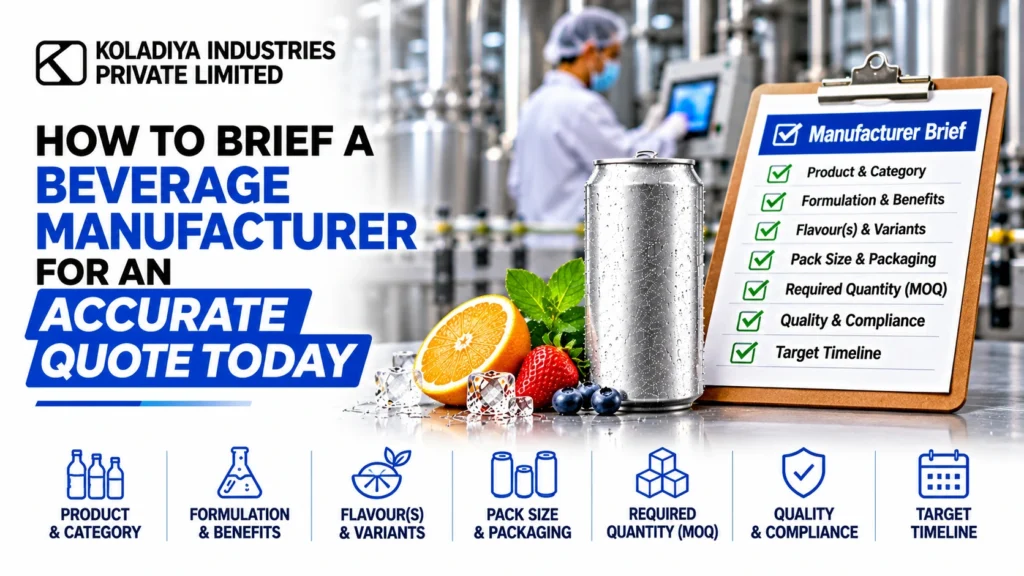
Start by explaining what you want to launch. Include the flavor profile, beverage type, target market, preferred pack size, packaging format, expected positioning, and intended sales channel.
The more precise the brief, the easier it is for the manufacturer to recommend an appropriate development pathway.
Step 2: Formulation and Product Development
Next, the formulation is developed or reviewed. The technical team works on flavor balance, sweetness, acidity, ingredient levels, processing requirements, and other product characteristics.
Samples can then be evaluated and refined.
Step 3: Testing and Approval
Once the formulation is close to the desired profile, the product can undergo appropriate testing and technical review.
At this stage, brands should also confirm specifications, labeling requirements, packaging details, and production documentation.
Step 4: Commercial Production
After approval, raw materials and packaging components are arranged for manufacturing.
The beverage is then processed, filled, sealed, coded, packed, and prepared for dispatch according to the agreed specifications.
Step 5: Scale-Up
Finally, the goal is to establish a repeatable production system.
As demand increases, your manufacturer should be able to discuss future production planning, batch scheduling, packaging requirements, and supply coordination.
What Is the MOQ for Flavored Water?
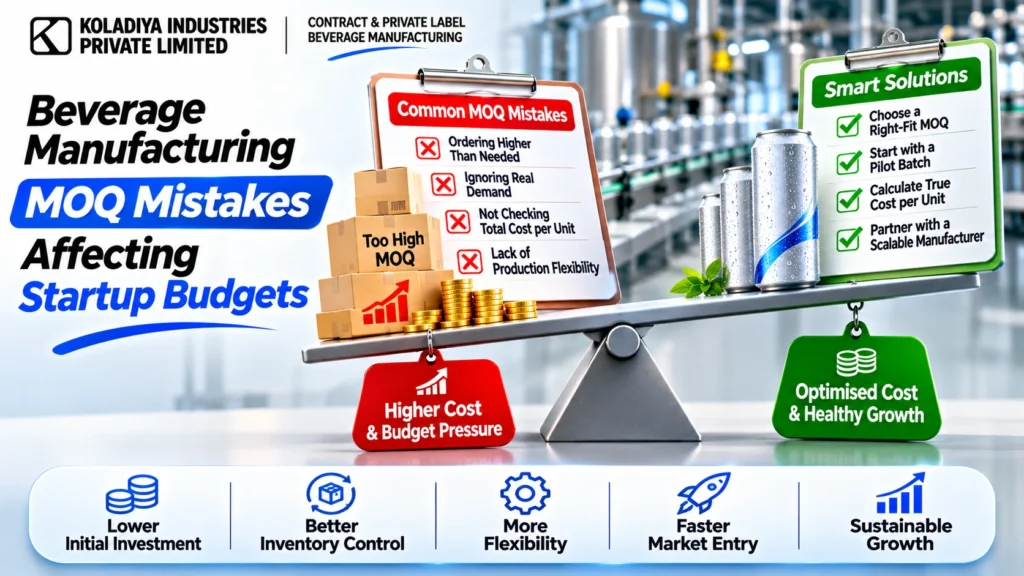
MOQ, or minimum order quantity, is one of the first questions most beverage buyers ask. However, there is no universal MOQ for every flavored water product.
The required quantity can vary depending on factors such as:
- Can size and packaging format
- Product formulation
- Number of flavors
- Packaging material
- Printed or plain packaging requirements
- Ingredient procurement
- Production scheduling
- Manufacturing line requirements
For that reason, asking only, “What is your MOQ?” may not give you the full commercial picture.
A better approach is to provide your estimated launch quantity and ask the manufacturer for the recommended minimum production volume, packaging implications, development costs, and scale-up options.
How Much Does It Cost to Manufacture Flavored Water?
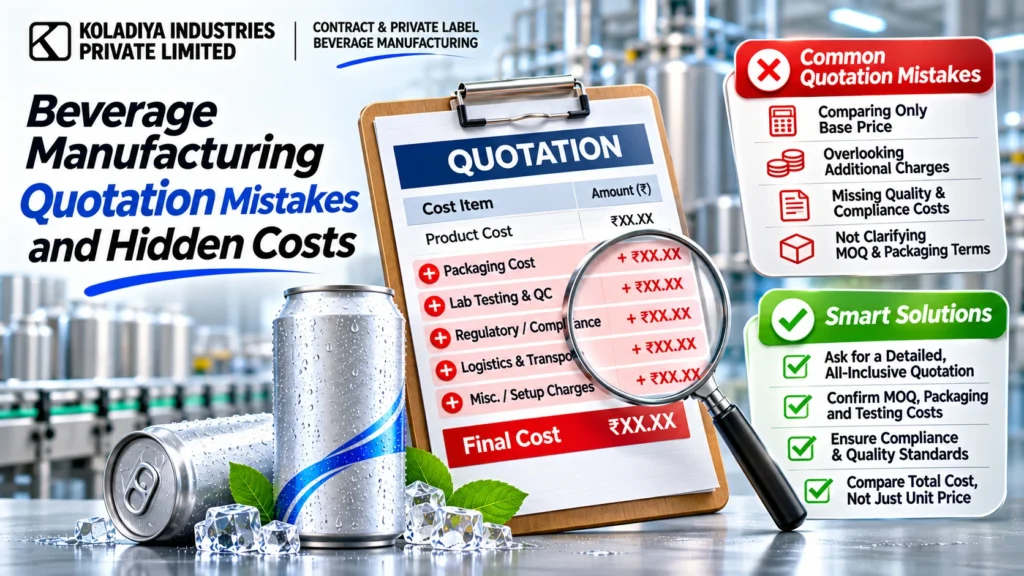
The total manufacturing cost depends on the product specification, so quoting a single generic price can be misleading.
Your final cost may be influenced by:
Ingredients: flavor systems, sweeteners, functional ingredients, acids, minerals, and other formulation components.
Packaging: can, lid, label or printed packaging, cartons, trays, and other secondary materials.
Processing: manufacturing, filling, sealing, coding, and packaging operations.
Testing and development: formulation trials, product testing, stability work, and related technical requirements.
Volume: larger production runs may produce different economics than small initial batches.
Logistics: transportation and distribution costs can also materially affect your delivered product cost.
Therefore, a serious buyer should request a detailed quotation based on the actual product specification rather than comparing manufacturers only by the headline price per can.
Can Startups Launch a Flavored Water Brand?
Yes. Contract manufacturing can make the category more accessible to startups because the business does not necessarily need to construct and operate its own beverage production facility from day one.
However, startups should still approach the project professionally.
Before placing a commercial order, prepare a clear product brief, define your target customer, establish your desired price positioning, estimate demand, finalize branding direction, and understand your expected distribution channels.
Most importantly, avoid choosing a manufacturer purely because it offers the lowest initial quotation.
The cheapest manufacturing option may not deliver the formulation support, quality consistency, packaging execution, responsiveness, or scalability your brand requires.
Who Can Use Flavored Water Contract Manufacturing?
Flavored water manufacturing can be suitable for a wide range of businesses, including beverage startups, private-label retailers, fitness and sports companies, wellness brands, restaurant and hospitality businesses, distributors, corporate brands, exporters, and established FMCG companies.
For example, a fitness business may create a hydration-focused beverage, while a distributor may develop a private-label line for regional retail networks.
Likewise, an established brand can use contract manufacturing to test a new beverage category without making an immediate investment in its own production plant.
Why Work With Koladiya Industries?
For businesses searching for a flavored water drink contract manufacturer in India, Koladiya Industries provides B2B beverage manufacturing solutions designed around brand development and commercial production. The company supports businesses with contract manufacturing, private label, white label, and OEM/ODM beverage solutions.
The objective is to help businesses move from beverage concept to finished product through coordinated development, manufacturing, packaging, and scale-up support.
Koladiya Industries is based in Surat, Gujarat, and works with beverage businesses seeking customized manufacturing solutions for modern packaged beverages. Its stated quality credentials include FSSAI, ISO 22000:2018, and FSSC 22000:2018 certifications.
For a new flavored water brand, this can create a more streamlined path from initial product discussion to commercial manufacturing.
What Information Should You Send a Manufacturer for a Quote?
To receive a more accurate quotation and reduce back-and-forth communication, provide the manufacturer with as much relevant information as possible.
Include your preferred flavor, beverage type, can or bottle size, carbonation preference, desired ingredients, sweetness direction, approximate order quantity, number of SKUs, packaging preference, target market, and expected launch timeline.
You can also ask the manufacturer whether your concept is technically suitable for the selected package format and what information is required before sample development.
As a result, you are more likely to receive a useful commercial proposal rather than a generic price estimate.
Final Checklist Before Choosing a Flavored Water Manufacturer
Before signing with a contract manufacturing partner, evaluate the entire project rather than one price figure.
Confirm the manufacturer’s product development capability, manufacturing infrastructure, packaging options, quality systems, regulatory support, MOQ, commercial pricing, lead times, communication process, and ability to scale.
Additionally, ask about sample development, documentation, testing, packaging procurement, batch traceability, and the process for handling formulation changes.
Ultimately, your manufacturing partner should function as more than a production vendor. The right partner can become an important part of your beverage brand’s development and long-term supply strategy.
Start Your Flavored Water Brand With the Right Manufacturing Partner
Launching a flavored water beverage becomes significantly easier when product development, manufacturing, packaging, and quality management are coordinated from the beginning.
Instead of searching only for the cheapest flavored water drink contract manufacturer, focus on finding a partner that understands your product concept, target market, packaging requirements, commercial goals, and future growth.
Whether you are launching your first beverage brand, adding a new SKU to an existing portfolio, or developing a private-label hydration product, the right manufacturing relationship can help turn an idea into a commercially viable beverage.
Ready to develop your flavored water brand? Contact Koladiya Industries to discuss your beverage concept, formulation requirements, packaging format, and commercial manufacturing needs.
FAQ’s
Can I create my own flavored water formula with a manufacturer?
Yes. Many manufacturers support custom beverage development, allowing brands to select flavors, sweetness levels, functional ingredients, carbonation preferences, and other product specifications. This helps create a differentiated product for the target market.
What is the MOQ for flavored water contract manufacturing in India?
MOQ varies depending on the formulation, packaging format, ingredients, production requirements, and customization level. Brands should discuss their expected volume with the manufacturer to determine a suitable production quantity and commercial plan.
Can startups launch a flavored water brand through contract manufacturing?
Yes. Contract manufacturing can help startups launch without investing in their own beverage production facility. A suitable manufacturing partner can support product development, packaging, production, and scale-up according to the brand's requirements.
Can flavored water be manufactured in aluminium cans?
Yes. Flavored water can be produced and packed in aluminium cans, depending on the product formulation, processing requirements, and packaging specifications. Cans also provide a convenient format for retail, fitness, travel, and on-the-go consumption.
What services should I look for in a flavored water manufacturer?
Look for a manufacturer offering end-to-end support, including R&D and formulation, flavor selection, ingredient sourcing, pilot development, production, can filling, packaging, quality control, documentation, and scalable manufacturing. Certifications and relevant beverage manufacturing experience are also important.
How can I start my flavored water brand with Koladiya Industries?
You can begin by sharing your beverage concept, preferred flavors, packaging format, target market, and expected quantity with Koladiya Industries. The team can then discuss product development, manufacturing, canning, packaging, and the next steps for bringing your flavored water brand to market.