Launching an energy drink brand requires more than developing an attractive flavour and eye-catching packaging. Brands must also ensure that their products maintain consistent taste, colour, aroma, carbonation, and overall quality throughout their intended shelf life. Even a promising energy drink can lose market potential when formulation problems, packaging defects, or poor storage conditions affect product stability. Energy drink shelf-life mistakes can create costly challenges for beverage startups, established brands, and manufacturers. For example, a product may develop an unexpected flavour, lose carbonation, show colour changes, or fail quality checks before reaching the end of its intended shelf life.
Therefore, beverage businesses should evaluate shelf-life requirements during product development rather than waiting until commercial production begins. Proper formulation, suitable packaging, controlled manufacturing processes, and reliable testing help brands identify risks before they affect the market. Koladiya Industries supports beverage brands with beverage formulation, flavour development, research and development (R&D), and manufacturing solutions. With the right development strategy, businesses can build energy drink products that meet their target quality and commercial requirements.
What Is Energy Drink Shelf Life?
Energy drink shelf life refers to the period during which a product maintains its intended quality under specified storage conditions. During this period, the beverage should meet applicable safety requirements and retain its expected flavour, appearance, carbonation, and other quality characteristics.
However, shelf life varies according to several factors, including:
- Ingredient selection and formulation.
- Acidity and pH management.
- Preservative selection, where permitted and appropriate.
- Carbonation level and filling conditions.
- Packaging material and container integrity.
- Manufacturing hygiene and process controls.
- Storage temperature and distribution conditions.
Consequently, brands should not assume that every energy drink has the same shelf life. Instead, they should establish a suitable shelf-life target through product-specific testing and validation.
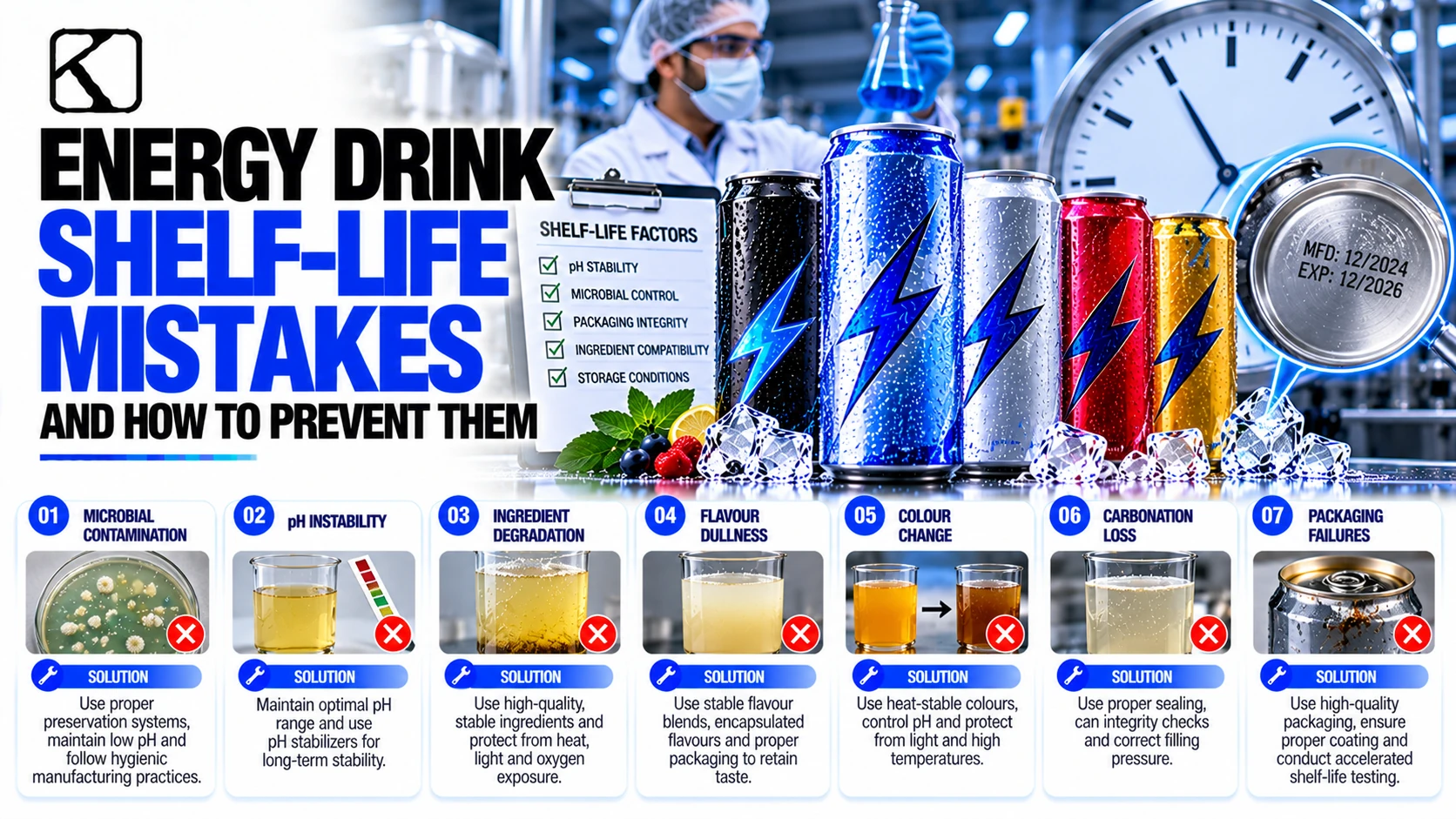
Energy Drink Shelf-Life Mistakes: Common Problems and Solutions
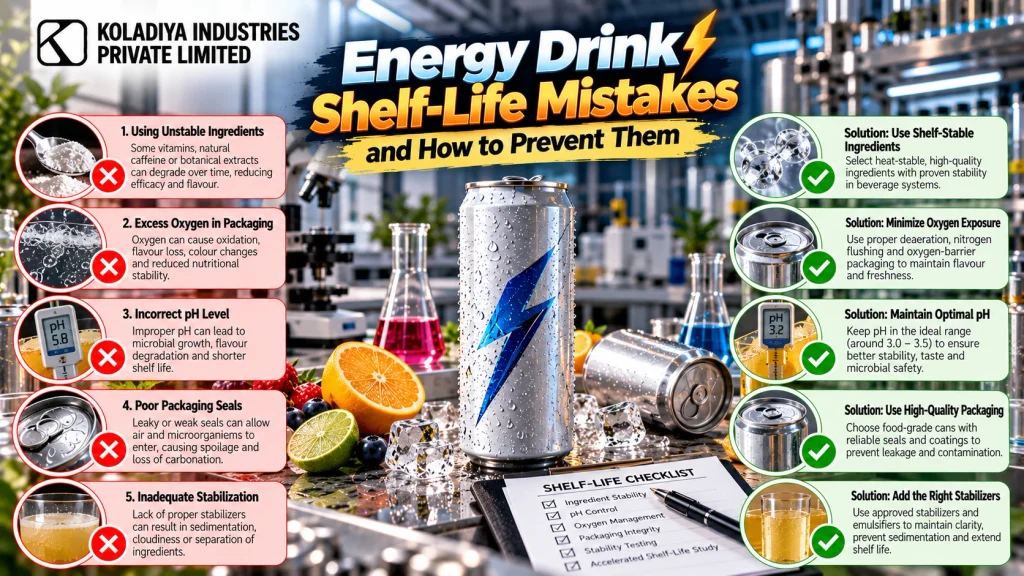
1. Energy Drink Shelf-Life Mistakes Caused by Poor Formulation
Formulation problems represent one of the most important risks during energy drink development. An energy drink may contain caffeine, sweeteners, acids, vitamins, flavoring substances, and other functional ingredients. Each ingredient contributes to the product’s overall characteristics and stability.
For instance, certain vitamins may degrade over time, while some flavour compounds may react with other ingredients or lose their intensity. In addition, poorly balanced acidity or sweetness can make flavour changes more noticeable during storage.
How to prevent this mistake:
- Select ingredients according to the beverage’s intended pH, processing conditions, and storage requirements.
- Evaluate ingredient compatibility before finalising the formulation.
- Check the stability of caffeine, vitamins, sweeteners, colours, and flavouring ingredients where relevant.
- Conduct pilot trials before moving to commercial production.
- Monitor taste, aroma, colour, and other critical quality parameters throughout testing.
Furthermore, beverage brands should work with experienced formulation specialists to identify potential stability problems early. A well-developed formula provides a stronger foundation for consistent commercial production.
2. Ignoring pH and Acidity Control
Acidity influences the flavour, stability, and microbiological characteristics of many energy drinks. If a formulation lacks appropriate pH control, the product may experience quality issues or fail to meet its intended specifications.
However, a suitable pH alone does not guarantee product safety or shelf stability. The complete formulation, processing method, packaging, and storage conditions also influence the final result.
How to prevent this mistake:
- Establish a target pH based on the formulation and applicable safety requirements.
- Measure pH with calibrated equipment during product development and production.
- Monitor acidity across pilot batches and commercial batches.
- Validate the complete manufacturing process for the intended product.
- Investigate any unexpected changes in pH or other critical quality parameters.
As a result, consistent acidity management can help brands maintain product specifications and reduce avoidable manufacturing problems.
3. Choosing the Wrong Energy Drink Packaging
Packaging does more than improve the appearance of an energy drink. It also protects the beverage against external influences and helps maintain product quality during transportation and storage.
For example, aluminium cans offer useful protection against light and provide a suitable format for many carbonated energy drinks. Nevertheless, brands must evaluate the complete packaging system, including the can lining, seams, closure integrity, and compatibility with the formulation.
An unsuitable container or defective closure can contribute to leakage, carbonation loss, corrosion, or other quality issues.
How to prevent this mistake:
- Select packaging that suits the beverage formulation and carbonation level.
- Assess compatibility between the beverage and the container’s internal lining.
- Verify can seaming and closure integrity using appropriate quality checks.
- Inspect containers for damage, leaks, and visible defects.
- Evaluate packaging performance under expected storage and distribution conditions.
Additionally, brands should assess packaging suitability during product development rather than making the final decision based solely on appearance or cost.
4. Skipping Energy Drink Shelf-Life Testing
One of the most costly energy drink shelf-life mistakes involves launching a product without sufficient stability data. A beverage may look and taste acceptable immediately after production, but its characteristics can change over time.
For example, flavour intensity may decrease, colour may shift, or carbonation may decline. Microbiological risks may also arise if the formulation or manufacturing process lacks adequate controls.
How to prevent this mistake:
- Develop a shelf-life testing plan for the final formulation and packaging.
- Evaluate samples at defined intervals throughout the proposed shelf life.
- Monitor sensory characteristics, pH, appearance, and carbonation where applicable.
- Conduct appropriate microbiological testing.
- Assess relevant chemical or physical stability parameters.
- Use real-time stability studies to support the proposed shelf life.
Accelerated stability testing can help identify potential problems more quickly. However, it does not automatically replace real-time studies or other validation required for the product.
Therefore, brands should establish shelf-life claims using documented evidence rather than assumptions or competitor comparisons.
5. Using Inconsistent Manufacturing Processes
Even a stable formulation can develop quality problems when production conditions vary between batches. Differences in ingredient measurements, mixing, carbonation, filling, sanitation, or processing can affect the final beverage.
For instance, inconsistent carbonation may change the drinking experience, while inadequate process control can introduce contamination risks. Similarly, incorrect ingredient dosing may alter flavour or cause the finished product to fall outside its specifications.
How to prevent this mistake:
- Develop clear manufacturing procedures for every production stage.
- Verify ingredient quantities and mixing parameters.
- Maintain appropriate equipment calibration and preventive maintenance.
- Establish suitable hygiene and sanitation controls.
- Monitor filling operations and packaging integrity.
- Maintain batch records and investigate deviations promptly.
Moreover, pilot-scale production helps brands identify process challenges before they commit to larger manufacturing volumes. This approach supports smoother scale-up and more consistent product quality.
6. Poor Storage and Transportation Conditions
Energy drinks may encounter temperature fluctuations, direct sunlight, humidity, and extended transportation periods before reaching retailers. These conditions can influence product quality, particularly when the formulation or packaging does not adequately protect the beverage.
For example, excessive heat may accelerate changes in flavour, colour, or certain sensitive ingredients. Meanwhile, rough handling can damage packaging and compromise container integrity.
How to prevent this mistake:
- Define appropriate storage conditions for the finished product.
- Protect products from direct sunlight and excessive heat.
- Use suitable warehousing and transportation practices.
- Inspect packaging before dispatch and during quality investigations.
- Communicate storage recommendations to distributors and retailers.
- Evaluate stability under relevant distribution conditions.
Consequently, effective supply-chain management helps preserve the quality established during product development and manufacturing.
7. Overlooking Flavour Changes During Storage
Flavour consistency is especially important for energy drinks because consumers expect the same taste from every purchase. Nevertheless, flavour compounds can change during storage because of oxidation, ingredient interactions, temperature exposure, or other formulation-related factors.
Citrus, tropical fruit, berry, and botanical flavour profiles may each present different stability challenges. Likewise, changes in sweetness or acidity can affect the overall sensory balance.
How to prevent this mistake:
- Select flavour systems suitable for the intended beverage formulation.
- Assess flavour compatibility with acids, sweeteners, colours, and functional ingredients.
- Evaluate aroma, aftertaste, sweetness, and flavour intensity during stability studies.
- Use suitable processing and packaging controls to minimise relevant degradation risks.
- Review sensory results before finalising the commercial formula.
In addition, brands should test the finished product in its intended packaging. Testing individual ingredients alone cannot fully predict the behaviour of the complete beverage.
Energy Drink Shelf-Life Mistakes: A Practical Prevention Checklist
Before launching an energy drink, brands should review the following areas:
| Quality checkpoint | Recommended action |
|---|---|
| Formulation | Verify ingredient compatibility and stability |
| pH and acidity | Establish and monitor suitable product specifications |
| Flavour | Assess sensory consistency during storage |
| Packaging | Confirm container compatibility and closure integrity |
| Manufacturing | Validate process controls and batch consistency |
| Microbiological quality | Apply appropriate testing and safety controls |
| Shelf-life studies | Document results at defined testing intervals |
| Storage and distribution | Assess expected handling and environmental conditions |
This checklist provides a starting point. Each beverage requires a product-specific quality plan based on its ingredients, processing method, packaging, and intended market.
How Koladiya Industries Can Support Energy Drink Development
Developing a commercially viable energy drink requires coordination between formulation, flavour selection, packaging, quality control, and manufacturing. For startups, managing these activities independently can create unnecessary complexity and increase the risk of costly development errors.
Koladiya Industries offers beverage manufacturing solutions for businesses looking to develop and scale beverage products. Its capabilities include beverage formulation and R&D, customized flavour development, private-label manufacturing, and third-party beverage manufacturing.
For energy drink brands, a structured development process can help address important considerations such as:
- Product formulation: Developing a beverage concept around the brand’s target ingredients, flavour profile, and product specifications.
- Flavour development: Evaluating flavour direction and sensory characteristics for the intended consumer market.
- Pilot development: Assessing the formulation and production process before commercial-scale manufacturing.
- Packaging evaluation: Reviewing packaging suitability for the selected product and production requirements.
- Manufacturing coordination: Establishing appropriate production and quality-control procedures for consistent batches.
Ultimately, the right manufacturing partner can help businesses evaluate technical requirements, identify potential problems earlier, and plan a more controlled route from concept to commercial production.
Brands should discuss their specific formulation, testing, packaging, and manufacturing requirements with their selected partner to determine the appropriate development plan.
Conclusion
Energy drink shelf-life mistakes can affect product quality, consumer confidence, distribution performance, and profitability. Poor formulation, inadequate pH control, unsuitable packaging, insufficient testing, inconsistent manufacturing, and improper storage can all create avoidable risks.
Fortunately, brands can reduce these risks through systematic product development, validated manufacturing processes, suitable packaging, and documented shelf-life studies. Most importantly, they should establish product specifications early and evaluate the finished energy drink under relevant storage conditions before confirming its intended shelf life.
For startups and established beverage businesses alike, a proactive approach to formulation and quality management creates a stronger foundation for long-term growth.
Looking for an Energy Drink Manufacturing Partner?
Are you planning to launch a new energy drink, improve an existing formulation, or scale your beverage brand? Koladiya Industries can help you explore beverage formulation, flavour development, R&D, and private-label or third-party manufacturing solutions based on your product requirements.
Contact Koladiya Industries to discuss your energy drink concept, packaging preferences, development goals, and commercial manufacturing needs. Start planning your next energy drink product with a structured approach to quality, stability, and production.
How can manufacturers prevent energy drink spoilage?
Manufacturers can reduce spoilage risks through appropriate formulation, validated processing, effective sanitation, suitable packaging, and regular microbiological testing.
How does formulation affect energy drink shelf life?
Ingredient compatibility, acidity, sweeteners, vitamins, and flavouring compounds can influence product stability. Manufacturers should evaluate the complete formulation through stability testing.
Why is shelf-life testing important for energy drinks?
Shelf-life testing helps identify changes in flavour, colour, carbonation, and other quality parameters. It also helps manufacturers establish a suitable shelf life using documented evidence.
Can energy drink packaging affect product stability?
Yes. Unsuitable packaging or defective seals can contribute to leakage, carbonation loss, and other quality issues. Manufacturers should assess container compatibility and closure integrity.
How can energy drink brands maintain consistent flavour during storage?
Brands should select suitable flavour systems, control processing conditions, use compatible packaging, and conduct sensory evaluations throughout shelf-life testing.
Can Koladiya Industries help with energy drink formulation and manufacturing?
Koladiya Industries offers beverage formulation, R&D, flavour development, and private-label and third-party manufacturing solutions. Energy drink brands can discuss their product development and commercial production requirements with the team.