Scaling an energy drink business requires more than increasing production volume. As demand grows, brands must manage ingredient sourcing, beverage formulation, manufacturing capacity, carbonation, quality control, packaging, and distribution. Without proper planning, production expansion can increase operational costs, create quality inconsistencies, and delay product deliveries. For startups and established beverage companies, Energy Drink Production Scaling offers an opportunity to reach new markets, increase manufacturing efficiency, and strengthen brand growth. However, businesses must identify common production challenges and implement practical solutions before moving from small batches to large-scale commercial manufacturing.
We explore the most common energy drink production scaling mistakes, explain how brands can prevent them, and highlight the importance of choosing the right beverage manufacturing partner.
Why Energy Drink Production Scaling Requires Strategic Planning
The energy drink market continues to attract startups and established beverage brands. Consumers increasingly explore different flavours, functional ingredients, convenient packaging formats, and sugar-free beverage options. Consequently, brands need manufacturing processes that can support changing market demand.
However, moving from a small production batch to thousands or lakhs of cans introduces new operational challenges.
For example, a formulation that performs well during a pilot batch may behave differently during commercial production. Similarly, manual quality checks may no longer provide sufficient control when manufacturing volumes increase.
Therefore, brands should develop a structured production strategy before expanding operations. This strategy should cover formulation consistency, ingredient procurement, manufacturing capacity, packaging requirements, quality testing, and cost management.
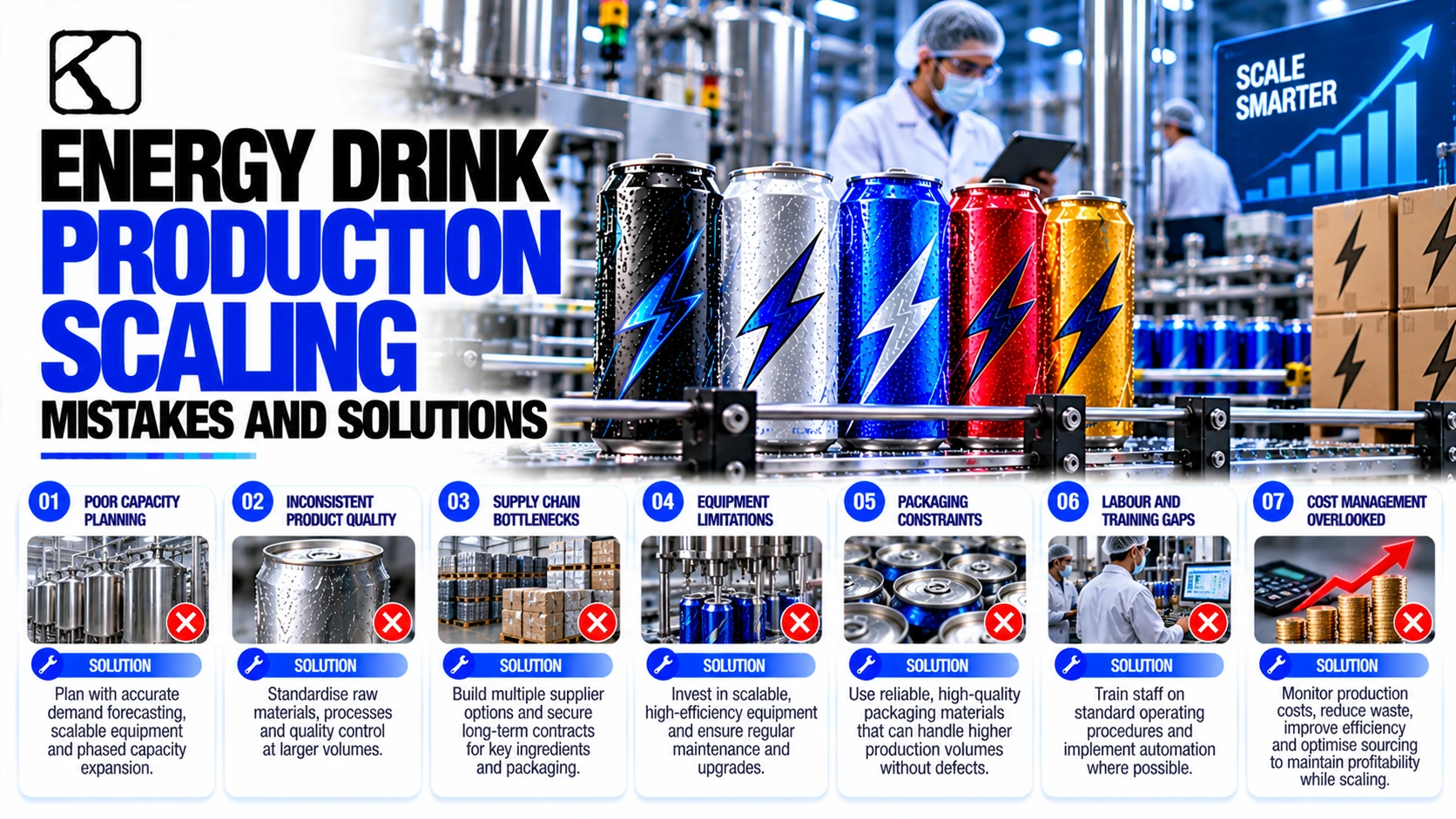
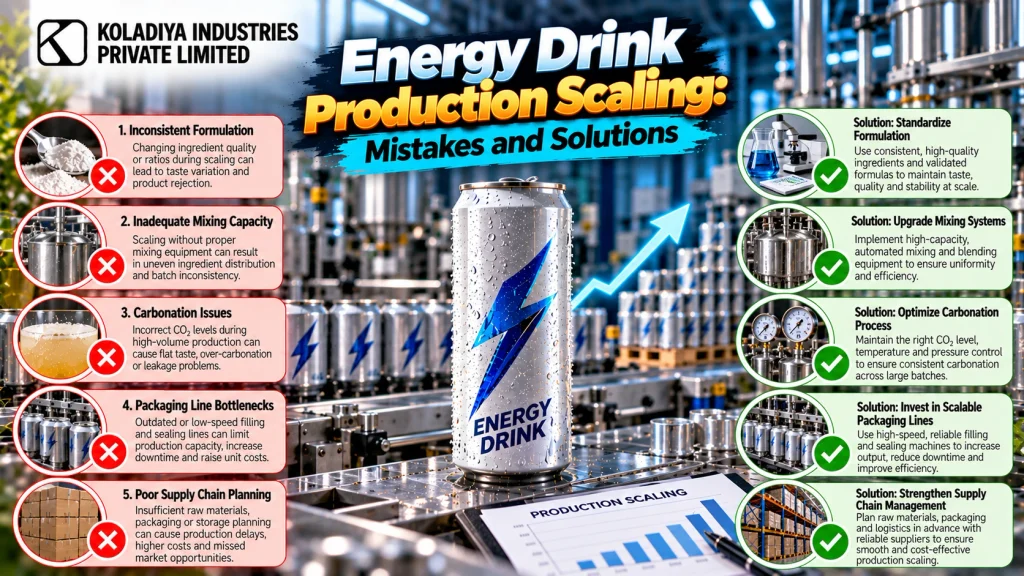
7 Common Energy Drink Production Scaling Mistakes and Their Solutions
1. Increasing Production Without Proper Demand Forecasting
One of the biggest mistakes brands make involves increasing production without understanding actual market demand.
Although higher production volumes can reduce manufacturing costs per unit, unnecessary inventory creates storage expenses, working capital pressure, and potential product wastage. Furthermore, energy drinks have specific shelf-life requirements, which makes inventory planning especially important.
Solution: Develop Accurate Production Forecasts
Before increasing production, analyse historical sales, customer demand, distributor requirements, seasonal trends, and upcoming marketing campaigns.
Additionally, consider a phased production strategy. Instead of immediately increasing manufacturing volumes, gradually move from pilot batches to larger commercial orders.
This approach helps brands balance manufacturing capacity with market demand while reducing unnecessary inventory.
2. Ignoring Energy Drink Formulation Consistency
Formulation consistency becomes increasingly important when brands increase production volumes.
Energy drinks often contain ingredients such as caffeine, taurine, B vitamins, sweeteners, acids, flavouring agents, and other functional ingredients, depending on the product concept and applicable regulations.
However, inconsistent ingredient measurements, mixing conditions, or raw material quality can affect flavour, sweetness, colour, acidity, and overall product performance.
As a result, consumers may notice differences between batches, which can damage brand trust.
Solution: Standardise the Beverage Formulation
Create a documented master formulation with precise ingredient measurements and defined processing parameters.
Moreover, conduct pilot batch testing before commercial manufacturing. Check flavour consistency, sweetness, acidity, ingredient compatibility, and product stability.
An experienced beverage R&D team can also help brands refine formulations and establish repeatable manufacturing processes.
3. Underestimating Raw Material Procurement Requirements
A small production batch may require limited quantities of ingredients. However, large-scale manufacturing demands reliable and continuous raw material supplies.
For instance, fluctuations in the availability or quality of caffeine, sweeteners, flavours, packaging materials, and other ingredients can interrupt production schedules.
Furthermore, depending on a single supplier may expose brands to unexpected price changes and procurement delays.
Solution: Build a Reliable Ingredient Supply Chain
Establish relationships with dependable suppliers and evaluate their material quality, consistency, documentation, and delivery performance.
Additionally, maintain approved alternative suppliers for critical ingredients wherever possible.
Create a procurement schedule based on production forecasts. Consequently, manufacturers can reduce material shortages, improve inventory planning, and maintain uninterrupted manufacturing operations.
4. Overlooking Manufacturing Equipment Capacity
Another common mistake involves increasing production targets without evaluating manufacturing equipment capacity.
Energy drink production requires coordinated operations, including water treatment, ingredient mixing, blending, carbonation where applicable, filling, and packaging.
When equipment cannot support the required production volume, manufacturing teams may experience bottlenecks, extended production schedules, equipment downtime, and inconsistent output.
Solution: Evaluate Production Capacity Before Expansion
Assess the capacity of every major production stage rather than focusing only on the filling machine.
Consider mixing tank capacity, processing time, cooling requirements, carbonation systems, filling speed, packaging equipment, and cleaning schedules.
Furthermore, identify the stages that create production bottlenecks.
Manufacturers should upgrade equipment, improve production scheduling, or introduce additional capacity based on actual demand and operational requirements.
5. Neglecting Carbonation and Filling Accuracy
Carbonation plays an important role in many energy drink products, particularly carbonated energy drinks.
However, inconsistent carbonation levels, unsuitable filling conditions, excessive foaming, and inaccurate fill volumes can affect product quality and packaging performance.
Additionally, aluminium cans require suitable filling and seaming processes to maintain package integrity.
Solution: Strengthen Carbonation and Filling Controls
Establish appropriate carbonation parameters according to the beverage formulation and packaging requirements.
Monitor product temperature, carbonation levels, filling pressure, fill volume, and foaming throughout production.
For aluminium cans, maintain suitable seaming equipment settings and regularly inspect seam quality.
Consequently, brands can improve packaging consistency, minimize product losses, and support reliable commercial production.
6. Reducing Quality Control During Large-Scale Manufacturing
Some businesses focus heavily on production speed and overlook the importance of consistent quality checks.
However, higher manufacturing volumes increase the importance of systematic quality management.
Problems involving ingredient measurements, water quality, microbial control, acidity, flavour consistency, packaging integrity, or product stability can affect entire production batches.
For energy drinks, brands must also consider caffeine levels, ingredient specifications, applicable food safety requirements, and product labelling regulations.
Solution: Establish a Strong Quality Control System
Introduce quality checks at every major manufacturing stage.
These checks should cover:
- Raw material inspection and supplier documentation.
- Water quality and ingredient measurements.
- Formulation consistency and pH monitoring.
- Microbiological and relevant safety testing.
- Carbonation and filling accuracy.
- Can seam integrity and packaging inspection.
- Shelf-life and product stability evaluation.
Moreover, maintain production records and batch traceability. These practices help manufacturers identify potential problems quickly and improve production reliability.
7. Choosing Packaging Without Considering Production Growth
Packaging decisions influence manufacturing efficiency, transportation, storage, and product presentation.
For example, energy drinks commonly use aluminium cans because they offer convenient handling, efficient storage, and strong brand presentation opportunities.
However, selecting an unsuitable can size, packaging material, or filling format can create operational difficulties during expansion.
Similarly, inconsistent packaging specifications may affect filling lines, sealing performance, and supply planning.
Solution: Select Scalable Beverage Packaging
Choose packaging formats that match your product positioning, target customers, manufacturing requirements, and distribution strategy.
Consider aluminium cans, including 250 ml slim cans, where the format suits the brand concept.
Additionally, evaluate can availability, compatibility with filling equipment, seaming quality, secondary packaging, and transportation requirements.
Most importantly, finalise packaging specifications before increasing commercial production. This helps avoid unnecessary packaging changes and operational disruptions.
How to Improve Energy Drink Production Scaling Efficiency
Beyond avoiding common mistakes, brands should establish an efficient manufacturing strategy that supports long-term growth.
Consider these important practices:
1. Start With Pilot Batch Development
Test the formulation, flavour profile, carbonation, ingredient compatibility, and processing parameters before commercial production. Pilot batches help identify issues before brands commit to larger manufacturing volumes.
2. Create a Detailed Production Plan
Establish manufacturing targets, ingredient requirements, equipment schedules, packaging quantities, and delivery timelines. Consequently, production teams can coordinate operations more effectively.
3. Monitor Production Costs
Calculate ingredient costs, packaging expenses, labour, processing, utilities, quality testing, and transportation. Regular cost reviews help identify unnecessary expenses and improve production profitability.
4. Maintain Consistent Product Quality
Use standardised formulations, documented processes, routine testing, and batch records. Furthermore, review production performance regularly to identify opportunities for improvement.
5. Work With an Experienced Beverage Manufacturing Partner
A reliable manufacturing partner can help startups and established brands coordinate product development, formulation, packaging, and commercial production. This approach can reduce operational complexity and support a smoother expansion process.
Energy Drink Production Scaling: The Importance of Beverage R&D
Research and development plays a significant role in successful production expansion.
A beverage formulation must perform consistently across different manufacturing volumes. Therefore, brands should evaluate ingredient interactions, flavour stability, sweetness levels, acidity, carbonation, and shelf-life performance before commercialising a product.
For example, a zero-sugar energy drink may require careful sweetener selection to achieve the desired taste profile. Similarly, fruit-flavoured energy drinks require suitable flavour balancing and stability evaluation.
Additionally, brands must ensure that caffeine levels, functional ingredients, formulations, and labelling comply with applicable food safety regulations.
A structured R&D process helps businesses move from product concepts to commercially viable beverages with greater confidence.
How Koladiya Industries Supports Energy Drink Production Scaling
Choosing the right beverage manufacturing partner can make a significant difference when expanding an energy drink business.
Koladiya Industries supports beverage brands through private-label, third-party, and contract beverage manufacturing solutions. The company focuses on helping businesses move from product development concepts towards commercial beverage production.
Its beverage-related capabilities include:
- Beverage Formulation and R&D: Support for customised beverage formulations and flavour development through an in-house formulation lab.
- Energy Drink Manufacturing: Manufacturing support for brands developing and expanding energy drink product lines.
- Private-Label Manufacturing: Solutions for businesses looking to develop beverage products under their own brand names.
- Third-Party Manufacturing: Manufacturing support for startups and established beverage companies.
- Packaging Expertise: Experience with beverage packaging requirements, including 250 ml aluminium slim cans.
- Product Development Support: Assistance with beverage development and preparation for commercial manufacturing.
By coordinating formulation, product development, manufacturing, and packaging requirements, Koladiya Industries aims to help beverage businesses establish a structured approach to production growth.
Whether you are launching a new energy drink or expanding an existing product line, selecting a suitable manufacturing partner can help simplify production planning and support your long-term business objectives.
Conclusion: Build a Scalable Energy Drink Manufacturing Strategy
Successful Energy Drink Production Scaling requires careful planning, consistent formulations, reliable ingredient sourcing, suitable manufacturing equipment, effective quality control, and scalable packaging solutions.
Although increasing production volumes creates opportunities for business growth, overlooking important manufacturing requirements can increase costs and affect product quality.
Therefore, brands should take a structured approach that includes pilot batch testing, production forecasting, process standardisation, cost management, and continuous quality monitoring.
Most importantly, working with an experienced beverage manufacturing partner can help businesses manage production requirements more effectively.
Planning to Scale Your Energy Drink Brand?
Koladiya Industries can support your beverage journey through formulation and R&D, private-label manufacturing, third-party manufacturing, and product development solutions.
Whether you are developing your first energy drink or preparing for larger commercial production, connect with Koladiya Industries to discuss your product concept and manufacturing requirements.
Contact Koladiya Industries today and take the next step towards scalable energy drink manufacturing.