Energy drink manufacturing requires careful planning, accurate formulation, consistent processing, and reliable quality control. Even a small production mistake can increase ingredient costs, create packaging waste, delay production, or damage product quality. For beverage startups and established brands, these issues can directly affect manufacturing budgets and overall profitability. As the energy drink market continues to develop, brands must balance product quality, consumer expectations, production efficiency, and competitive pricing. However, without proper manufacturing controls, businesses may face unnecessary expenses during product development and commercial production.
Common Energy Drink Manufacturing Errors helps brand owners prevent avoidable losses, improve production performance, and build a consistent product. From formulation mistakes and ingredient selection to carbonation problems and packaging defects, every manufacturing stage requires attention. We explore the most common energy drink manufacturing errors that raise production costs and explain practical ways to prevent them.
Why Energy Drink Manufacturing Errors Increase Production Costs
Energy drink manufacturing involves multiple interconnected stages, including product formulation, ingredient sourcing, water treatment, blending, carbonation, filling, sealing, and quality testing. A problem at any stage can affect the next stage. For example, an incorrect formulation may require additional testing and ingredient adjustments. Similarly, poor filling-line settings can cause product spillage, underfilling, or rejected cans.
Consequently, manufacturers may experience:
- Increased raw material consumption.
- Higher product development and testing expenses.
- Production delays and equipment downtime.
- Packaging waste and product rejection.
- Inconsistent flavour and carbonation.
- Shelf-life and quality-related complaints.
Therefore, identifying potential errors early helps beverage brands control production expenses and maintain consistent product standards.
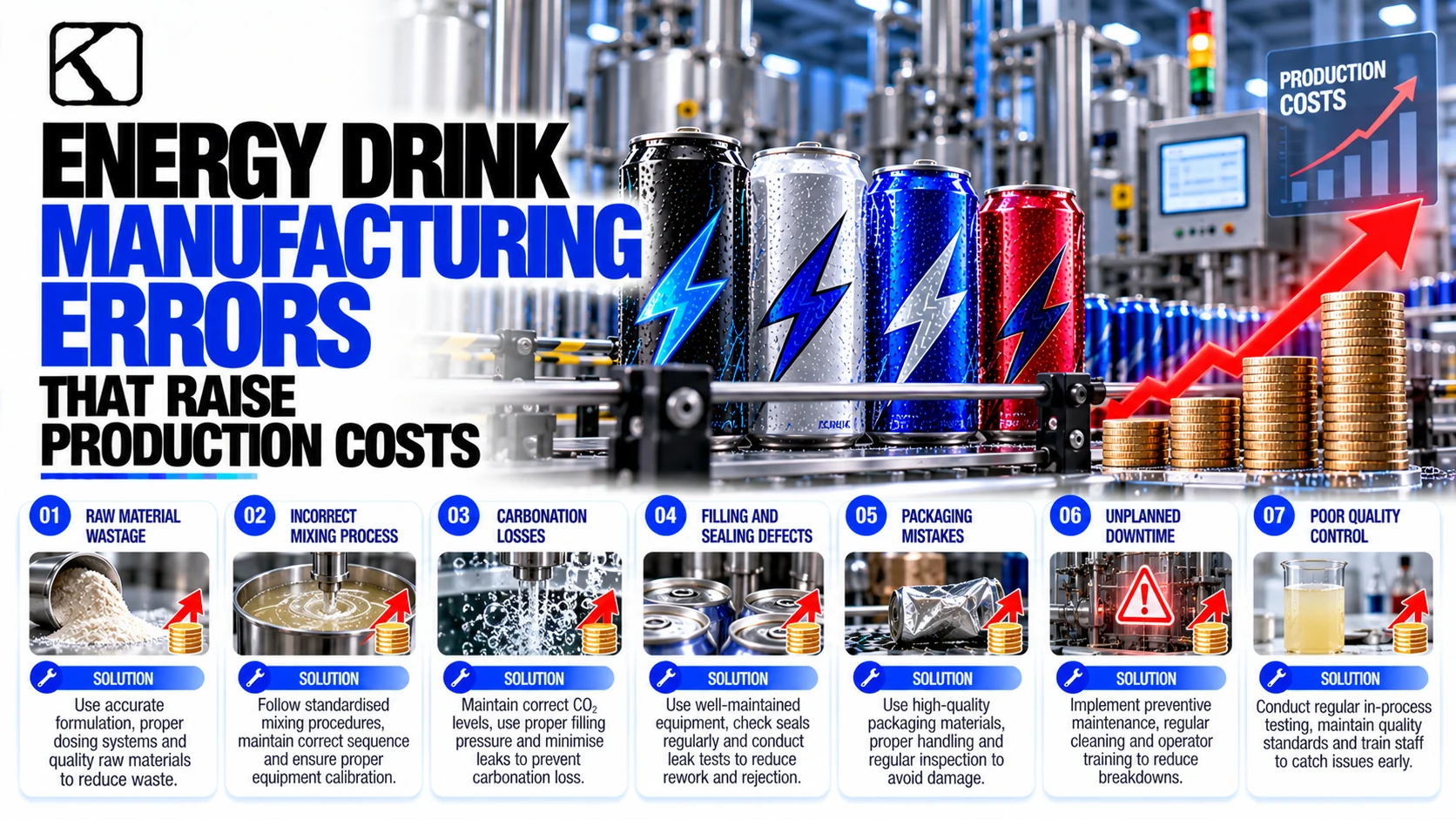
7 Common Energy Drink Manufacturing Errors That Raise Production Costs
1. Poor Energy Drink Formulation and Ingredient Selection
Formulation mistakes rank among the most common energy drink manufacturing errors. An energy drink requires a balanced combination of ingredients, such as caffeine, sweeteners, flavouring agents, acids, vitamins, and other functional ingredients.
However, selecting ingredients without considering their compatibility can create several problems. For instance, excessive acidity may produce an unpleasant sour taste, while an unsuitable sweetener combination can leave a bitter or lingering aftertaste.
Furthermore, some vitamins and functional ingredients may affect flavour, colour, or product stability.
How to prevent this error:
- Develop a formulation based on the target consumer and product positioning.
- Evaluate the compatibility of caffeine, vitamins, sweeteners, acids, and flavours.
- Conduct sensory evaluations before finalising the recipe.
- Test both sugar-based and zero-sugar formulations when relevant.
- Validate the formulation before commercial production.
A structured formulation process reduces repeated adjustments and helps brands avoid unnecessary ingredient waste.
2. Choosing Low-Quality or Inconsistent Raw Materials
Raw material selection directly affects the cost, flavour, stability, and quality of an energy drink. Some businesses focus only on purchasing ingredients at the lowest available price. However, inexpensive ingredients do not always deliver consistent results.
For example, variations in flavour concentrates, sweeteners, caffeine quality, and acidity regulators can affect the finished beverage. In addition, inconsistent supplier specifications may create differences between production batches.
Consequently, manufacturers may need to reject ingredients, reformulate products, or repeat quality testing.
How to prevent this error:
- Work with reliable ingredient suppliers.
- Establish clear raw material specifications.
- Review certificates of analysis and relevant quality documentation.
- Test incoming ingredients according to an approved quality plan.
- Maintain approved supplier records and traceability.
Although quality ingredients may require careful purchasing decisions, consistent raw materials can reduce production failures and long-term costs.
3. Incorrect Batch Scaling During Commercial Production
A formula that performs well in a small laboratory sample may not behave exactly the same during large-scale manufacturing. Differences in mixing capacity, ingredient addition, processing conditions, and blending time can affect the final product.
For example, a flavour may disperse evenly in a small sample but create inconsistent taste across a larger batch when the manufacturer uses unsuitable mixing conditions.
Similarly, incorrect ingredient calculations can cause variations in caffeine concentration, sweetness, acidity, or functional ingredient levels.
How to prevent this error:
- Validate the formulation through pilot batches.
- Use accurate weighing and dosing equipment.
- Prepare standard batch manufacturing instructions.
- Monitor mixing time and ingredient addition sequence.
- Compare laboratory, pilot, and commercial production samples.
Most importantly, brands should validate product performance before increasing production volumes. This approach helps reduce costly batch rejection and repeated manufacturing trials.
4. Poor Carbonation and Mixing Control
Carbonation plays an important role in the taste and drinking experience of carbonated energy drinks. However, incorrect carbonation settings can create excessive foaming, inconsistent mouthfeel, filling difficulties, and product quality variations.
Poor mixing can also affect ingredient distribution, particularly when the manufacturer does not maintain consistent processing conditions.
For instance, excessive foaming during filling may slow the production line and increase product loss. On the other hand, insufficient carbonation can affect the intended sensory experience.
How to prevent this error:
- Establish suitable carbonation specifications for the product.
- Monitor beverage temperature and carbonation conditions.
- Check mixing and blending performance.
- Maintain consistent filling-line settings.
- Conduct carbonation and sensory checks during production.
Additionally, manufacturers should evaluate carbonation performance during pilot production rather than waiting until large-scale manufacturing begins.
5. Ignoring Water Quality and Processing Controls
Water forms a major part of most energy drink formulations. Therefore, poor water quality can influence taste, product consistency, and manufacturing performance.
Uncontrolled mineral content, unwanted impurities, and microbiological contamination may create quality concerns. Furthermore, inconsistent water treatment can affect flavour perception and formulation accuracy.
Water quality also influences how other ingredients perform within the beverage.
How to prevent this error:
- Establish appropriate water quality specifications.
- Monitor the water treatment process.
- Conduct regular physical, chemical, and microbiological testing.
- Maintain sanitation procedures for water storage and distribution.
- Record water quality results for production batches.
By maintaining consistent water quality, manufacturers can reduce formulation variations and support reliable beverage production.
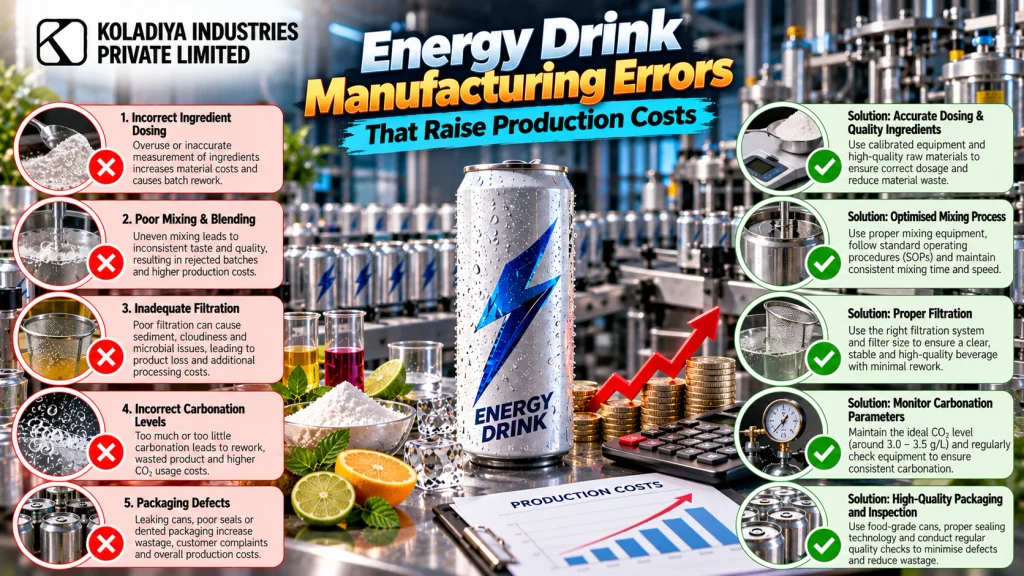
6. Packaging Defects and Incorrect Can Seaming
Packaging errors can increase production costs through leakage, damaged containers, rejected products, and customer complaints. Aluminium cans offer a suitable packaging option for many energy drink brands, particularly those targeting modern retail and on-the-go consumption.
However, incorrect filling levels, unsuitable line settings, damaged can ends, and poor seaming control can create packaging defects.
A defective can seam may compromise package integrity. Similarly, incorrect filling control can increase beverage waste or result in rejected units.
How to prevent this error:
- Inspect cans and ends before production.
- Maintain suitable filling and seaming equipment settings.
- Conduct routine seam inspections and measurements.
- Monitor fill levels throughout production.
- Segregate defective packaging before products reach distribution.
In addition, brands should evaluate packaging compatibility and production-line performance during product development. Early validation helps prevent expensive packaging-related losses at commercial scale.
7. Skipping Shelf-Life Testing and Quality Validation
Launching an energy drink without adequate shelf-life validation can create long-term financial risks. A product may initially meet its flavour and appearance targets but develop changes during storage.
For example, flavour deterioration, colour changes, carbonation loss, ingredient instability, or packaging-related issues may affect consumer acceptance.
These problems can lead to product returns, wasted inventory, and damage to brand reputation.
How to prevent this error:
- Develop an appropriate shelf-life testing plan.
- Evaluate flavour, colour, aroma, and physical stability.
- Monitor pH and carbonation where applicable.
- Assess microbiological quality using suitable testing protocols.
- Evaluate packaging integrity during storage.
- Maintain batch records and investigate quality variations.
Shelf-life validation should form part of product development rather than an afterthought. It helps brands understand how their beverages perform under defined storage conditions before distribution.
How Energy Drink Manufacturing Errors Can Be Reduced
Preventing production losses requires a coordinated approach across product development, procurement, processing, packaging, and quality assurance.
Build a Reliable R&D and Formulation Process
A structured R&D process helps manufacturers identify formulation problems before commercial production. It also allows brands to evaluate different flavour profiles, sweetness levels, ingredient combinations, and product concepts.
Use Pilot Batches Before Scaling Up
Pilot production helps identify practical manufacturing challenges before a business commits to larger volumes. It provides an opportunity to assess mixing, carbonation, filling, packaging, and product consistency.
Implement Quality Checks at Every Stage
Quality control should begin with incoming raw materials and continue through finished product evaluation. Regular checks help identify deviations early and reduce the chances of large-scale rejection.
Improve Production Planning and Inventory Management
Accurate demand forecasting and raw material planning help prevent over-purchasing, ingredient shortages, and unnecessary inventory holding costs. Additionally, organised production scheduling can reduce equipment downtime and changeover losses.
Maintain Clear Manufacturing Documentation
Standard operating procedures, formulation records, batch sheets, cleaning schedules, and quality reports help teams maintain consistency. They also make it easier to investigate errors and implement corrective actions.
The Role of a Reliable Beverage Manufacturing Partner
Selecting the right manufacturing partner can help energy drink brands manage technical challenges and control production expenses. An experienced beverage manufacturing partner can support product development, formulation, pilot production, commercial manufacturing, and packaging evaluation.
Koladiya Industries supports beverage brands through private-label, third-party, and contract beverage manufacturing solutions. Its beverage capabilities include formulation and R&D support, flavour development, and manufacturing support for categories such as energy drinks, carbonated soft drinks, sparkling water, and tonic water.
For energy drink businesses, a structured development approach can help evaluate formulations, ingredient combinations, production requirements, and packaging options before commercial manufacturing.
Moreover, working with a manufacturing partner that understands product development and production planning can help brands identify potential challenges earlier and make better manufacturing decisions.
Conclusion: Prevent Energy Drink Manufacturing Errors to Control Costs
Energy drink manufacturing errors can increase expenses at every stage, from ingredient selection and formulation to carbonation, filling, packaging, and shelf-life testing. Although some problems may appear minor during early production, they can create significant losses when manufacturing volumes increase. Therefore, beverage brands should prioritise formulation accuracy, consistent raw materials, pilot batch validation, reliable processing controls, packaging inspections, and comprehensive quality testing.
Most importantly, businesses should treat manufacturing efficiency as part of their product development strategy. By addressing potential issues early, brands can reduce avoidable waste, improve product consistency, and build a stronger foundation for commercial growth.
Develop Your Energy Drink with Koladiya Industries
Planning to launch a new energy drink or improve your existing beverage formulation? Koladiya Industries can support your beverage journey with R&D, flavour development, private-label manufacturing, and third-party beverage manufacturing solutions.
Connect with Koladiya Industries to discuss your energy drink concept, formulation requirements, packaging preferences, and commercial production plans. Take the next step towards developing a consistent, market-ready energy drink brand.