Launching an energy drink brand requires more than an attractive can and a memorable name. Brands must develop a balanced formula that delivers the right taste, energy profile, mouthfeel, stability, and consumer experience. However, many startups and established beverage businesses encounter formulation challenges that increase production costs, delay product launches, and affect product quality. Energy drink formulation mistakes can occur at almost every stage, from ingredient selection and flavour development to carbonation, sweetness, shelf-life testing, and commercial manufacturing. Even a small formulation error can affect the final product’s taste, stability, or manufacturing performance.
Fortunately, brands can prevent many of these problems through systematic product development, laboratory trials, ingredient compatibility assessments, and pilot-batch testing. Moreover, working with an experienced beverage manufacturing partner can help businesses identify potential issues before they invest in large-scale production. At Koladiya Industries, beverage brands can explore product development, formulation, flavour customization, and manufacturing support to move from an initial concept toward commercial production. Understanding common formulation challenges is an important first step toward developing a competitive energy drink.
Energy Drink Formulation Mistakes That Affect Product Quality
Energy drink formulation requires careful coordination between ingredients, flavour systems, acidity, sweetness, carbonation, and processing conditions. Therefore, brands should identify potential formulation problems early rather than trying to correct them after commercial production begins.
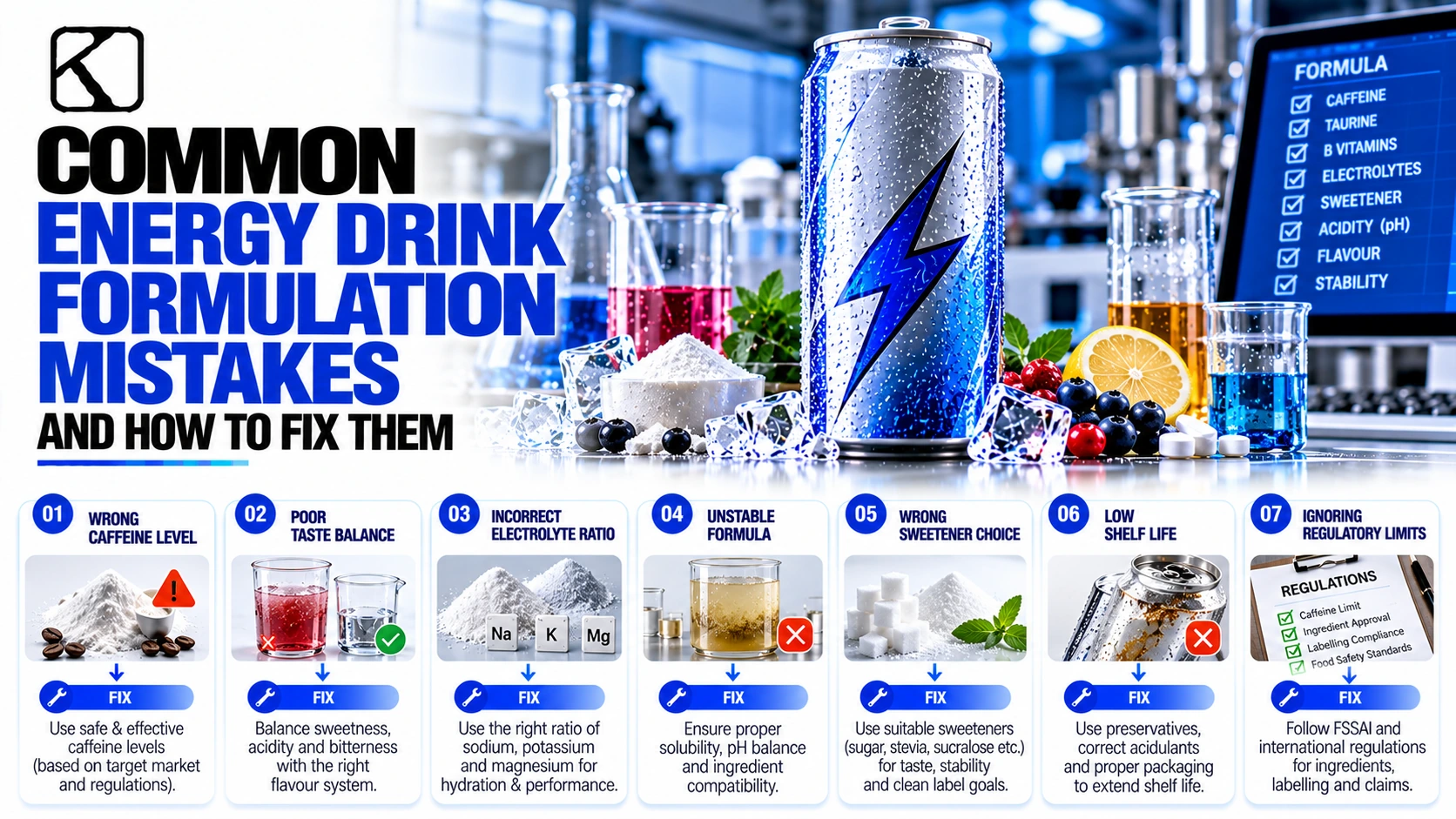
The following are seven common energy drink formulation mistakes and practical ways to address them.
1. Energy Drink Formulation Mistakes Caused by Poor Ingredient Selection
Ingredient selection directly affects an energy drink’s flavour, functionality, stability, and production cost. However, some brands select ingredients based primarily on price or marketing appeal without evaluating their compatibility with the complete formula.
For example, caffeine, taurine, vitamins, botanical extracts, sweeteners, and other functional ingredients can behave differently depending on the beverage’s acidity, processing conditions, and storage environment.
In addition, certain ingredients may introduce bitterness, undesirable odours, sedimentation, or colour changes. These problems can compromise the consumer experience and create unnecessary reformulation expenses.
How to fix it:
- Define the product’s target consumer, flavour profile, and functional positioning before selecting ingredients.
- Evaluate ingredient specifications, purity, solubility, and compatibility.
- Check the applicable regulatory requirements for each ingredient and its permitted use level.
- Conduct laboratory trials before finalizing the formula.
- Document ingredient suppliers, specifications, and approved alternatives.
Consequently, a structured ingredient-selection process helps brands build a more reliable foundation for product development.
2. Incorrect Caffeine Levels and Functional Ingredient Balance
Caffeine plays a central role in many energy drinks. However, adding too much caffeine or failing to calculate its contribution accurately can create formulation, compliance, and consumer-safety concerns.
Brands must consider caffeine from every source, including added caffeine and ingredients that naturally contain caffeine. Furthermore, they should evaluate how the selected concentration fits the intended serving size, target market, and applicable food regulations.
Functional ingredients also require careful consideration. For example, adding taurine, B vitamins, or botanical ingredients without assessing their compatibility and permitted levels may increase costs without improving the overall product experience.
How to fix it:
- Establish a target caffeine concentration based on the intended market and product category.
- Calculate caffeine content per serving and per container.
- Account for every ingredient that contributes caffeine.
- Verify ingredient dosages against current regulatory requirements.
- Test the finished beverage to confirm that it meets the product specification.
Importantly, brands should never assume that a higher caffeine concentration automatically creates a better energy drink. A carefully controlled formula supports consistent quality and responsible product development.
3. Poor Sweetness Balance and Unpleasant Aftertaste
Sweetness strongly influences how consumers perceive an energy drink. Nevertheless, achieving the right sweetness can become challenging when a formulation includes caffeine, acids, vitamins, minerals, or high-intensity sweeteners.
For instance, an excessively sweet beverage may feel heavy, while insufficient sweetness can make bitterness and acidity more noticeable. Similarly, some sweeteners can leave a lingering aftertaste that reduces consumer acceptance.
Zero-sugar energy drinks introduce additional challenges because removing sugar changes the beverage’s body, sweetness profile, and overall mouthfeel.
How to fix it:
- Establish a target sweetness profile before beginning formulation.
- Compare suitable sugar-based, reduced-sugar, and zero-sugar approaches.
- Evaluate approved sweetener combinations where appropriate.
- Conduct sensory trials with representative target consumers.
- Assess sweetness, bitterness, acidity, and aftertaste together.
As a result, brands can develop a more balanced flavour profile rather than correcting sweetness in isolation.
4. Energy Drink Formulation Mistakes Related to Flavour Development
Flavour development is one of the most important stages of energy drink formulation. Popular profiles include citrus, orange, tropical fruit, berry, mango, and other fruit-inspired combinations. However, a flavour that performs well in a simple beverage base may behave differently in a caffeinated, acidic, or carbonated energy drink.
Caffeine can contribute bitterness, while certain vitamins and functional ingredients can introduce distinctive tastes or odours. Moreover, carbonation may change how consumers perceive sweetness, acidity, and flavour intensity.
Consequently, a promising initial sample may not deliver the same experience after the complete formula comes together.
How to fix it:
- Develop flavours in the actual beverage base rather than evaluating them only in water.
- Test flavour performance alongside caffeine, sweeteners, acids, and functional ingredients.
- Compare multiple flavour variations through structured sensory evaluations.
- Assess the formula both before and after carbonation, where applicable.
- Recheck flavour quality during stability testing.
For startups, professional beverage flavour development can reduce trial-and-error and help create a distinctive product that aligns with the brand’s positioning.
5. Incorrect Acidity and pH Control
Acidity influences an energy drink’s flavour, microbial stability, ingredient compatibility, and overall product performance. However, an incorrect acid balance can make the beverage taste excessively sour, harsh, or flat.
Furthermore, brands should not assume that a particular pH automatically guarantees product safety or shelf stability. The complete formulation, processing method, packaging, and storage conditions all influence the final outcome.
How to fix it:
- Define a suitable pH and acidity specification for the product.
- Select food-grade acidulants appropriate for the formulation.
- Measure pH using calibrated equipment.
- Evaluate titratable acidity when it helps explain the product’s flavour balance.
- Validate the complete process and preservation strategy through appropriate testing.
Therefore, controlled acidity helps brands improve flavour consistency while supporting a scientifically validated product-safety approach.
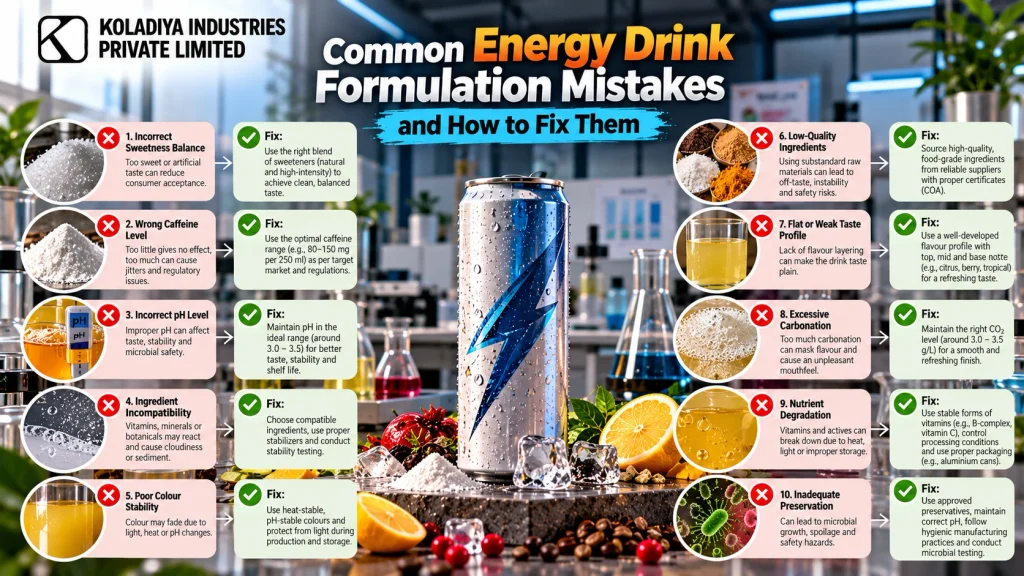
6. Carbonation and Mouthfeel Problems
Carbonation gives many energy drinks their refreshing character. However, incorrect carbonation levels can affect the drinking experience and create difficulties during filling and packaging.
Excessive carbonation may produce aggressive foaming, while insufficient carbonation can make the beverage feel flat. In addition, temperature, filling conditions, packaging compatibility, and dissolved gas levels can influence the final result.
Brands must also consider how carbonation interacts with sweetness, acidity, and flavour intensity.
How to fix it:
- Establish a target carbonation level based on the product concept.
- Test carbonation at controlled temperatures.
- Evaluate foaming and filling performance during production trials.
- Check compatibility with the selected can or bottle.
- Verify package integrity and finished-product specifications.
Consequently, pilot-batch testing helps identify carbonation problems before the brand commits to large production volumes.
7. Ignoring Shelf-Life and Ingredient Stability Testing
A beverage may taste excellent immediately after formulation but develop problems during storage. These changes can include flavour deterioration, colour variation, sedimentation, loss of carbonation, or changes in ingredient performance.
For example, certain vitamins and flavour compounds may degrade under specific combinations of temperature, light, oxygen exposure, and storage time. Similarly, ingredient interactions can become more noticeable as the product ages.
Skipping stability testing can therefore result in costly product complaints, wasted inventory, and delayed distribution.
How to fix it:
- Develop a stability-testing plan before commercial launch.
- Evaluate the finished product in its intended packaging.
- Monitor relevant physical, chemical, sensory, and microbiological parameters.
- Assess carbonation retention, colour, flavour, and appearance over time.
- Establish a scientifically supported shelf-life specification.
- Validate the manufacturing process and packaging system.
Ultimately, appropriate shelf-life studies help brands understand how their energy drinks perform under defined storage conditions.
Energy Drink Formulation Mistakes During Commercial Manufacturing
Even a well-developed formula can encounter problems during scale-up. Laboratory samples and commercial production batches operate under different conditions, so brands must validate the transition carefully.
Inadequate Pilot-Batch Testing
Moving directly from a laboratory sample to a large production run can expose brands to unexpected challenges. Mixing performance, ingredient dispersion, carbonation, filling conditions, and processing parameters may change as production volume increases.
Solution: Conduct pilot batches, document critical process parameters, and confirm that the beverage consistently meets its approved specifications before scaling up.
Poor Ingredient Compatibility and Mixing Procedures
Incorrect mixing sequences, unsuitable processing temperatures, or insufficient dispersion can create inconsistent flavour and ingredient distribution. In some cases, these problems can also contribute to sedimentation or processing difficulties.
Solution: Establish a validated mixing procedure, control ingredient addition, and verify the uniformity of the finished beverage.
Packaging and Filling Inconsistencies
Packaging problems can undermine an otherwise successful energy drink formulation. For example, inconsistent fill levels, poor seam integrity, or unsuitable packaging materials can affect product quality and distribution.
Solution: Test the formulation with the intended packaging format, establish suitable filling controls, and verify package integrity through appropriate quality checks.
By addressing these manufacturing risks early, brands can reduce avoidable production losses and improve consistency across batches.
How to Develop a Better Energy Drink Formula
A structured product development process helps beverage brands reduce formulation mistakes and improve launch readiness.
Step 1: Define the product concept. Identify the target consumer, flavour direction, caffeine profile, sweetness level, packaging format, and intended market.
Step 2: Develop the initial formulation. Select suitable ingredients and establish preliminary specifications for taste, acidity, and other product characteristics.
Step 3: Conduct laboratory trials. Prepare sample variations and compare flavour, sweetness, mouthfeel, ingredient compatibility, and appearance.
Step 4: Complete safety and compliance checks. Review applicable food regulations, ingredient limits, labelling requirements, and product specifications for the target market.
Step 5: Validate the pilot batch. Test the formula under representative manufacturing conditions and evaluate packaging performance.
Step 6: Conduct stability testing. Monitor the finished beverage over an appropriate period to establish its quality and shelf-life requirements.
Step 7: Prepare for commercial production. Finalize the formula, quality specifications, processing instructions, and production controls before scaling up.
This approach allows businesses to make evidence-based decisions and avoid costly changes after launch.
How Koladiya Industries Can Support Energy Drink Product Development
Developing an energy drink requires coordination between formulation, flavour development, ingredient selection, quality control, packaging, and manufacturing. For startups and established brands, managing every stage independently can increase complexity and delay commercialization.
Koladiya Industries supports beverage businesses seeking private-label, third-party, and contract beverage manufacturing solutions. Its beverage development capabilities include formulation and R&D support, flavour customization, and manufacturing planning for suitable product concepts.
For brands developing a new energy drink, a structured collaboration can help establish the product brief, evaluate flavour directions, refine the formulation, and plan pilot production before commercial scale-up.
Koladiya Industries also works with beverage categories such as energy drinks, carbonated soft drinks, sparkling water, and tonic water. Its manufacturing and packaging capabilities can help brands explore product concepts that align with their target market and business requirements.
However, each formulation requires its own technical assessment. Ingredient compatibility, regulatory compliance, production feasibility, packaging suitability, and shelf-life validation remain essential parts of the development process.
By addressing these requirements early, beverage businesses can make more informed decisions and prepare their products for a smoother transition from concept to market.
Conclusion
Common energy drink formulation mistakes can affect taste, ingredient stability, carbonation, production efficiency, and shelf life. Fortunately, brands can reduce these risks through careful ingredient selection, balanced sweetness, controlled acidity, structured flavour trials, pilot-batch testing, and appropriate stability studies.
Moreover, successful energy drink development requires more than an appealing flavour. Brands must also consider regulatory compliance, packaging performance, manufacturing consistency, and the expectations of their target consumers.
Whether you plan to launch a conventional energy drink, a zero-sugar variant, or a distinctive fruit-flavoured formulation, a systematic development process can help you avoid unnecessary delays and improve product readiness.
Ready to Develop Your Energy Drink Brand?
Planning to launch a new energy drink or improve an existing formulation? Koladiya Industries can help you explore beverage formulation, flavour development, private-label manufacturing, and contract manufacturing solutions tailored to your product concept.
Contact Koladiya Industries to discuss your energy drink idea, target market, formulation requirements, packaging preferences, and commercial production goals. Take the next step toward developing an energy drink that aligns with your brand vision and manufacturing needs.
What are the most common energy drink formulation mistakes?
Common mistakes include incorrect caffeine levels, poor ingredient compatibility, excessive bitterness, unbalanced sweetness, carbonation issues, and inadequate shelf-life testing. Addressing these problems early helps reduce reformulation costs and production delays.
Can I develop a custom energy drink flavour for my private-label brand?
Yes. Brands can explore custom flavour profiles such as citrus, tropical fruit, berry, orange, and other fruit-inspired combinations. Koladiya Industries offers beverage formulation and flavour customization support to help businesses develop products aligned with their brand positioning.
How much does energy drink formulation and manufacturing cost in India?
The cost depends on the ingredient profile, formulation complexity, packaging format, production volume, testing requirements, and customization needs. Contact Koladiya Industries to discuss your project specifications and explore a suitable manufacturing approach.
Can I manufacture a zero-sugar energy drink with a balanced taste?
Yes. A zero-sugar energy drink requires careful sweetener selection, flavour balancing, and mouthfeel optimization to minimize bitterness and lingering aftertaste. Laboratory trials and sensory evaluations help identify a suitable formulation.
What should I check before choosing an energy drink contract manufacturer in India?
Evaluate the manufacturer's formulation and R&D capabilities, flavour development support, quality control procedures, packaging options, production capacity, and ability to meet applicable regulatory requirements. Also, discuss minimum order quantities, pilot batches, and project timelines before proceeding.
How can I get started with energy drink formulation and contract manufacturing at Koladiya Industries?
Start by sharing your energy drink concept, preferred flavour, caffeine and sugar requirements, packaging format, target market, and estimated order volume. Koladiya Industries can discuss your requirements and help you explore the next steps toward formulation, product development, and commercial manufacturing.