Beverage packaging plays a critical role in product safety, quality, shelf life, and brand reputation. Even a well-formulated drink can lose its market appeal when packaging develops leaks, dents, sealing failures, label problems, or other defects. For beverage brands, these issues can lead to product wastage, customer complaints, retailer rejections, and increased production costs. As competition grows in the energy drink and ready-to-drink beverage markets, manufacturers must maintain consistent packaging quality throughout production. Moreover, brands need packaging that protects the beverage, supports efficient transportation, and delivers a professional appearance on retail shelves. Common beverage packaging defects helps beverage brands identify potential problems early and implement effective preventive measures. From aluminium cans and plastic bottles to closures, labels, and secondary packaging, every component requires proper inspection and quality control.
This guide explains the most common beverage packaging defects, their causes, and practical ways to prevent them, including important considerations for energy drink manufacturing.
What Are Beverage Packaging Defects?
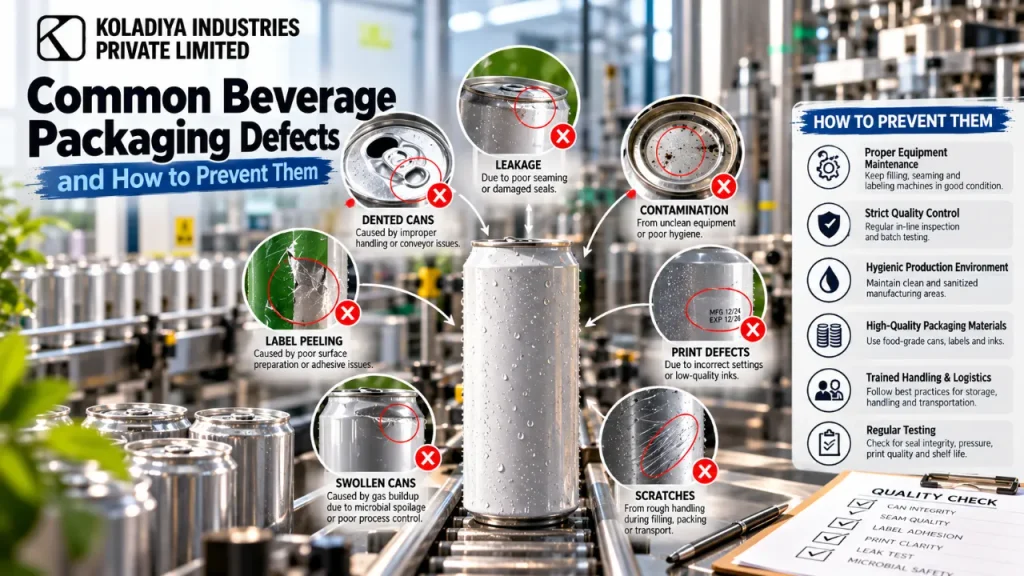
Beverage packaging defects are faults or inconsistencies in a container, closure, label, or outer packaging that affect product integrity, safety, appearance, or performance. These defects can develop during filling, sealing, labelling, storage, handling, or transportation.
For example, a poorly sealed energy drink can may leak or lose carbonation. Similarly, an incorrectly applied label can make a finished product look unprofessional and reduce consumer confidence.
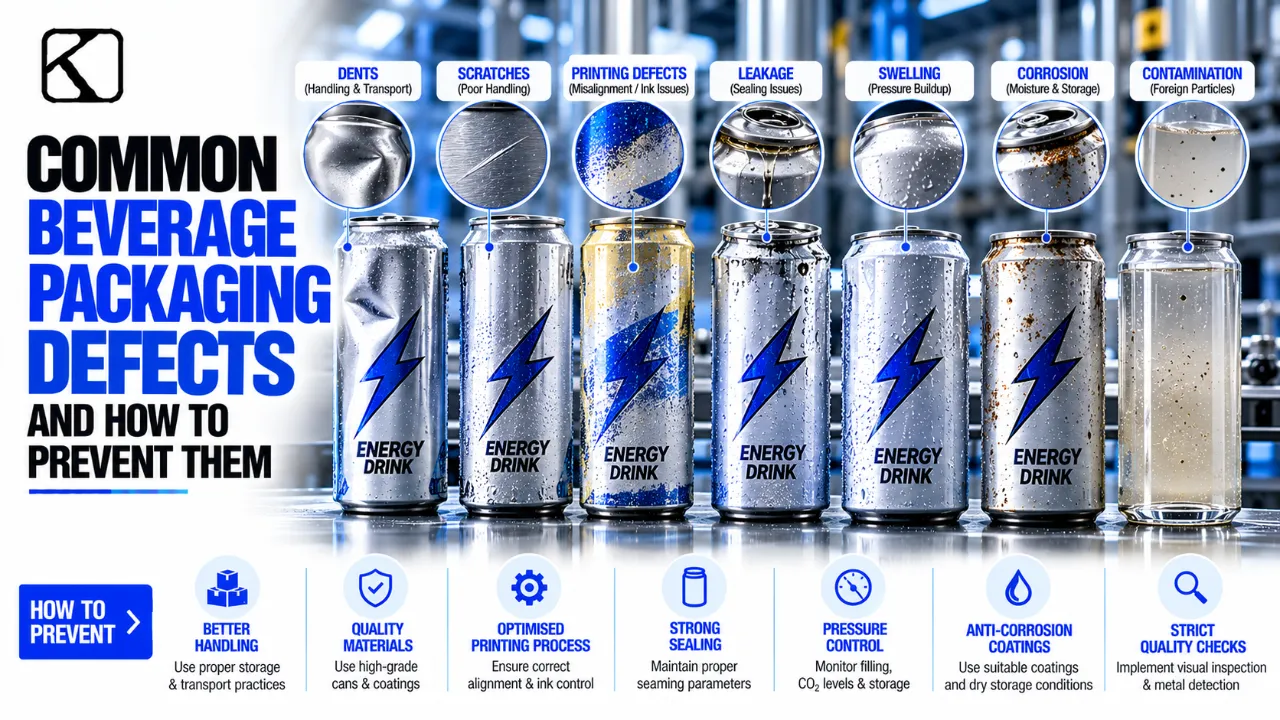
Packaging defects generally fall into three categories:
- Functional defects: Leaks, faulty seals, damaged closures, or containers that fail to protect the beverage.
- Visual defects: Dents, scratches, misaligned labels, faded printing, or damaged artwork.
- Performance defects: Packaging that fails during stacking, transportation, storage, or normal product handling.
Therefore, beverage manufacturers should assess packaging quality throughout the production process instead of relying only on final inspections.
Common Beverage Packaging Defects and Their Causes
1. Beverage Packaging Defects Caused by Leaking Containers
Leaking containers represent one of the most serious packaging problems because they can damage surrounding products and compromise product quality.
In aluminium cans, leaks may result from faulty seams, damaged can ends, material defects, or incorrect seaming settings. In plastic bottles, common causes include loose caps, damaged threads, faulty liners, and inconsistent closure application.
For energy drinks and carbonated soft drinks, leaks can also cause carbonation loss and reduce product appeal.
How to prevent leaks:
- Check container and closure quality before production.
- Maintain appropriate filling and sealing parameters.
- Inspect can seams or bottle closures using suitable quality-control procedures.
- Conduct leak tests at defined production intervals.
- Investigate recurring failures before continuing affected production.
Consequently, consistent sealing controls help protect the beverage and reduce product losses.
2. Beverage Packaging Defects in Aluminium Can Seaming
Aluminium cans require a reliable double seam to secure the can end to the body. Poor seam formation can compromise the container’s integrity and create leakage risks.
Common can-seaming defects include incomplete seams, damaged seam structures, wrinkles, excessive tightness, and inconsistent dimensions. These problems may arise from worn tooling, incorrect machine settings, misaligned components, or unsuitable can-end specifications.
Energy drink manufacturers should pay particular attention to seaming because carbonated formulations create internal pressure.
How to prevent can-seaming defects:
- Maintain and calibrate seaming equipment.
- Use compatible cans and can ends.
- Inspect seam dimensions and cross-sections according to an established quality plan.
- Train operators to recognise abnormal seam conditions.
- Document inspection findings and correct recurring issues promptly.
Furthermore, manufacturers should establish appropriate inspection frequencies based on product requirements, equipment performance, and production volume.
3. Dented, Scratched, or Deformed Beverage Containers
Dents and scratches can affect the appearance of packaged beverages and weaken consumer confidence. Severe container damage may also affect structural integrity.
These defects often develop during can handling, conveyor movement, palletising, warehouse storage, or transportation. Excessive stacking pressure and rough handling can increase the risk.
For premium energy drinks, where sleek aluminium cans often contribute to brand identity, visible damage can make products less attractive on retail shelves.
How to prevent container damage:
- Inspect empty containers before filling.
- Adjust conveyors and handling equipment to minimise collisions.
- Use appropriate dividers, trays, and protective packaging.
- Follow safe palletising and stacking practices.
- Check finished products before dispatch.
As a result, careful material handling helps preserve packaging appearance while reducing avoidable wastage.
4. Faulty Caps, Closures, and Bottle Seals
Caps and closures protect beverages from leakage, contamination, and unwanted exposure. However, loose caps, damaged threads, defective liners, and excessive or insufficient tightening can reduce their effectiveness.
In energy drink and functional beverage production, closure performance matters because the packaging must maintain product integrity throughout distribution and storage.
How to prevent closure defects:
- Verify that caps match the selected bottle design.
- Maintain suitable cap application and tightening settings.
- Check closure alignment and application consistency.
- Inspect seals and tamper-evident features where applicable.
- Perform suitable leak and closure-integrity tests.
In addition, manufacturers should verify closure performance under the product’s intended storage and distribution conditions.
5. Beverage Labeling and Printing Defects
Labels influence product recognition, communicate important information, and support brand positioning. Unfortunately, wrinkles, bubbles, crooked labels, smudged printing, and peeling edges can make products look inconsistent.
These defects may result from incorrect label positioning, unsuitable adhesives, poorly prepared surfaces, or inconsistent labelling-machine settings.
Energy drink packaging often includes prominent branding, flavour names, ingredient declarations, and nutritional information. Therefore, even a minor printing or alignment issue can affect the finished product’s presentation.
How to prevent labelling defects:
- Check label artwork and print quality before production.
- Confirm that labels match the correct product and flavour.
- Maintain accurate label positioning and application settings.
- Use compatible adhesives and packaging materials.
- Inspect label alignment, legibility, and placement throughout the run.
Moreover, brands should verify mandatory declarations and product-specific information before approving packaging artwork for commercial production.
6. Incorrect Filling Levels and Overfilled Containers
Incorrect filling levels create consistency problems and can affect product presentation. Underfilled containers may trigger quality complaints, while overfilling can contribute to spills, closure problems, or insufficient headspace.
For carbonated energy drinks, the filling process must account for the formulation, carbonation requirements, container design, and operating conditions.
How to prevent filling defects:
- Calibrate filling equipment at planned intervals.
- Monitor fill volumes during production.
- Establish suitable operating parameters for each beverage.
- Inspect filling performance after product or format changes.
- Record deviations and investigate repeated inconsistencies.
Therefore, consistent filling controls help maintain product uniformity and reduce avoidable losses.
7. Beverage Packaging Defects Related to Carbonation and Internal Pressure
Carbonated energy drinks require packaging that can withstand the product’s internal pressure under intended storage and distribution conditions. Incorrect formulation, inadequate container specifications, filling variations, or temperature exposure can contribute to packaging performance problems.
Potential warning signs include leaking seams, closure failures, bulging containers, or unexpected carbonation loss. However, these symptoms can have different causes, so manufacturers should investigate them systematically.
How to prevent pressure-related defects:
- Select packaging suitable for the beverage’s carbonation and storage requirements.
- Maintain appropriate formulation and filling controls.
- Validate packaging performance under relevant conditions.
- Monitor storage and transportation conditions.
- Investigate unusual pressure-related failures immediately.
Most importantly, brands should never assume that a container suitable for a non-carbonated drink will automatically suit a carbonated energy drink.
8. Packaging Contamination and Foreign-Material Risks
Dust, residues, damaged packaging fragments, and other foreign materials can create product-quality and safety concerns. Contamination risks may arise during container storage, handling, filling, or packaging operations.
Energy drinks require the same disciplined hygiene practices as other beverages, regardless of flavour, colour, or formulation.
How to prevent contamination:
- Maintain clean and organised production areas.
- Store packaging materials in suitable conditions.
- Inspect containers before they enter the filling line.
- Follow established cleaning and sanitation procedures.
- Train personnel to handle packaging materials correctly.
Additionally, manufacturers should investigate contamination incidents, document corrective actions, and verify that the controls remain effective.
9. Damaged Cartons and Secondary Packaging Failures
Secondary packaging protects finished beverages during storage, stacking, and transportation. Weak cartons, poor adhesive bonding, damaged shrink film, or incorrect palletising can allow individual cans and bottles to move, collide, or fall.
For energy drinks sold in multipacks or wholesale cartons, packaging failures may lead to damaged units and higher distribution costs.
How to prevent secondary packaging defects:
- Choose cartons and protective materials suitable for the product’s weight.
- Verify carton dimensions and closure strength.
- Set shrink-wrapping equipment correctly.
- Follow consistent palletising procedures.
- Inspect packed products before shipment.
Consequently, effective secondary packaging protects both the product and the brand throughout the supply chain.
How to Build an Effective Beverage Packaging Quality-Control Process
Preventing beverage packaging defects requires a systematic approach. Instead of inspecting only finished products, manufacturers should introduce quality checks at several production stages.
Beverage Packaging Defects: Inspect Materials Before Production
First, examine cans, bottles, caps, labels, cartons, and other packaging components when they arrive. Check specifications, visible damage, dimensions, and compatibility with the beverage.
Beverage Packaging Defects: Monitor the Filling and Packaging Line
Next, establish routine checks for filling accuracy, seaming quality, closure application, label positioning, and packaging appearance. Operators should record deviations and follow defined procedures for corrective action.
Beverage Packaging Defects: Test Finished Products
After packaging, perform appropriate inspections and tests based on the product and container. These may include leak testing, seam evaluation, closure-integrity checks, visual inspection, and packaging-performance assessments.
Beverage Packaging Defects: Track Recurring Problems
Finally, analyse defect records to identify repeated failures. For example, frequent dents may indicate a conveyor-handling issue, while recurring leaks may point to a closure or seaming problem.
By examining the root cause, manufacturers can address the underlying issue instead of repeatedly rejecting defective products.
Beverage Packaging Defects in Energy Drink Manufacturing
Energy drinks often combine carbonation, distinctive flavours, functional ingredients, and strong visual branding. As a result, packaging choices must align with both the beverage formulation and the intended market position.
Aluminium cans can offer a practical option for carbonated energy drinks, particularly when brands want a modern appearance and convenient single-serve formats. Nevertheless, successful packaging requires suitable can specifications, reliable seaming, controlled filling, and careful handling.
Brands should evaluate packaging compatibility during product development rather than waiting until commercial production. Pilot batches can help teams assess filling behaviour, seam performance, label quality, handling requirements, and packaging consistency before scaling up.
Additionally, flavour development, carbonation, formulation stability, and shelf-life evaluation should work together with packaging selection. This integrated approach helps beverage brands identify potential issues early and build a more reliable route to commercial production.
How Koladiya Industries Supports Beverage Development and Manufacturing
For beverage startups and established brands, preventing packaging defects begins with coordinated product development and manufacturing planning. Koladiya Industries supports beverage brands through beverage formulation and R&D, flavour development, private-label manufacturing, and third-party beverage manufacturing.
These services can help brands plan product requirements and prepare for commercial production across categories such as energy drinks, carbonated soft drinks, sparkling water, and tonic water.
For energy drink projects, brands should discuss the intended formulation, carbonation level, container format, artwork, production requirements, and quality expectations early in the development process. This preparation helps teams evaluate suitable packaging options and establish appropriate quality-control checks before production scales.
However, packaging performance depends on the specific beverage, container, equipment, and process conditions. Each product therefore requires appropriate technical evaluation and quality checks rather than a single solution for every drink.
Conclusion: Prevent Beverage Packaging Defects Before They Affect Your Brand
Beverage packaging defects can increase production costs, damage customer trust, and interrupt distribution. Fortunately, manufacturers can reduce these risks through careful material selection, equipment maintenance, filling controls, sealing inspections, hygiene practices, and systematic quality management.
For energy drinks in particular, brands should pay close attention to can-seaming integrity, carbonation compatibility, filling accuracy, label quality, and handling conditions. Furthermore, integrating packaging evaluation into product development can help teams identify potential issues before commercial production.
Are you planning to develop or manufacture an energy drink or another beverage product? Contact Koladiya Industries to discuss your beverage formulation, R&D, private-label, and third-party manufacturing requirements. Build your beverage concept with a clear plan for packaging quality and commercial production.