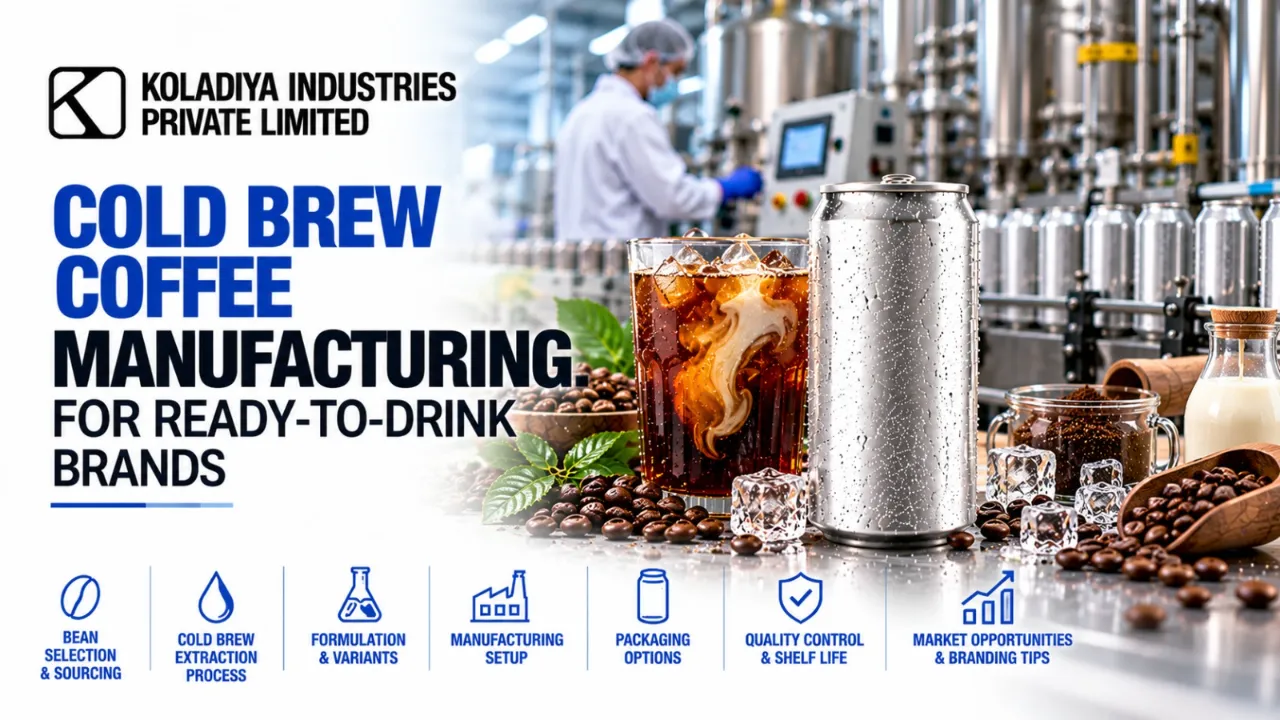
Cold brew coffee has become an attractive product opportunity for beverage startups, coffee brands, cafés, and established beverage companies. Its smooth taste, convenient format, and premium positioning make it suitable for modern consumers who want ready-to-drink coffee without the time required to prepare it at home. However, launching a successful cold brew product requires more than soaking coffee grounds in cold water. Brands must develop the right flavour profile, select suitable ingredients, establish reliable production processes, choose appropriate packaging, and maintain consistent product quality. Cold Brew Coffee Manufacturing helps brands transform a coffee concept into a commercially viable ready-to-drink beverage. With the right manufacturing partner, businesses can streamline product development, improve production efficiency, and prepare for retail distribution.
Koladiya Industries can be considered by beverage entrepreneurs exploring contract manufacturing and ready-to-drink product development, subject to the required product specifications and manufacturing capabilities.
What Is Cold Brew Coffee Manufacturing?
Cold brew coffee manufacturing involves extracting coffee flavours using cool or room-temperature water, followed by filtration, formulation, and preparation for packaging. Unlike conventional hot-brewed coffee, cold brew relies on a longer extraction period rather than hot water. This process creates a distinctive flavour profile that often features lower perceived bitterness, a smooth mouthfeel, and balanced coffee notes. The final taste depends on the coffee variety, roast level, grind size, water quality, extraction time, and formulation. Commercial manufacturers adapt this process to meet the requirements of ready-to-drink brands. They focus on repeatable extraction, hygienic handling, product stability, and packaging compatibility.
Why Cold Brew Coffee Manufacturing Matters for Beverage Brands
Commercial production allows brands to move beyond small-batch preparation and establish a consistent supply for customers.
Key advantages include:
- Consistent flavour: Standardised recipes and extraction parameters help maintain the desired taste across batches.
- Convenient consumption: Ready-to-drink formats allow consumers to enjoy coffee without brewing equipment.
- Product differentiation: Brands can develop black cold brew, flavoured coffee, milk-based beverages, and other coffee-inspired concepts.
- Scalable production: A structured manufacturing process supports growth from initial market testing to larger commercial volumes.
- Retail opportunities: Suitable packaging can help brands target supermarkets, convenience stores, cafés, offices, and online customers.
Nevertheless, every product requires a suitable formulation and production strategy. Shelf life, ingredient compatibility, and storage requirements must guide decisions from the beginning.
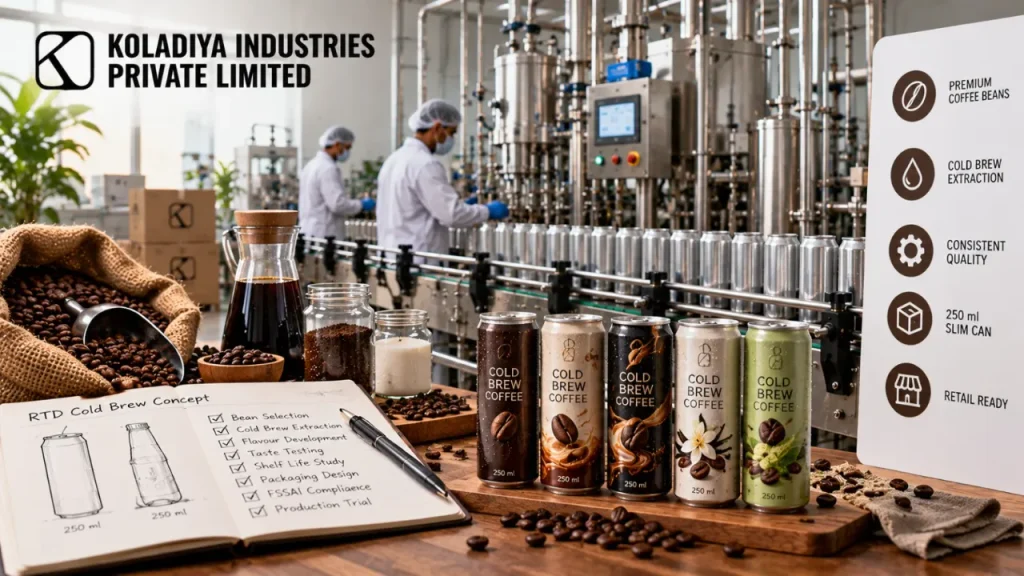
Cold Brew Coffee Manufacturing Process: Step by Step
A reliable production process helps brands achieve a consistent product while reducing avoidable quality issues. Although the exact process varies by formulation and equipment, commercial cold brew production generally follows these stages.
1. Select the Right Coffee Beans
Coffee selection establishes the foundation of the finished beverage. Different beans offer different flavour characteristics, including chocolate, caramel, nutty, fruity, and roasted notes.
Brands should evaluate Arabica, Robusta, or suitable blends according to their target audience and price positioning. Arabica beans deliver a smooth, aromatic flavour profile ideal for premium cold brew coffee, while Robusta beans add a bolder taste, stronger character, and fuller body.
The roast level also influences the outcome. Medium roasts may provide a balanced profile, whereas darker roasts can deliver more pronounced roasted notes.
Before moving into production, manufacturers should assess bean quality, consistency, freshness, and suitability for the intended formulation.
2. Determine the Coffee Grind Size
Grind size affects extraction speed, flavour development, and filtration efficiency. A grind that is too fine may increase sediment and complicate filtration. Conversely, an excessively coarse grind may produce a weaker extraction under certain conditions.
Manufacturers should select a grind size that suits their extraction equipment and desired flavour profile. They should also maintain consistent grinding practices to reduce batch variation.
3. Optimise the Cold Extraction Process
During extraction, ground coffee comes into contact with water for a controlled period. The coffee-to-water ratio, water temperature, extraction duration, and agitation method all influence the final concentrate.
For example, a brand may begin pilot trials with different ratios and extraction times before selecting a preferred recipe. The development team can then evaluate flavour strength, aroma, acidity, bitterness, and overall balance.
Commercial production requires documented process parameters. Therefore, teams should establish repeatable operating procedures rather than rely on informal preparation methods.
4. Filter and Standardise the Coffee Extract
After extraction, manufacturers separate the coffee liquid from the grounds. Filtration helps remove particles and creates a cleaner, more consistent beverage.
The manufacturer may then standardise the extract to achieve the required strength and flavour. Depending on the product, this stage can involve dilution, blending, or other formulation adjustments.
For concentrate products, the manufacturer must define the intended concentration and provide clear preparation or usage instructions where necessary.
5. Develop the Final Beverage Formulation
Once the coffee extract meets the desired specifications, the development team can create the finished product.
Possible product concepts include:
- Ready-to-drink black cold brew coffee.
- Unsweetened cold brew for consumers who prefer a simple ingredient profile.
- Lightly sweetened cold brew coffee.
- Vanilla or caramel-flavoured cold brew.
- Milk-based cold brew coffee.
- Plant-based cold brew beverages.
- Premium coffee concentrates for cafés or home preparation.
Each formulation introduces different technical considerations. For instance, milk-based products require careful management of ingredient compatibility, microbial safety, processing conditions, and storage stability.
Similarly, sweeteners and flavourings can change the taste, composition, and processing requirements of the beverage. Brands should evaluate these changes during formulation trials instead of assuming that one recipe will work across every product variation.
6. Validate Food Safety and Shelf Life
Food safety represents one of the most important stages in cold brew coffee manufacturing. Cold extraction does not automatically make a beverage safe, and refrigeration alone does not replace a validated food safety process.
Manufacturers should assess microbial risks, raw material quality, water quality, sanitation, and suitable processing controls. They should also establish the required treatment and storage conditions for the specific formulation.
Shelf-life studies should evaluate relevant microbiological, chemical, and sensory characteristics over the proposed storage period. Where appropriate, testing should also examine changes in aroma, flavour, colour, separation, and packaging performance.
Brands should not assign a commercial shelf life based solely on another coffee product or a small home-preparation trial. Instead, they need product-specific evidence that supports the proposed shelf life and storage instructions.
7. Choose Suitable Packaging
Packaging protects the product, supports convenience, and communicates the brand’s market position. The best option depends on the formulation, processing method, distribution environment, and desired shelf life.
Common packaging formats include:
- Aluminium cans: Suitable for modern beverage branding and convenient single-serve formats when the product and packaging system support the required processing conditions.
- PET bottles: Useful for selected beverage applications that require lightweight packaging and practical handling.
- Glass bottles: Appropriate for premium positioning, subject to considerations such as weight, breakage, and distribution costs.
- Larger concentrate packs: Potentially suitable for food-service businesses and customers who prepare multiple servings.
Packaging selection must align with the product’s acidity, ingredients, processing method, and storage conditions. The manufacturer should also verify closure integrity, compatibility, and protection against oxygen and other factors that may affect quality.
8. Conduct Quality Checks Before Distribution
Before releasing a batch, manufacturers should verify that the product meets its approved specifications.
Depending on the formulation, quality checks may include:
- Coffee strength and relevant formulation parameters.
- Taste, aroma, and appearance.
- Ingredient and batch traceability.
- Microbiological testing and food safety controls.
- Fill volume and packaging integrity.
- Label accuracy and storage instructions.
- Shelf-life and stability requirements.
Documented quality checks help identify inconsistencies early and support more reliable production as the brand grows.
Cold Brew Coffee Manufacturing for Different Business Models
Different brands need different production strategies. Consequently, manufacturers should align their approach with the business model and intended customer.
Cold Brew Coffee Manufacturing for Startups
Startups often need to validate demand before investing in large production volumes. Pilot batches allow founders to test flavour preferences, packaging concepts, pricing, and consumer feedback.
During this stage, brands should define their target market, product positioning, initial sales channels, and expected order volumes. They should also ask prospective manufacturing partners about minimum order quantities, development costs, production timelines, and available packaging options.
A structured launch plan helps startups avoid unnecessary formulation changes and packaging expenses.
Cold Brew Coffee Manufacturing for Established Brands
Established beverage companies may prioritise production capacity, supply consistency, quality documentation, and efficient distribution.
Their requirements may include repeatable batch specifications, reliable ingredient sourcing, clear production schedules, and coordinated packaging procurement. In addition, brands expanding into multiple flavours should assess how each variation affects manufacturing complexity and inventory management.
A suitable manufacturing arrangement should support both current demand and realistic growth forecasts.
Cold Brew Coffee Manufacturing for Private-Label Products
Private-label products allow businesses to sell coffee beverages under their own brand while working with an external manufacturing partner.
The commercial arrangement may cover formulation development, production, packaging, and quality checks, depending on the services offered by the manufacturer.
Before signing an agreement, businesses should confirm product ownership, recipe confidentiality, ingredient specifications, quality responsibilities, minimum order quantities, and delivery terms.
Key Factors That Influence Cold Brew Coffee Manufacturing Costs
Manufacturing costs vary according to product specifications, production scale, and commercial requirements. Therefore, brands should request a quotation based on their actual product brief rather than rely on a generic per-unit estimate.
Coffee Ingredients and Formulation
Coffee bean grade, origin, roast profile, flavourings, sweeteners, dairy ingredients, and plant-based alternatives can affect material costs.
Premium ingredients may increase product costs but can also support a higher-value market position when consumers recognise the difference.
Production Volume and Minimum Order Quantity
Larger production runs may improve operational efficiency and spread setup costs across more units. However, higher volumes also require more working capital, storage capacity, and demand planning.
Brands should balance unit economics against inventory risk, especially when launching an untested product.
Packaging and Labelling
Packaging material, can or bottle size, closure type, label design, printing method, and carton requirements all influence the total cost.
Custom packaging may also involve minimum purchase quantities and additional setup expenses. Consequently, brands should evaluate packaging options early in product development.
Testing, Processing, and Storage
Food safety validation, shelf-life studies, specialised processing, refrigeration, and distribution conditions may contribute to the overall cost.
For this reason, businesses should consider the total delivered cost of the product rather than focus exclusively on the manufacturing price.
How to Choose a Cold Brew Coffee Manufacturing Partner
Selecting the right partner can improve launch readiness and reduce operational challenges. However, brands should evaluate suppliers against specific requirements rather than choose on price alone.
Consider the following factors:
- Product development support: Determine whether the manufacturer can help refine the recipe and assess the feasibility of your concept.
- Relevant production capabilities: Confirm that the facility can handle your particular coffee formulation, processing method, and packaging format.
- Food safety and quality systems: Review applicable licences, documented procedures, traceability, testing arrangements, and quality responsibilities.
- Minimum order quantities: Ensure the production commitment fits your launch budget and sales forecast.
- Packaging options: Confirm the availability and compatibility of your preferred container, closure, and label.
- Commercial transparency: Request a clear quotation covering ingredients, packaging, production, testing, and any additional charges.
- Production timelines: Clarify development milestones, material procurement, trial batches, and expected manufacturing schedules.
A detailed discussion at the beginning can help both parties identify technical limitations and agree on realistic deliverables.
How Koladiya Industries Can Support Beverage Brand Development
For businesses exploring contract beverage manufacturing, Koladiya Industries can be a potential partner to discuss product development and commercial production requirements.
Brands considering a cold brew coffee launch should prepare a product brief covering the coffee profile, ingredient preferences, packaging format, target market, expected order quantity, and intended storage conditions.
This information helps a prospective manufacturing partner assess the project and clarify which services and processing capabilities it can provide. Before proceeding, businesses should verify that the required cold brew extraction, formulation, packaging, and shelf-life validation capabilities are available for their specific product.
A clear brief also helps establish realistic expectations for development costs, minimum order quantities, testing requirements, and production timelines.
Common Mistakes to Avoid in Cold Brew Coffee Manufacturing
Even a promising coffee concept can face difficulties when brands overlook technical and commercial details.
Common mistakes include:
- Skipping pilot trials: Small-scale trials help identify flavour and formulation problems before commercial production.
- Assuming cold brew is automatically safe: Cold extraction requires appropriate food safety controls and validated processing.
- Choosing packaging too early: Packaging decisions should reflect the final formulation, treatment method, and storage requirements.
- Ignoring shelf-life testing: Product quality can change during storage, so brands need suitable supporting data.
- Launching too many flavours: Multiple variants can increase ingredient complexity, testing needs, and inventory costs.
- Underestimating distribution expenses: Refrigeration, transport, warehousing, and retailer requirements can affect profitability.
- Failing to plan demand: Production volumes should reflect realistic sales forecasts and the product’s validated shelf life.
By addressing these issues early, brands can improve their readiness for launch and create a more dependable manufacturing strategy.
Conclusion: Building a Successful Cold Brew Coffee Brand
Cold brew coffee offers beverage businesses an opportunity to develop convenient, premium, and differentiated ready-to-drink products. However, success depends on more than flavour alone. Brands need a reliable extraction process, carefully developed formulations, appropriate packaging, validated food safety controls, and a realistic production plan.
From selecting coffee beans to evaluating manufacturing costs, every decision influences product quality and commercial viability. Therefore, businesses should test their concepts, establish clear specifications, and choose a manufacturing partner that can meet their actual requirements.
Koladiya Industries can be approached to discuss your beverage manufacturing goals and determine whether the required services match your cold brew coffee concept.
Ready to Launch Your Cold Brew Coffee Brand?
Planning to introduce a ready-to-drink coffee product? Contact Koladiya Industries to discuss your beverage concept, manufacturing requirements, packaging preferences, and production goals. Start with a clear product brief and explore the next steps toward developing a market-ready beverage.
FAQ’s
What are the main steps in Cold Brew Coffee Manufacturing?
The process includes coffee bean selection, grinding, cold extraction, filtration, formulation, food safety validation, packaging, and quality testing.
Which coffee beans are best for ready-to-drink cold brew coffee?
Arabica beans offer aromatic, nuanced flavours, while Robusta beans provide a bolder taste and fuller body. Brands can select either variety or combine them to create a distinctive flavour profile.
What packaging options are available for ready-to-drink cold brew coffee?
Popular options include aluminium cans, PET bottles, and glass bottles. The right choice depends on the formulation, processing requirements, shelf life, budget, and target market.
How is the shelf life of cold brew coffee determined?
Shelf life depends on the ingredients, processing method, packaging, and storage conditions. Manufacturers should conduct appropriate shelf-life and microbiological testing to establish safe storage instructions and an accurate expiry date.
What factors affect Cold Brew Coffee Manufacturing costs?
Costs depend on coffee bean quality, formulation, production volume, packaging materials, processing requirements, quality testing, and storage and distribution expenses. Brands should request a quotation based on their specific requirements.
How can Koladiya Industries help launch a ready-to-drink cold brew coffee brand?
Koladiya Industries can be approached to discuss beverage manufacturing requirements, product concepts, and packaging preferences. Brands should confirm the availability of suitable cold brew processing and validation capabilities for their product.