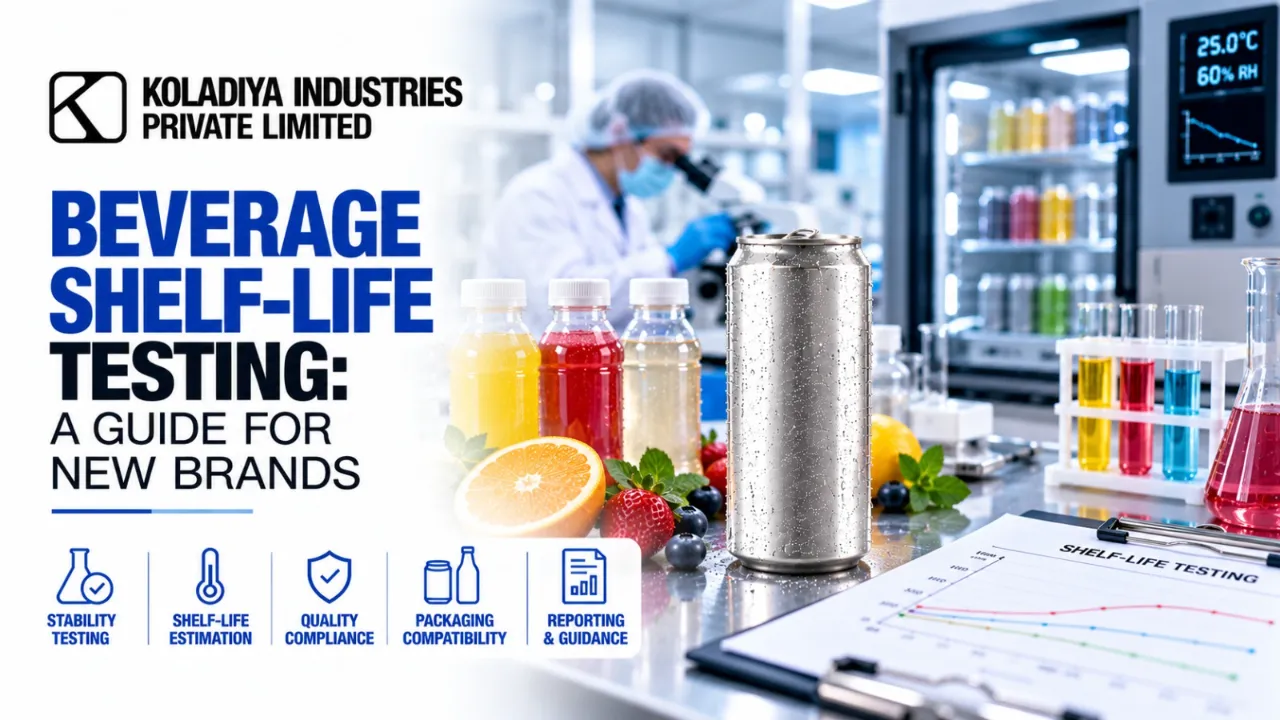
Launching a new beverage brand requires more than an attractive package and a great-tasting formula. You also need to ensure that your drink maintains its quality, flavour, appearance, and safety throughout its intended shelf life. This is where Beverage Shelf-Life Testing becomes an essential part of product development. For new beverage brands, shelf-life testing helps determine how long a product can maintain its intended characteristics under specified storage conditions. It also helps manufacturers identify potential formulation problems, choose suitable packaging, and develop a more reliable production process before launching commercially.
Whether you plan to launch energy drinks, protein water, flavoured water, fruit-based beverages, hydration drinks, or functional beverages, you should consider shelf-life testing during product development rather than waiting until production begins. We explain how beverage shelf-life testing works, which factors influence shelf life, and how new brands can prepare their products for commercial manufacturing.
What Is Beverage Shelf-Life Testing?
Beverage shelf-life testing evaluates how a drink changes over time under defined storage conditions. The testing process examines the product’s microbiological quality, chemical stability, physical characteristics, and sensory properties.
For example, a beverage might taste excellent immediately after production but develop an unwanted flavour after several weeks. Similarly, a drink may experience colour changes, sediment formation, loss of carbonation, or changes in nutritional components during storage.
Shelf-life testing helps identify these changes and establish a scientifically supported shelf-life period for the specific formulation and packaging combination.
However, every beverage behaves differently. An acidic fruit drink, a protein-based beverage, and a carbonated energy drink may require different testing parameters. Therefore, brands should develop a product-specific testing plan instead of applying the same testing process to every beverage.
Why Is Beverage Shelf-Life Testing Important for New Brands?
New beverage brands often focus on flavour development, packaging design, marketing, and distribution. Nevertheless, shelf-life validation deserves the same attention because product stability directly affects customer experience and business operations.
1. Beverage Shelf-Life Testing Supports Product Safety
A beverage must meet appropriate microbiological and food-safety requirements throughout its intended shelf life. Depending on its ingredients and processing method, the product may require specific microbial testing and process validation.
For example, beverages containing certain fruit ingredients, proteins, dairy components, or other sensitive ingredients may present different microbiological risks.
Testing helps identify potential issues and supports decisions about formulation, processing, storage, and handling. However, shelf-life testing does not replace hygienic manufacturing, validated processing, or routine quality control.
2. It Helps Maintain Flavour and Appearance
Customers expect a beverage to deliver a consistent experience every time they purchase it. Unfortunately, exposure to oxygen, light, temperature changes, and ingredient interactions can affect its flavour, aroma, colour, or texture.
A structured testing programme helps identify these changes before the product reaches the market. As a result, brands can investigate the cause and make suitable improvements to the formulation or packaging.
3. It Helps Select Suitable Packaging
Packaging protects a beverage during storage, transportation, and retail display. However, different packaging materials offer different protection against oxygen, light, moisture, and environmental conditions.
For instance, a brand considering aluminium cans, PET bottles, or other suitable beverage containers should evaluate how the chosen package interacts with its formulation and manufacturing process.
Shelf-life testing of the actual product in its intended package helps determine whether that combination maintains the required quality over time.
4. It Supports Distribution and Inventory Planning
A realistic shelf life helps brands plan manufacturing schedules, warehousing, transportation, and retail distribution more effectively.
Moreover, a suitable shelf-life period can help reduce avoidable product wastage and make inventory management easier. Brands should establish that period using appropriate evidence rather than choosing an arbitrary number of months to meet market expectations.
Which Parameters Does Beverage Shelf-Life Testing Evaluate?
The testing parameters depend on the beverage category, ingredients, production process, packaging, and intended storage conditions. A qualified laboratory and beverage development team can help determine the appropriate testing plan.
1. Microbiological Testing
Microbiological testing evaluates relevant microorganisms that may affect product safety or quality. Depending on the product, the plan may include testing for specified pathogens, indicator organisms, yeast, and mould.
The selection of microorganisms and acceptance criteria should reflect the beverage’s composition, applicable requirements, and risk assessment.
2. Chemical and Physicochemical Testing
Chemical and physicochemical tests help track changes in the beverage during storage.
Common parameters may include:
- pH and acidity
- Brix or soluble solids, where relevant
- Colour and other measurable quality attributes
- Oxidation-related changes
- Preservative levels, where applicable
- Nutritional or functional components when relevant to the product
These results help the development team understand whether the formulation maintains its intended specifications over time.
3. Sensory Evaluation
Sensory evaluation examines the characteristics that customers experience when consuming a beverage.
The evaluation may cover flavour, aroma, sweetness, mouthfeel, colour, and overall acceptability. For beverages with added flavours, botanical ingredients, proteins, vitamins, or functional components, the team should pay particular attention to undesirable taste changes or ingredient interactions.
4. Physical Stability Testing
Physical stability testing checks whether the beverage retains its intended appearance and structure.
Depending on the formula, the team may evaluate sedimentation, separation, cloud stability, viscosity, carbonation retention, or the dispersion of suspended ingredients.
These checks matter because even a microbiologically acceptable beverage may fail to meet customer expectations when it develops visible separation or an unexpected texture.
How Does Beverage Shelf-Life Testing Work?
A structured process gives new brands clearer information about product stability and potential improvements.
Step 1: Finalise the Beverage Formulation
Start with a clearly defined formulation that includes the ingredients, their intended quantities, and relevant product specifications. The development team should also understand the beverage’s target pH, sweetness, flavour profile, and processing requirements where applicable.
Any significant formulation change may affect stability. Therefore, brands should discuss changes with their development and quality teams before relying on earlier test results.
Step 2: Select the Manufacturing Process
Next, identify the intended processing method and the controls required for the beverage category. Heat treatment, filtration, hygienic filling, carbonation, and other processing steps may affect product stability and safety.
The team should consider the actual commercial manufacturing process rather than assuming that laboratory samples and full-scale production will perform identically.
Step 3: Choose the Intended Packaging
Select the package that matches the product’s requirements and target market. The team should consider material compatibility, closure integrity, oxygen and light exposure, and the expected distribution environment.
Whenever possible, test samples in the intended commercial package because packaging can influence the product’s behaviour during storage.
Step 4: Establish Storage Conditions and Testing Intervals
The team develops a testing schedule based on the proposed shelf life, product risks, and expected storage conditions.
Real-time testing evaluates samples under the intended storage conditions over the planned period. Accelerated studies may expose samples to elevated temperatures or other controlled conditions to investigate possible deterioration more quickly.
However, accelerated testing does not automatically establish the same shelf life as real-time testing. The team must interpret the results using suitable scientific evidence for the specific product.
Step 5: Test Samples at Planned Intervals
At scheduled intervals, the team evaluates the selected microbiological, chemical, physical, and sensory parameters.
The team records the results and compares them with predefined acceptance criteria. If a sample shows an unexpected change, the team investigates the possible cause before making a decision about the formulation or process.
Step 6: Review Results and Establish Shelf Life
Finally, the responsible technical team reviews the full set of results, processing information, packaging details, and storage conditions.
The brand can then establish a suitable shelf-life period based on the available evidence and applicable requirements. It should also maintain appropriate records and ensure that the product label reflects the approved shelf-life and storage instructions.
What Factors Affect Beverage Shelf Life?
Several factors influence how long a beverage maintains its intended quality.
1. Ingredient Quality and Formulation
Raw material quality, ingredient compatibility, acidity, sugar content, proteins, vitamins, natural extracts, and other components can influence stability. The development team should assess the complete formulation to understand how the ingredients work together.
2. Processing and Filling Conditions
The manufacturing process plays an important role in product safety and consistency. Inadequate process controls, poor hygiene, or unsuitable filling conditions can compromise product quality. Brands should align shelf-life studies with the intended manufacturing process and relevant quality controls.
3. Packaging Material and Seal Integrity
The chosen package influences product protection during storage and transportation. A damaged closure, unsuitable material, or inadequate barrier performance may contribute to quality deterioration.
For that reason, brands should evaluate the finished product and package together.
4. Storage and Transportation
Temperature fluctuations, direct sunlight, humidity, and rough handling may affect beverage quality, depending on the product.
Clear storage instructions and suitable distribution practices help the beverage maintain its intended characteristics throughout its established shelf life.
Common Beverage Shelf-Life Testing Mistakes to Avoid
New brands can reduce launch delays by starting shelf-life testing early and keeping product specifications consistent.
- Choosing a shelf life without sufficient evidence: Do not simply copy a competitor’s expiry period. Different formulas and packaging systems may behave differently.
- Testing only the laboratory sample: Confirm that the commercial formulation and manufacturing process match the conditions covered by the study.
- Ignoring packaging compatibility: A stable formula can still experience problems when the packaging does not provide suitable protection.
- Relying only on accelerated testing: Use an appropriate testing strategy that considers real-time evidence and product-specific risks.
- Changing ingredients without reviewing stability: Reassess the testing requirements when a formulation change may affect the product.
- Starting testing too late: Include stability planning during formulation and packaging development to reduce the risk of launch delays.
How Can Koladiya Industries Help New Beverage Brands?
Developing a commercially viable beverage involves several connected activities, from formulation development and ingredient selection to manufacturing, packaging, and quality planning. New brands benefit from coordinating these activities early instead of treating each decision as a separate task.
Koladiya Industries Private Limited supports beverage brands through contract manufacturing and private-label beverage development. The right project approach depends on the beverage category, formulation requirements, packaging format, production scale, and commercial objectives.
Brands should work with their development and manufacturing partners to define shelf-life targets, storage conditions, packaging requirements, testing needs, and quality standards.
Whether you are planning an energy drink, protein water, flavoured water, hydration beverage, or another non-alcoholic drink, early technical planning can help you identify potential challenges before scaling production.
Planning to launch your own beverage brand? Contact Koladiya Industries to explore your beverage idea, formulation requirements, packaging options, and contract manufacturing needs.
Conclusion
Beverage Shelf-Life Testing helps new brands determine how their products maintain quality during storage. It helps assess microbiological safety, flavour, appearance, packaging performance, and overall product stability. Brands should plan shelf-life testing during product development to identify potential issues early. Reviewing the formulation, manufacturing process, packaging, and storage conditions together helps brands prepare their beverages for commercial production.
For startups preparing to enter the beverage market, working closely with a capable development and manufacturing partner can simplify technical planning and support a more organized product launch. Koladiya Industries supports beverage brands with development and manufacturing solutions tailored to their business objectives.
FAQ’s
How Can I Determine the Shelf Life of My Beverage Product?
You can determine shelf life through product-specific testing under defined storage conditions. The testing plan depends on your formulation, manufacturing process, packaging, and intended storage environment.
How Much Does Beverage Shelf-Life Testing Cost in India?
The cost depends on the beverage type, required laboratory tests, number of samples, and study duration. Contact a qualified testing laboratory for a quotation based on your product requirements.
Which Tests Are Required Before Commercial Beverage Manufacturing?
Depending on the formulation, your testing plan may include microbiological analysis, pH, acidity, flavour evaluation, physical stability, and packaging compatibility. A technical team can help identify the appropriate requirements for your beverage.
Can Packaging Affect the Shelf Life of My Beverage?
Yes. Packaging can influence exposure to oxygen and light, seal integrity, and product stability. Evaluating your beverage in its intended commercial packaging helps determine whether it meets your quality requirements.
Can I Develop My Beverage Formula Before Choosing a Manufacturer?
Yes. You can begin with your product concept, target flavour, ingredients, and packaging preferences, then discuss formulation development and manufacturing requirements with a suitable beverage partner. Early planning helps align product development with commercial production needs.
Where Can I Find a Beverage Manufacturing Partner for My New Brand in India?
Koladiya Industries Private Limited supports beverage brands through contract manufacturing and private-label development. Share your beverage concept, formulation requirements, packaging preferences, and production goals with the team to discuss the next steps for your project.
Ready to develop your beverage brand? Contact Koladiya Industries to discuss your product concept and contract manufacturing requirements.