The beverage industry continues to evolve as consumer preferences shift towards healthier, functional, low-sugar, and innovative drink options. Consequently, beverage brands regularly reformulate existing products to improve taste, introduce new ingredients, reduce sugar content, and meet changing market demands. However, beverage reformulation involves much more than replacing ingredients or adjusting their quantities. Even a small change in sweeteners, flavours, preservatives, acidity regulators, or functional ingredients can affect a product’s taste, appearance, texture, and shelf life. Beverage Reformulation Mistakes can create several challenges, including flavour imbalance, ingredient incompatibility, sedimentation, carbonation loss, and reduced product stability. Moreover, these problems can increase development costs and delay commercial product launches.
These challenges become particularly important in energy drink manufacturing. For example, replacing sugar with alternative sweeteners, introducing vitamins, adjusting caffeine levels, or adding functional ingredients requires careful formulation and testing. Beverage manufacturers should follow a systematic reformulation strategy. Through proper research and development (R&D), ingredient selection, laboratory trials, and quality control, brands can maintain consistent product quality while introducing improvements.
This article explores common beverage reformulation mistakes, their effects on taste and stability, and practical solutions to prevent them.
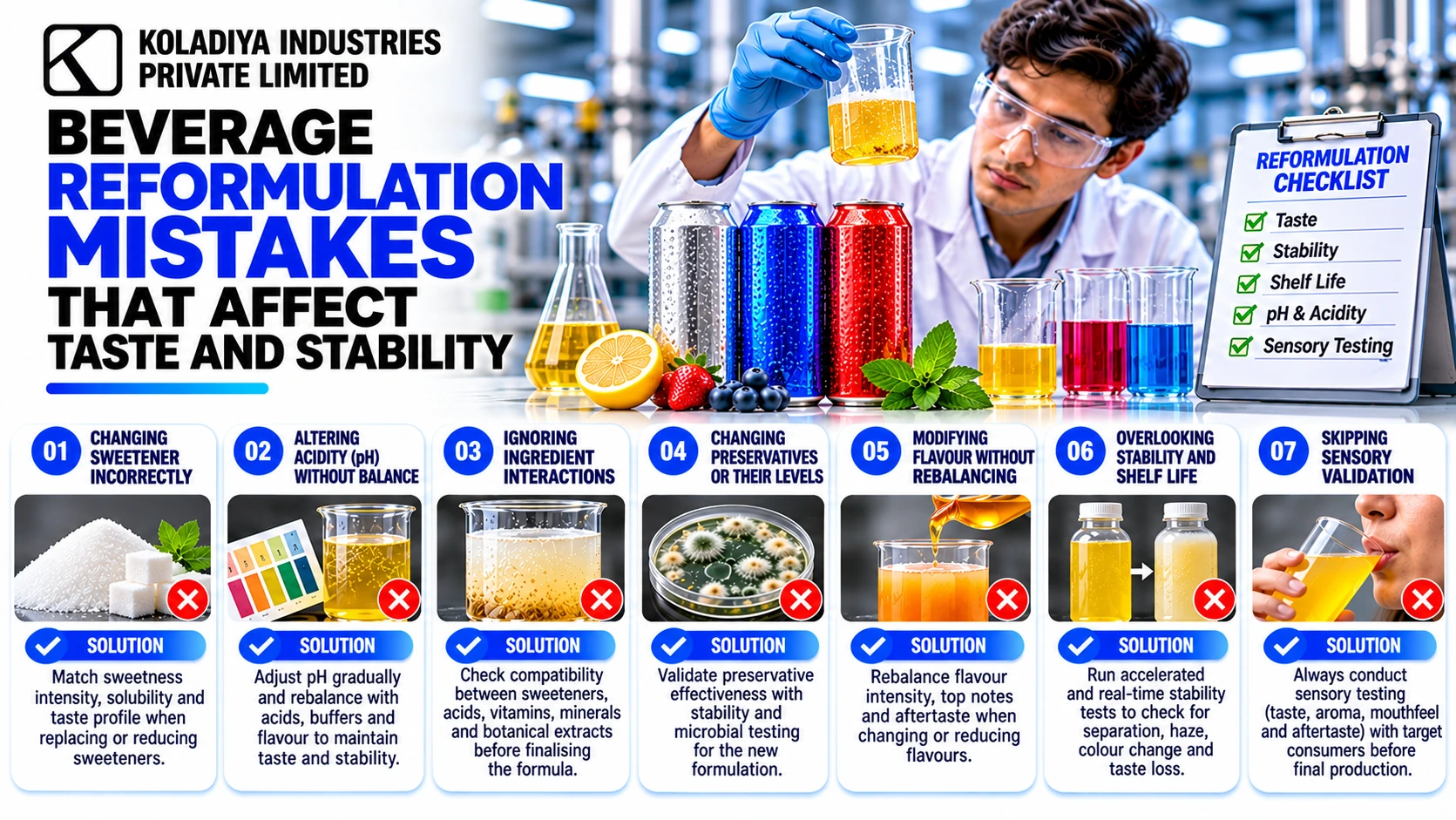
1. Beverage Reformulation Mistakes: Changing Ingredients Without Testing
One of the most common mistakes involves replacing existing ingredients without understanding their functional properties.
Every ingredient performs a specific role in a beverage. Sweeteners influence sweetness and mouthfeel, acids control flavour balance, preservatives support product protection, and stabilisers help maintain consistency.
Consequently, replacing an ingredient without evaluating its interaction with other components can affect the entire formulation.
Common problems:
- Unexpected sweetness and flavour changes.
- Reduced ingredient solubility.
- Unwanted colour variations.
- Sedimentation or separation.
- Changes in acidity and shelf life.
How to prevent it: Manufacturers should conduct laboratory trials before introducing ingredient substitutions. Additionally, they should compare the original and revised formulations to identify changes in taste, appearance, pH, and stability.
2. Replacing Sugar Without Maintaining Taste Balance
Reducing sugar content has become an important strategy for beverage brands developing healthier product alternatives. However, replacing sugar with alternative sweeteners can create unexpected sensory challenges.
Sugar contributes more than sweetness. It also influences mouthfeel, flavour balance, and the overall drinking experience. Therefore, replacing it with stevia, sucralose, or other high-intensity sweeteners without adjusting the formulation may create bitterness, lingering sweetness, or an artificial aftertaste.
How to prevent it:
- Evaluate different sweetener combinations.
- Adjust sweetness through controlled formulation trials.
- Test flavour-masking requirements.
- Assess mouthfeel and aftertaste.
- Conduct sensory evaluations.
For zero-sugar energy drinks, manufacturers must balance alternative sweeteners with caffeine-related bitterness, acidity, and flavour intensity. Ultimately, a successful formulation should deliver satisfying taste without compromising stability.
3. Beverage Reformulation Mistakes: Ignoring Ingredient Compatibility
Ingredient compatibility plays a critical role in beverage quality and long-term stability.
Certain ingredients may interact negatively when manufacturers introduce new components or change existing ingredient concentrations. For example, adding minerals, proteins, vitamins, amino acids, or botanical extracts can influence beverage clarity, colour, and solubility.
These interactions may cause sedimentation, cloudiness, precipitation, or unwanted flavour changes.
How to prevent it: Manufacturers should conduct ingredient compatibility assessments before finalising a revised formulation. Important evaluation parameters include ingredient solubility, pH compatibility, interactions between minerals and acids, vitamin stability, and preservative compatibility.
Furthermore, accelerated and real-time stability studies can help identify potential formulation problems before commercial production.
4. Using the Wrong Flavour Concentration
Flavour consistency directly influences consumer acceptance. Nevertheless, changing flavour ingredients or concentrations without proper evaluation can affect the overall sensory profile.
For instance, increasing citrus flavour in an energy drink may produce excessive acidity or an overpowering aroma. Similarly, reducing flavour concentration during sugar reduction can make the beverage taste weak or unbalanced.
How to prevent it: Manufacturers should conduct sensory evaluations to establish suitable flavour concentrations. They should also assess flavour intensity, sweetness, acidity, aroma retention, and aftertaste.
Additionally, experienced flavour suppliers and formulation specialists can help identify suitable flavour systems for revised beverage products.
5. Beverage Reformulation Mistakes: Overlooking pH and Acidity
Acidity influences beverage taste, ingredient performance, microbial control, and product stability.
When manufacturers change sweeteners, flavouring agents, preservatives, or functional ingredients, the beverage’s pH may also change. An unsuitable acidity level can create an excessively sour taste, affect flavour performance, or reduce preservative effectiveness.
In carbonated soft drinks and energy beverages, acidity also contributes significantly to the overall sensory experience.
How to prevent it:
- Measure pH during every reformulation trial.
- Evaluate the relationship between acidity and sweetness.
- Select appropriate acidulants.
- Check preservative performance.
- Conduct stability and microbiological assessments.
Maintaining suitable pH levels helps manufacturers achieve consistent taste and reliable product performance.
6. Adding Functional Ingredients Without Evaluating Stability
Functional beverages attract consumers because they offer ingredients such as vitamins, minerals, amino acids, electrolytes, and botanical extracts.
Energy drinks also commonly contain functional ingredients such as caffeine, taurine, and B vitamins. However, adding these components without understanding their stability can create formulation challenges.
Certain vitamins may degrade under unsuitable storage conditions. Similarly, some minerals can affect beverage clarity, while botanical extracts may introduce bitterness, colour changes, or sedimentation.
How to prevent it: Manufacturers should evaluate ingredient solubility, heat sensitivity, light and oxygen exposure, pH requirements, storage stability, and sensory impact.
Moreover, suitable processing conditions can help protect the final formulation and maintain its intended characteristics.
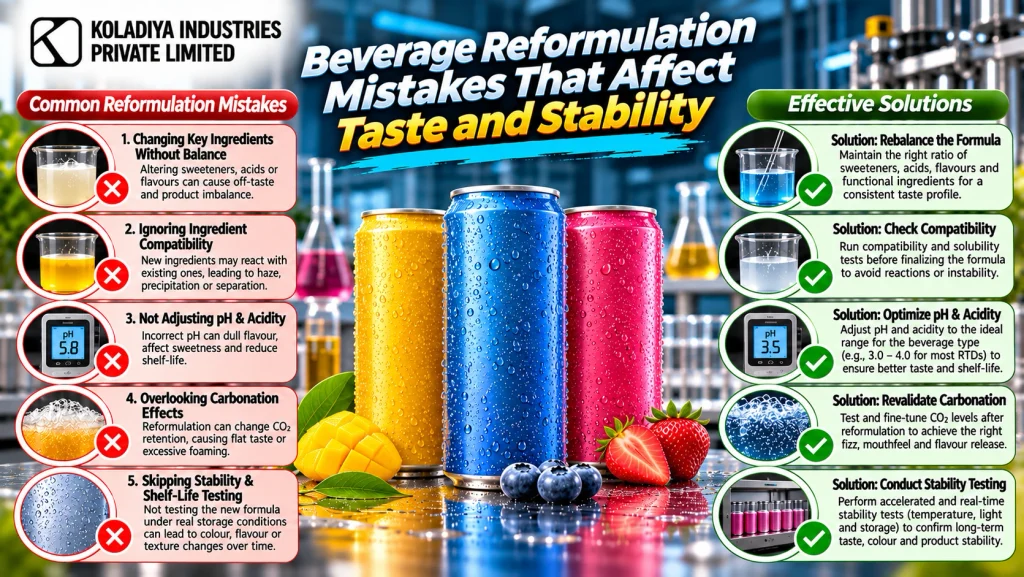
7. Beverage Reformulation Mistakes: Ignoring Carbonation Changes
Carbonation significantly influences the taste, mouthfeel, and consumer experience of sparkling beverages and energy drinks.
However, changing acidity, sweeteners, or flavour ingredients can influence perceived carbonation and overall sensory balance. Inadequate carbonation control may result in flat-tasting products, excessive foaming, or inconsistent filling performance.
How to prevent it: Manufacturers should establish the required carbonation level, evaluate carbonation retention, monitor product temperature during filling, and check container and closure performance.
For energy drink manufacturers, consistent carbonation becomes particularly important when developing new flavours or zero-sugar product variants.
8. Neglecting Shelf-Life Testing After Reformulation
A beverage may taste excellent immediately after production but develop quality problems during storage. This often happens when manufacturers focus only on initial taste evaluations.
Reformulation can influence flavour retention, colour stability, ingredient solubility, and microbiological quality. For example, a new flavour system may initially perform well but develop unwanted aroma changes over time.
How to prevent it: Manufacturers should establish a structured shelf-life testing programme covering:
- Taste and aroma changes.
- pH variations.
- Colour stability.
- Sedimentation and separation.
- Microbiological quality.
- Packaging compatibility.
Both accelerated and real-time stability studies provide useful information about product performance under different storage conditions.
9. Skipping Pilot Batch Trials Before Commercial Production
Moving directly from laboratory formulation to commercial manufacturing creates unnecessary risks.
A formulation that performs well in small laboratory samples may behave differently during industrial production. Differences in mixing, heating, cooling, carbonation, filtration, and filling can influence the final product.
For example, a revised energy drink formulation may deliver consistent flavour during laboratory testing but develop foaming or ingredient dispersion problems during commercial production.
How to prevent it: Manufacturers should develop the laboratory formulation, conduct compatibility and sensory testing, produce pilot batches, evaluate processing performance, validate packaging compatibility, and approve the final formulation before commercial production.
Consequently, pilot trials help identify challenges before businesses invest in full-scale manufacturing.
10. Overlooking Packaging and Quality Control
Packaging plays an essential role in maintaining beverage quality and stability. Changes in acidity, flavour ingredients, carbonation, or functional components may influence packaging compatibility.
For energy drinks packaged in 250 ml aluminium slim cans, manufacturers should evaluate internal coating suitability, can integrity, product compatibility, and seam quality.
Furthermore, inconsistent production practices can affect sweetness, acidity, flavour, colour, and carbonation between batches.
How to prevent it: Manufacturers should establish quality control procedures covering raw material inspection, formulation accuracy, pH and Brix measurements, sensory evaluations, microbiological testing, and packaging inspection.
Regular monitoring helps maintain consistent product quality throughout commercial production.
11. Ignoring Regulatory Requirements During Reformulation
Changes in ingredients, additives, sweeteners, nutritional composition, and product claims may affect regulatory requirements.
For example, developing a zero-sugar energy drink requires manufacturers to verify applicable ingredient permissions, nutritional declarations, caffeine-related requirements, and labelling conditions.
How to prevent it: Manufacturers should review applicable FSSAI requirements before finalising the formulation. They should verify ingredient permissions, additive limits, product category requirements, nutritional information, and labelling declarations.
A proactive compliance review can reduce regulatory risks and support a smoother product launch.
Best Practices for Avoiding Beverage Reformulation Mistakes
Successful beverage reformulation requires scientific evaluation, sensory development, manufacturing expertise, and quality assurance.
Rather than changing multiple ingredients without understanding their effects, manufacturers should follow a systematic development strategy.
| Best practice | Expected benefit |
|---|---|
| Ingredient compatibility testing | Reduces formulation conflicts |
| Sensory evaluation | Maintains taste consistency |
| pH and Brix monitoring | Supports formulation accuracy |
| Sweetener optimisation | Improves sweetness balance |
| Pilot batch production | Identifies manufacturing challenges |
| Shelf-life testing | Evaluates long-term stability |
| Packaging compatibility | Supports product integrity |
| Quality control validation | Improves batch consistency |
| Regulatory assessment | Supports compliance |
Additionally, collaboration between formulation specialists, R&D teams, ingredient suppliers, and manufacturing partners can simplify product development and reduce unnecessary trials.
How Koladiya Industries Supports Beverage Reformulation and Product Development
Reformulating a beverage requires technical knowledge, manufacturing experience, and a clear understanding of consumer expectations. For beverage startups and established brands planning to introduce new product variants, an experienced manufacturing partner can help streamline product development.
Koladiya Industries Private Limited supports beverage businesses through beverage formulation, research and development (R&D), private-label manufacturing, and third-party beverage manufacturing solutions. With an in-house formulation laboratory and a focus on product development, Koladiya Industries supports businesses exploring different beverage categories.
1. Beverage Reformulation Mistakes: Energy Drink Development
Energy drink development requires careful attention to flavour profiles, sweetness, acidity, carbonation, and functional ingredients. Koladiya Industries supports customized energy drink formulation requirements for beverage brands.
2. Beverage Reformulation Mistakes: Zero-Sugar Formulation
Brands entering the zero-sugar beverage segment need formulations that balance alternative sweeteners with flavour, mouthfeel, and overall sensory performance. Proper formulation trials help evaluate these characteristics.
3. Carbonated Soft Drinks, Sparkling Water and Tonic Water
Koladiya Industries supports beverage brands exploring carbonated soft drinks, sparkling water, and tonic water concepts with customised product development requirements.
4. Private-Label and Third-Party Manufacturing
Businesses planning to introduce their own beverage brands can explore private-label and third-party manufacturing solutions. Koladiya Industries also offers packaging expertise in 250 ml aluminium slim cans, particularly suitable for energy drinks and other compatible beverage products.
From product development to commercial production, businesses can explore solutions aligned with their formulation, packaging, and manufacturing requirements.
Conclusion
Beverage reformulation involves much more than changing ingredients or reducing sugar content. Every formulation adjustment can influence taste, aroma, texture, pH, ingredient compatibility, carbonation, packaging performance, and shelf life. Beverage Reformulation Mistakes often occur when manufacturers overlook ingredient interactions, skip sensory evaluations, neglect stability testing, or move directly into commercial production without pilot trials. Therefore, beverage brands should prioritise systematic R&D, ingredient compatibility assessments, sensory testing, shelf-life validation, and quality control.
For energy drink manufacturers, these steps become particularly important when developing zero-sugar formulations, introducing new flavours, adding functional ingredients, or improving existing products. Ultimately, the right formulation strategy and manufacturing expertise can help beverage businesses improve product consistency, reduce development risks, and prepare their products for commercial success.
Partner with Koladiya Industries for Beverage Formulation and Manufacturing
Planning to reformulate an existing beverage or develop a new energy drink product? Partner with Koladiya Industries Private Limited for beverage formulation, R&D, private-label manufacturing, and third-party beverage manufacturing solutions.
Whether you want to develop a zero-sugar energy drink, improve an existing beverage formulation, or introduce a new carbonated drink, Koladiya Industries can support your product development and manufacturing requirements. Contact Koladiya Industries today to discuss your beverage concept, formulation requirements, and commercial manufacturing goals.