Launching a successful beverage product requires more than an innovative concept and attractive packaging. Before entering the market, beverage brands must test their formulations, evaluate ingredient compatibility, validate manufacturing processes, and maintain consistent product quality. Therefore, pilot batch production plays a critical role in beverage product development. A beverage pilot batch mistakes allows manufacturers and brand owners to test a product on a smaller scale before moving towards commercial production. During this stage, businesses can identify formulation issues, flavour inconsistencies, ingredient compatibility problems, carbonation variations, and packaging challenges.
However, many beverage startups overlook important details during pilot batch development. As a result, they experience unexpected production costs, product quality issues, and commercial launch delays. These challenges become even more important for energy drink manufacturers. Energy drink formulations often combine caffeine, taurine, vitamins, sweeteners, acids, and flavoring agents. Consequently, manufacturers must carefully evaluate ingredient interactions, taste, stability, and production performance before scaling.
We explore common Beverage Pilot Batch Mistakes, practical prevention strategies, and important considerations for energy drink brands planning commercial manufacturing.
What Is Beverage Pilot Batch Production?
Beverage pilot batch production involves manufacturing a smaller quantity of a beverage to evaluate its formulation, taste, quality, stability, and manufacturing performance before commercial production. It helps businesses understand how their product behaves under actual production conditions. Moreover, it allows manufacturers to make necessary adjustments without committing significant resources to a large production run.
For example, an energy drink startup planning to introduce a 250 ml aluminium slim can product can use pilot batch development to evaluate:
- Flavour balance and sweetness.
- Caffeine and functional ingredient compatibility.
- Carbonation levels and retention.
- pH and acidity.
- Ingredient solubility.
- Product stability and shelf life.
- Filling and packaging performance.
Therefore, an effective pilot batch reduces uncertainty and creates a stronger foundation for commercial manufacturing.
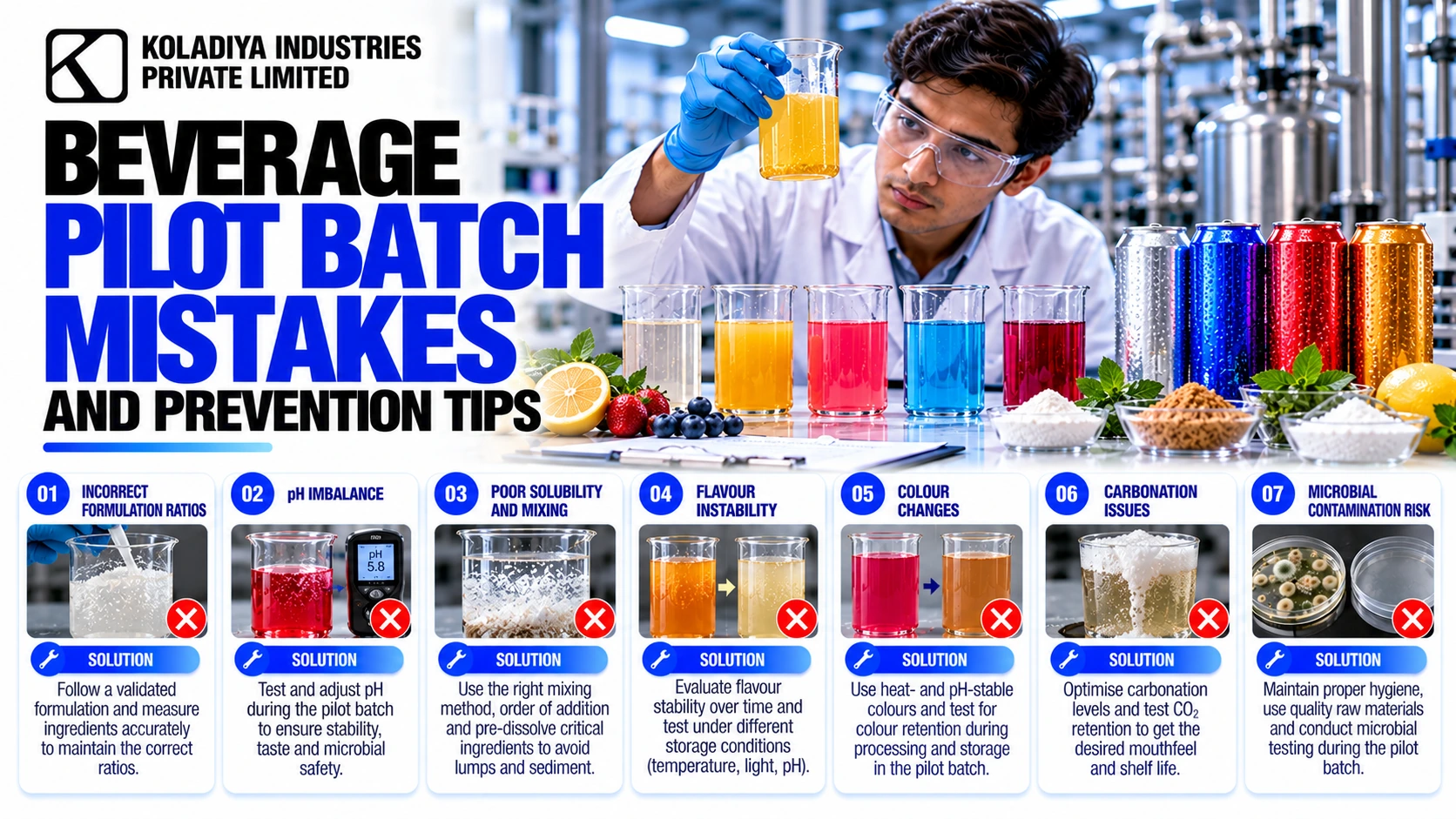
7 Common Beverage Pilot Batch Mistakes and How to Prevent Them
1. Beverage Pilot Batch Mistakes: Incorrect Ingredient Measurements
Incorrect ingredient measurements represent one of the most common challenges during pilot batch development. Even small variations in sweeteners, flavours, acids, preservatives, or functional ingredients can change the final beverage profile.
For instance, an energy drink formulation may contain caffeine, taurine, vitamins, sweeteners, and flavouring agents. Incorrect measurements can affect sweetness, bitterness, solubility, and overall product consistency.
How to prevent this mistake:
- Follow a standardized beverage formulation.
- Use calibrated weighing and measuring equipment.
- Maintain accurate ingredient records.
- Verify ingredient quantities before mixing.
- Document every formulation adjustment.
Consequently, accurate measurements help manufacturers reproduce the same product quality across multiple production batches.
2. Poor Beverage Flavour Development
Flavour inconsistency can negatively affect customer acceptance. A beverage may taste balanced during initial formulation but develop excessive sweetness, bitterness, acidity, or an unpleasant aftertaste during pilot production.
This challenge frequently occurs in energy drinks because caffeine, functional ingredients, acids, and sweeteners can influence the overall flavour profile.
For example, excessive sweetness may overpower the intended citrus flavour, while certain functional ingredients can introduce unwanted bitterness.
How to prevent this mistake:
- Conduct multiple flavour trials.
- Evaluate sweetness, acidity, and bitterness separately.
- Test different flavour combinations.
- Collect feedback through sensory evaluations.
- Recheck the flavour after processing and storage.
Furthermore, manufacturers should evaluate the complete beverage formulation instead of selecting ingredients individually. This approach helps create a balanced product that meets customer expectations.
3. Ignoring Ingredient Compatibility Issues
Ingredient compatibility plays an important role in beverage stability. Some ingredients interact with each other and create unexpected changes in colour, flavour, appearance, or solubility.
For example, energy drink formulations containing vitamins, minerals, botanical extracts, and acidulants may experience compatibility challenges. Similarly, certain ingredients may lose stability under specific processing or storage conditions.
How to prevent this mistake:
- Evaluate ingredient compatibility before pilot production.
- Test ingredient solubility and dispersion.
- Monitor changes in colour, taste, and appearance.
- Conduct stability testing.
- Adjust ingredient combinations when necessary.
Additionally, manufacturers should maintain detailed formulation records. This makes it easier to identify the cause of unexpected reactions and develop suitable solutions.
4. Incorrect Carbonation and pH Management
Carbonation and pH directly influence beverage taste, product consistency, and manufacturing performance.
If carbonation levels fluctuate, a carbonated beverage may develop inconsistent mouthfeel or excessive foaming. Similarly, incorrect pH management can affect flavour balance, ingredient stability, and product quality.
Energy drinks and carbonated soft drinks require particular attention because manufacturers must balance acidity, carbonation, and sweetness.
How to prevent this mistake:
- Measure pH using calibrated instruments.
- Establish suitable carbonation targets.
- Monitor carbonation throughout production.
- Check foaming during filling trials.
- Evaluate product consistency after packaging.
Moreover, manufacturers should assess carbonation and pH under actual production conditions rather than relying only on laboratory samples.
5. Skipping Shelf-Life and Stability Testing
Some beverage brands focus heavily on taste and appearance during pilot development but overlook long-term product stability.
However, beverages can experience changes during storage. Flavour degradation, colour variations, sediment formation, ingredient separation, and carbonation loss can affect the final product.
Energy drinks also require careful stability evaluation because their functional ingredients and flavour systems must maintain acceptable quality throughout the intended shelf life.
How to prevent this mistake:
- Conduct appropriate shelf-life studies.
- Evaluate product samples under defined storage conditions.
- Monitor flavour, colour, pH, and appearance.
- Check ingredient stability.
- Assess carbonation retention where applicable.
- Maintain documented quality control results.
Therefore, stability testing helps manufacturers identify potential problems before introducing products into the market. Brands should establish shelf-life claims using suitable testing and supporting evidence.
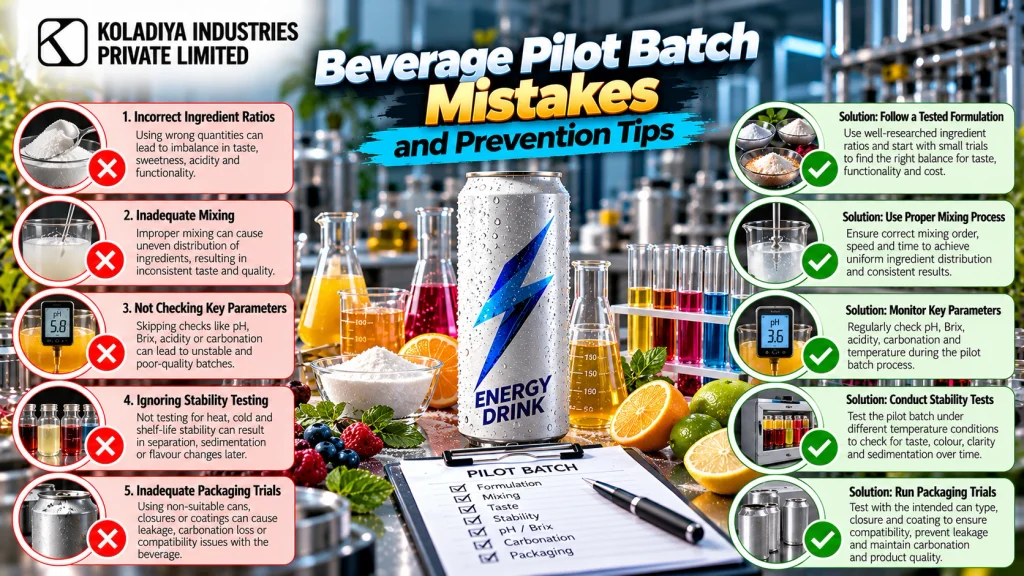
6. Choosing Unsuitable Packaging Materials
Packaging decisions can create unexpected challenges during pilot production. A beverage may perform well in a laboratory but develop problems during filling, sealing, transportation, or storage.
For energy drinks, aluminium cans offer a popular packaging option. Nevertheless, manufacturers must validate can compatibility, filling performance, seam integrity, and packaging specifications.
Incorrect packaging selection can increase leakage risks, affect product protection, and create production inefficiencies.
How to prevent this mistake:
- Select packaging according to product requirements.
- Conduct packaging compatibility checks.
- Test filling and sealing performance.
- Inspect can seams and closure integrity.
- Evaluate packaging under suitable storage conditions.
Additionally, brands should finalize packaging specifications before commercial production. This helps prevent unnecessary packaging changes and production delays.
7. Scaling Production Without Proper Process Validation
One of the biggest Beverage Pilot Batch Mistakes occurs when manufacturers move directly from small-scale testing to commercial manufacturing without validating the production process.
A formulation that works in a small laboratory batch may behave differently in larger manufacturing equipment. Differences in mixing, temperature, processing time, carbonation, and filling conditions can affect product consistency.
For example, an energy drink may require additional process adjustments when manufacturers increase production volume. Without proper validation, the final batch may differ from the approved pilot sample.
How to prevent this mistake:
- Review the pilot batch results.
- Standardize mixing and processing procedures.
- Validate production equipment.
- Define critical quality parameters.
- Conduct production trials at suitable intermediate volumes.
- Monitor the first commercial batches carefully.
As a result, manufacturers can reduce production risks and maintain better consistency when increasing manufacturing capacity.
Why Pilot Batch Testing Matters for Energy Drink Manufacturing
Energy drink production requires careful attention to formulation, processing, and product stability. Since these beverages often combine several functional and flavour ingredients, manufacturers must evaluate the complete formulation before commercial production.
A structured pilot batch process helps energy drink brands address important manufacturing considerations.
1. Caffeine and Functional Ingredient Evaluation
Manufacturers must carefully control ingredient quantities and verify compatibility. They should also check applicable food safety and regulatory requirements before finalizing the formulation.
2. Sweetener and Flavour Optimization
Energy drinks often require a balanced sweetness profile. Pilot testing helps manufacturers compare sugar-based, reduced-sugar, and zero-sugar formulations while evaluating taste and aftertaste.
3. Carbonation and Product Consistency
Carbonated energy drinks require suitable carbonation control. Therefore, manufacturers should evaluate carbonation retention, foaming, and filling performance.
4. Aluminium Can Packaging
Brands planning to use 250 ml aluminium slim cans should assess filling compatibility, seam integrity, and packaging performance before scaling production.
5. Commercial Production Readiness
Finally, pilot batch results help manufacturers establish standardized production procedures, quality parameters, and packaging specifications.
By addressing these areas early, energy drink startups can improve product consistency and prepare for a more efficient commercial launch.
How Koladiya Industries Supports Beverage Product Development and Manufacturing
Developing a beverage product requires the right combination of formulation expertise, manufacturing capabilities, packaging knowledge, and quality control.
Koladiya Industries supports beverage brands through private-label, third-party, and contract beverage manufacturing solutions. The company focuses on helping businesses move from product concepts towards commercial manufacturing.
Its beverage development and manufacturing support includes:
- Beverage Formulation and R&D: Support for developing customized beverage formulations and flavour profiles.
- Energy Drink Manufacturing: Manufacturing support for brands planning to introduce energy drink products.
- Private-Label Manufacturing: Solutions for businesses developing their own beverage brands.
- Third-Party Beverage Manufacturing: Manufacturing support for startups and established beverage businesses.
- Product Categories: Energy drinks, carbonated soft drinks, sparkling water, and tonic water.
- Packaging Solutions: Experience with beverage packaging requirements, including 250 ml aluminium slim cans.
Furthermore, beverage formulation and R&D support can help businesses evaluate product concepts, improve flavour profiles, and prepare formulations for manufacturing trials.
For startups, choosing an experienced manufacturing partner can simplify product development and help reduce avoidable production challenges. However, businesses should always define their formulation, quality, packaging, and production requirements before starting commercial manufacturing.
Conclusion
Pilot batch development represents an important stage in building a successful beverage brand. From ingredient measurements and flavour development to carbonation, shelf-life testing, and packaging validation, every stage requires careful planning.
However, businesses can prevent many common Beverage Pilot Batch Mistakes through structured formulation development, consistent testing, accurate documentation, and proper production validation.
For energy drink brands, these steps become especially important because caffeine, sweeteners, functional ingredients, carbonation, and packaging must work together to deliver a consistent product.
Ultimately, a well-planned pilot batch helps businesses improve product quality, control production risks, and prepare for commercial manufacturing.
Start Your Beverage Manufacturing Journey with Koladiya Industries
Planning to launch an energy drink, carbonated soft drink, sparkling water, or another innovative beverage? Koladiya Industries can support your beverage development journey with formulation and R&D, private-label manufacturing, and third-party beverage manufacturing solutions. Take the next step towards developing your beverage concept and preparing it for commercial production. Contact Koladiya Industries today to discuss your beverage formulation, pilot batch requirements, and manufacturing plans.