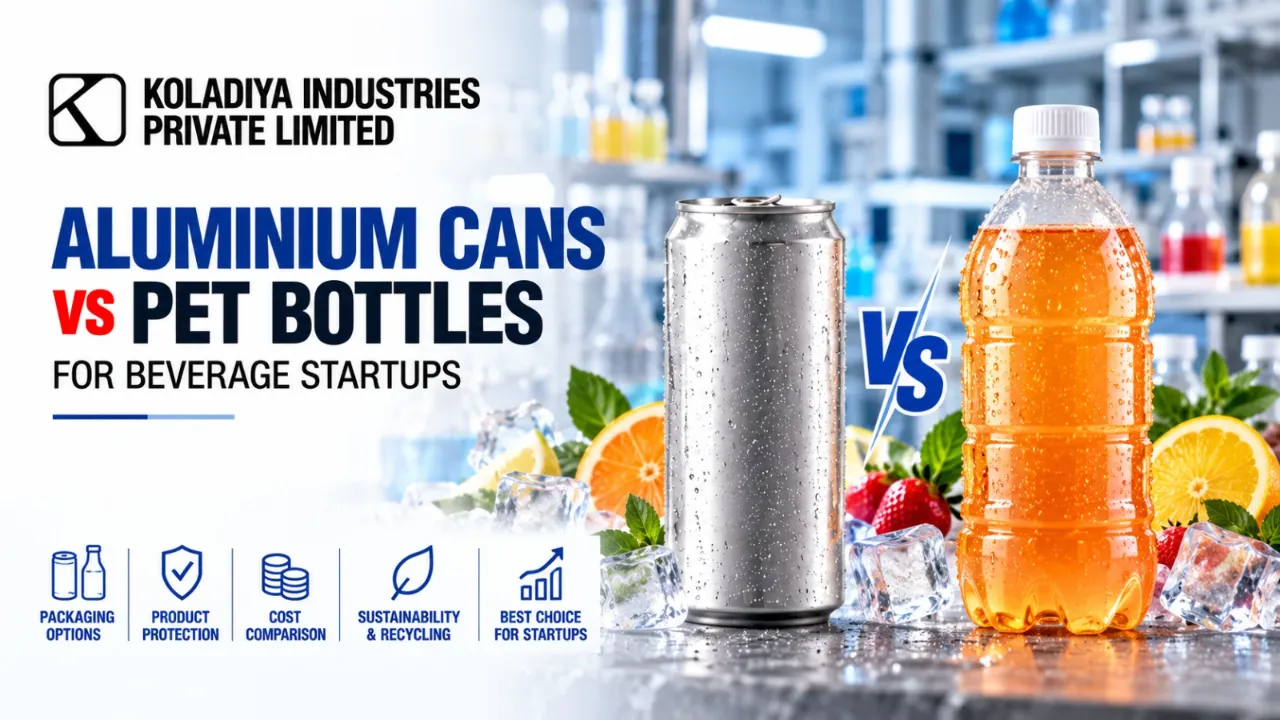
Launching a beverage brand requires more than developing a great recipe. You also need packaging that protects your product, attracts customers, supports your budget, and fits your distribution strategy. For many beverage startups, choosing between aluminium cans and PET bottles becomes one of the most important early decisions. Both packaging options offer unique advantages. Aluminium cans provide a modern appearance, strong light protection, and convenience for on-the-go consumption. In contrast, PET bottles offer transparency, lightweight handling, and easy resealing. However, the right option depends on your beverage category, target customers, production volume, and business goals. In this guide, we compare aluminium cans vs PET bottles across cost, product protection, branding, sustainability, transportation, and manufacturing requirements. As a result, you can make a more informed packaging decision before launching your beverage brand.
Aluminium Cans vs PET Bottles: A Complete Packaging Overview
Before comparing their advantages, you should understand how these two packaging materials work.
What Are Aluminium Cans?
Aluminium cans use lightweight metal packaging designed to hold beverages such as energy drinks, carbonated soft drinks, sparkling water, flavoured drinks, and certain ready-to-drink beverages. Manufacturers typically use an internal coating to separate the beverage from the metal and protect product quality.
Moreover, cans provide an excellent barrier against light and gases when the manufacturer selects the right packaging specification and closure system. As a result, aluminium cans are a practical choice for carbonated beverages and drinks that require protection from light exposure.
Aluminium cans also offer a smooth exterior for colourful branding and premium product designs. Therefore, many beverage startups choose them to create a distinctive shelf presence.
What Are PET Bottles?
PET stands for polyethylene terephthalate, a lightweight plastic commonly used for beverage bottles. These bottles can accommodate packaged drinking water, juices, soft drinks, flavoured water, and many other beverages when the material and bottle design suit the formulation.
One of their biggest advantages is transparency. Customers can see the beverage inside, which may improve product appeal for clear drinks and visually attractive formulations.
Additionally, PET bottles typically feature screw caps, making them easy to open and reseal. Consequently, they work well for customers who prefer to consume a beverage gradually rather than finish it immediately.
Aluminium Cans vs PET Bottles: Key Differences
Both options can support a successful beverage launch. Nevertheless, they differ in practical ways that can influence manufacturing decisions, operating costs, and customer experience.
| Comparison Factor | Aluminium Cans | PET Bottles |
|---|---|---|
| Material | Aluminium with an appropriate internal coating | PET plastic |
| Product visibility | Opaque; customers cannot see the beverage | Transparent or coloured, depending on design |
| Light protection | Blocks light effectively | Depends on bottle colour and material design |
| Resealability | Usually not resealable after opening | Usually resealable with a screw cap |
| Carbonated drinks | Suitable with the correct can and closure specification | Suitable with a pressure-rated bottle design |
| Branding | Strong surface for graphics and premium designs | Flexible label, sleeve, and bottle-shape options |
| Handling | Lightweight but vulnerable to denting | Lightweight and potentially squeezable or crushable |
| Storage | Efficient cylindrical packaging, depending on format | Available in numerous shapes and sizes |
| Sustainability | Aluminium recycling can offer significant material recovery benefits | PET recycling depends on collection and processing systems |
| Common advantage | Light protection and a premium appearance | Visibility and resealability |
Ultimately, the packaging decision should reflect your product requirements rather than appearance alone.
1. Packaging Cost and Initial Investment
For beverage startups, packaging costs directly affect product pricing, profit margins, and working capital. Therefore, compare the complete packaging cost instead of focusing only on the price of an empty can or bottle.
Aluminium Cans vs PET Bottles: Which Offers Better Cost Efficiency?
PET bottles may offer an attractive starting point for businesses that prioritise lightweight packaging and conventional bottle formats. Depending on supplier pricing, bottle design, cap selection, label requirements, and order volume, they may deliver competitive packaging costs.
However, aluminium cans can also become cost-effective at suitable production volumes. Their economics depend on can size, decoration, supply availability, filling arrangements, and minimum order quantities.
In addition, consider costs beyond the packaging unit itself. These may include:
- Labels, sleeves, caps, and closures.
- Filling and sealing arrangements.
- Transportation and storage.
- Printing and customisation.
- Quality testing and product trials.
- Minimum order quantities and inventory requirements.
For example, a startup launching a premium energy drink may accept a higher packaging cost to achieve a distinctive brand identity. Conversely, a value-focused water brand may prioritise affordability and easy distribution.
Practical tip: Request quotations for both formats at your expected production volume. Then calculate the total cost per saleable unit, including filling, packaging, transport, and expected wastage.
2. Product Protection and Shelf Life
Packaging plays a major role in protecting flavour, appearance, carbonation, and overall product quality. However, neither material automatically guarantees a particular shelf life.
Aluminium Cans and PET Bottles for Product Freshness
Aluminium cans provide an effective barrier against light. They can also protect against oxygen and carbon dioxide exchange when the can body, internal coating, seams, and filling process meet the product’s requirements.
Therefore, cans often suit carbonated beverages and formulations that benefit from protection against light exposure. This includes certain energy drinks and sparkling beverages.
PET bottles offer a different set of benefits. They allow consumers to view the product, but conventional PET packaging permits some oxygen and carbon dioxide transmission over time. The rate depends on bottle design, wall thickness, material specification, temperature, and storage duration.
Special barrier technologies can improve PET performance for certain applications. Likewise, suitable coloured or protective bottle designs can reduce light exposure.
Most importantly, you should test the actual beverage in its intended packaging. Product pH, ingredients, preservatives, processing method, storage conditions, and closure quality can all influence shelf life.
Before commercial production, establish a suitable testing plan and confirm that your packaging supports the required shelf-life target.
3. Branding, Appearance, and Customer Experience
Packaging communicates your brand’s positioning before customers taste the product. Consequently, you should choose a format that reflects your target market and product identity.
Aluminium Cans and PET Bottles for Beverage Branding
Aluminium cans can create a modern, premium, and compact appearance. They offer a broad surface for product graphics, brand colours, ingredient information, and promotional messages. As a result, they often suit energy drinks, sparkling beverages, and lifestyle-focused products.
Furthermore, cans can help a new brand establish a recognisable visual identity across retail shelves, vending machines, cafés, and online product listings.
PET bottles, on the other hand, offer greater visibility of the beverage itself. Their shape, label, cap colour, and transparent appearance can support different branding strategies.
For example, a clear flavoured-water product may benefit from a transparent bottle that highlights the drink’s appearance. Similarly, a family-oriented soft drink brand may prefer a resealable bottle for everyday consumption.
However, appearance should not outweigh usability. Consider how customers will carry, open, store, and consume your product before finalising the design.
4. Transportation, Storage, and Distribution
Distribution requirements often influence packaging choices, especially for startups operating across multiple cities or retail channels.
Aluminium cans offer relatively uniform shapes, which can simplify packing and stacking when the carton and pallet design suit the format. Nevertheless, dents can affect appearance and may require additional handling controls.
PET bottles are also lightweight and available in various shapes. However, certain designs may require careful packing to prevent deformation, leakage, or other handling problems.
In either case, calculate transport costs using the complete shipping configuration. Consider the number of units per carton, pallet efficiency, shipping weight, storage space, and protection against damage.
Think about where your customers will buy and enjoy your beverage. For example, products sold in supermarkets need packaging that stands out on shelves, while drinks sold at gyms, cafés, or restaurants may need convenient, easy-to-carry options. Therefore, choose packaging that fits your customers’ daily habits and makes your product easier to buy and enjoy.
5. Sustainability and Recycling
Sustainability can influence consumer perception, retailer expectations, and long-term packaging strategy. However, you should assess the full packaging system instead of relying on simple claims about one material being universally better.
Aluminium Cans and PET Bottles: Which Is More Sustainable?
Aluminium can be recycled repeatedly when collection and processing systems recover it effectively. Recycling aluminium also generally requires substantially less energy than producing primary aluminium from raw materials.
However, primary aluminium production can have a significant environmental footprint. Transportation, can manufacturing, coatings, and the energy mix all contribute to the overall impact.
PET bottles can also enter recycling streams where suitable collection and processing facilities exist. Recycled PET may support packaging applications that meet the relevant food-contact requirements. Nevertheless, contamination, labels, collection rates, and local recycling infrastructure can affect actual recovery.
Packaging weight also matters because it influences transport emissions. In addition, caps, labels, inks, coatings, and secondary packaging contribute to the environmental impact.
Therefore, compare verified supplier information, recycled content, local recycling access, transport distances, and packaging waste. Avoid making environmental claims unless you can support them with reliable evidence.
6. Which Packaging Works Best for Different Beverage Categories?
Your beverage formulation should guide the final decision. Although both formats serve many applications, certain product characteristics make one option more practical than another.
| Beverage Category | Potentially Suitable Option | Key Consideration |
|---|---|---|
| Energy drinks | Aluminium cans or PET bottles | Brand positioning, carbonation, and light sensitivity |
| Carbonated soft drinks | Both | Pressure resistance and carbonation retention |
| Packaged drinking water | PET bottles or suitable cans | Price, distribution, and target market |
| Flavoured water | Both | Clarity, ingredients, and shelf-life requirements |
| Sparkling water | Both | Carbon dioxide retention and packaging specification |
| Juice-based beverages | Depends on formulation | Processing method, acidity, oxygen sensitivity, and shelf life |
| Premium ready-to-drink beverages | Both | Brand identity, serving size, and product stability |
This table provides general guidance rather than a universal recommendation. Each formulation requires packaging compatibility checks and appropriate validation before commercial production.
7. What Should Beverage Startups Consider Before Choosing?
Before committing to a packaging format, assess the following factors carefully.
1. Define your target customer. Understand whether customers prioritise premium appearance, affordability, convenience, portability, or resealability.
2. Confirm product compatibility. Check the interaction between the beverage, packaging material, internal coating, cap, and closure.
3. Calculate minimum order quantities. Suppliers may require different order volumes for cans, bottles, labels, and customised designs. Confirm these requirements before finalising your budget.
4. Evaluate manufacturing capabilities. Confirm that your chosen manufacturing partner can fill, seal, inspect, and pack the selected format using suitable processes and equipment.
5. Test shelf life and quality. Assess microbial safety, flavour stability, appearance, packaging integrity, and other relevant product specifications.
6. Review distribution plans. Estimate storage needs, transport conditions, retailer requirements, and expected sales volume.
7. Compare total landed cost. Include packaging, filling, secondary packaging, transport, wastage, and inventory costs.
By completing these checks early, you can reduce avoidable packaging changes, production delays, and unexpected expenses.
8. How a Beverage Manufacturing Partner Can Help
Choosing packaging becomes easier when you work with a manufacturing partner that understands formulation, filling, packaging compatibility, and production planning.
For example, a beverage startup may have a strong product concept but remain unsure whether aluminium cans or PET bottles better suit its formulation. A structured evaluation can help identify practical options before the brand invests heavily in packaging materials and marketing.
Koladiya Industries can be part of your research when evaluating beverage manufacturing requirements for your brand. Discuss your beverage category, proposed ingredients, target pack size, expected order quantity, preferred packaging material, and launch timeline with the manufacturing team.
Additionally, request clear information about available packaging formats, minimum order quantities, production capabilities, quality checks, and commercial terms. Confirm these details directly before making a final commitment.
A suitable manufacturing arrangement should support product quality, consistent production, and your brand’s long-term growth objectives.
Final Verdict: Aluminium Cans vs PET Bottles
The choice between aluminium cans and PET bottles depends on your formulation, target customers, budget, distribution model, and brand positioning.
Aluminium cans may suit startups that prioritise light protection, a premium appearance, and packaging for carbonated beverages. Meanwhile, PET bottles can offer transparency, convenient resealing, and flexibility across many beverage categories.
Neither option is the best choice for every product. Instead, compare total packaging costs, test product compatibility, validate shelf life, and confirm manufacturing capabilities before selecting your final format.
For beverage startups, the smartest approach is to balance product quality, customer experience, operational practicality, and profitability. With the right planning and manufacturing partner, you can select packaging that supports a successful launch and provides a strong foundation for future growth.
FAQ’s
Which packaging option is more affordable for a new beverage brand?
PET bottles may offer lower initial packaging costs for some products. However, aluminium cans can suit premium positioning. Compare minimum order quantities (MOQs), filling costs, transportation, and storage expenses.
What is the difference between aluminium cans and PET bottles?
Aluminium cans block light and provide a metal barrier, while PET bottles are lightweight, transparent, and shatter-resistant. Both options require suitable product compatibility and proper sealing.
Which packaging is better for energy drinks and functional beverages?
Aluminium cans often suit energy drinks, protein water, and functional beverages because they support a modern, premium brand image. PET bottles may work better when consumers prefer resealable packaging.
Are aluminium cans more sustainable than PET bottles?
Both materials can be recycled. Aluminium cans often achieve high recycling value, while PET bottles can also support recycling systems. Actual environmental impact depends on recycled content, collection rates, transport, and local recycling infrastructure.
Which packaging option is better for beverage transportation and storage?
PET bottles are lightweight and resist shattering, while aluminium cans offer efficient stacking and protect products from light. Choose packaging based on distribution conditions, storage requirements, and product shelf-life needs.
How should startups choose between aluminium cans and PET bottles?
Startups should evaluate their beverage formulation, target customers, budget, minimum order quantity, shelf-life requirements, and brand positioning. Consult a reliable beverage contract manufacturer to compare production feasibility and packaging options before launching.