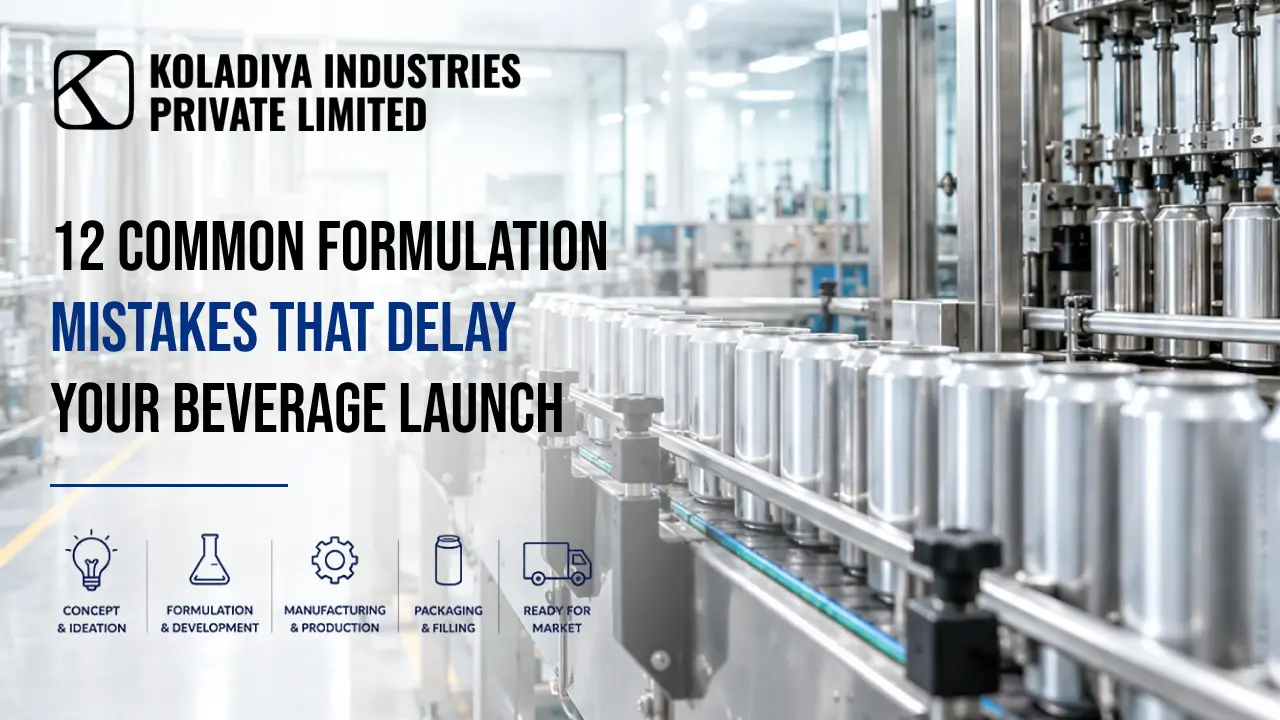
Launching a beverage brand requires more than a creative idea, attractive packaging, and a strong marketing strategy. You also need the right formulation, consistent product quality, reliable shelf stability, and a manufacturing process that supports your business goals. However, many startups and growing beverage brands overlook important formulation details during product development. As a result, they face production delays, unexpected costs, quality problems, and postponed product launches. Understanding common formulation mistakes early can help beverage entrepreneurs make better decisions, reduce development risks, and bring products to market more efficiently. Whether you plan to launch energy drinks, protein water, flavoured water, hydration drinks, juices, or functional beverages, a structured formulation process can make a significant difference.
In this guide, we explain the most common beverage formulation mistakes, why they occur, and how businesses can avoid them before starting commercial production.
Common Formulation Mistakes That Delay Beverage Launches
Beverage formulation involves balancing ingredients, taste, texture, stability, safety, packaging compatibility, and production requirements. Even a small oversight can create challenges during testing or large-scale manufacturing. Therefore, brands should evaluate each formulation mistakes decision carefully before finalizing their product.
1. Common Formulation Mistakes: Starting Without a Clear Product Concept
One of the most frequent mistakes occurs when entrepreneurs begin formulation without defining their product concept. They may know they want to launch an energy drink or functional beverage, but they have not identified their target customers, preferred flavour profile, price range, or product positioning.
Without clear objectives, the development team may struggle to create a formulation that meets the brand’s expectations.
For example, a premium protein water brand may require a light texture, a refreshing taste, and a specific protein content. In contrast, an energy drink may prioritise flavour intensity, carbonation, and a carefully designed functional ingredient profile.
How to avoid this mistake:
- Define your target audience and product category.
- Identify your preferred flavour, sweetness, and texture.
- Establish the intended nutritional and functional profile.
- Determine your target selling price and packaging format.
- Prepare a clear product brief before development begins.
Consequently, a well-defined concept helps your formulation team work towards measurable goals instead of making repeated adjustments.
2. Choosing Ingredients Without Evaluating Compatibility
Another common formulation mistake involves selecting ingredients individually without checking how they interact with one another.
An ingredient may perform well on its own but create problems when combined with acids, sweeteners, flavours, minerals, proteins, or functional extracts. These interactions can affect taste, colour, clarity, texture, and stability.
For instance, certain mineral ingredients may create an unpleasant aftertaste. Similarly, some protein ingredients may develop sediment or lose their desired texture under particular formulation conditions.
Moreover, ingredients can respond differently to changes in pH, temperature, and processing conditions.
How to avoid this mistake:
- Review ingredient specifications before formulation.
- Evaluate ingredient compatibility during laboratory trials.
- Test the product under relevant processing conditions.
- Check for changes in colour, taste, texture, and appearance.
- Work with qualified formulation professionals.
By evaluating compatibility early, brands can identify potential issues before they affect commercial production.
3. Ignoring Taste and Flavour Balance
Taste plays a major role in beverage acceptance. Even when a drink contains attractive ingredients, customers may reject it if the flavour feels artificial, excessively sweet, bitter, or unbalanced.
This problem often affects functional beverages because active ingredients can introduce distinctive flavours. Protein ingredients, minerals, plant extracts, vitamins, and certain botanical ingredients may create bitterness or lingering aftertastes.
Furthermore, a flavour that tastes pleasant in a small laboratory sample may behave differently when the team scales up the formulation.
How to avoid this mistake:
- Conduct multiple flavour development trials.
- Evaluate sweetness, acidity, aroma, and aftertaste together.
- Test different flavour combinations and ingredient levels.
- Gather feedback from representative target consumers.
- Recheck the final formulation before commercial production.
In addition, brands should consider how the beverage tastes at its intended serving temperature. A chilled drink may deliver a different flavour experience from one served at room temperature.
Ultimately, a balanced flavour profile can improve customer satisfaction and encourage repeat purchases.
4. Using the Wrong Sweetener or Sweetness Level
Sweetness affects the overall flavour, mouthfeel, and positioning of a beverage. However, choosing a sweetener based only on cost or sweetness intensity can create unexpected problems.
Sugar, high-intensity sweeteners, and alternative sweetening systems each behave differently. Some may leave a lingering aftertaste, while others may not provide the body or flavour balance that the product requires.
For example, a low-sugar energy drink may need a carefully balanced sweetener system to deliver a pleasant taste without excessive bitterness. Similarly, a fruit beverage may require a different balance of sweetness and acidity.
How to avoid this mistake:
- Define the desired sweetness level before development.
- Evaluate sweetener taste and aftertaste.
- Consider the product’s nutritional and positioning goals.
- Test the sweetener system with the complete formulation.
- Verify applicable ingredient and labelling requirements.
Therefore, brands should evaluate sweetness as part of the entire formulation rather than treating it as an isolated ingredient decision.
5. Overlooking pH and Acidity Control
Acidity influences beverage flavour, ingredient performance, microbial stability, and processing requirements. However, some brands focus on taste without considering how pH affects the complete product.
An unsuitable pH can contribute to ingredient instability, changes in flavour, precipitation, or other quality issues. It may also affect the processing and preservation approach required for the beverage.
Different beverage categories require different technical considerations. A fruit drink, protein beverage, carbonated soft drink, and functional water do not necessarily share the same formulation requirements.
How to avoid this mistake:
- Establish appropriate pH targets for the product.
- Measure pH throughout development.
- Evaluate the relationship between acidity and flavour.
- Check ingredient stability at the intended pH.
- Validate the processing and preservation approach.
Most importantly, do not assume that achieving the desired taste automatically ensures product safety or shelf stability. Qualified technical professionals should evaluate these factors together.
6. Skipping Shelf-Life and Stability Testing
One of the most expensive formulation mistakes is launching a beverage without sufficient stability testing.
A product may look and taste excellent immediately after preparation. However, changes can occur during storage, transportation, and distribution. These changes may include colour deterioration, flavour loss, sediment formation, separation, carbonation loss, or packaging-related problems.
Shelf life depends on several factors, including the ingredients, formulation, processing method, packaging, storage conditions, and product characteristics.
How to avoid this mistake:
- Develop a suitable stability testing plan.
- Evaluate the product under relevant storage conditions.
- Monitor taste, colour, aroma, appearance, and other quality parameters.
- Assess microbiological safety where appropriate.
- Establish shelf-life claims using suitable supporting evidence.
Additionally, accelerated stability testing may help identify potential concerns, but it does not automatically replace appropriate real-time studies or other required validation.
By identifying stability problems early, brands can reduce the risk of product rejection, customer complaints, and costly reformulation.
7. Finalizing the Formula Before Testing Packaging Compatibility
Packaging plays an important role in beverage quality. However, businesses sometimes finalise their formulation before checking whether the selected container suits the product.
Cans, PET bottles, glass bottles, and other packaging formats have different technical characteristics. The product and its packaging must work together throughout filling, storage, transportation, and distribution.
For example, carbonation requirements, oxygen exposure, light sensitivity, sealing performance, and material compatibility may influence packaging decisions.
How to avoid this mistake:
- Select packaging according to the beverage’s requirements.
- Evaluate product and packaging compatibility.
- Confirm the suitability of closures and seals.
- Assess filling and processing requirements.
- Conduct appropriate packaging and storage trials.
As a result, early packaging evaluation can prevent last-minute changes to the formula, production line, or packaging specifications.
8. Ignoring Commercial Manufacturing Requirements
A formulation that works in a laboratory does not always translate smoothly into commercial production.
During scale-up, mixing conditions, ingredient addition order, temperature control, processing time, and equipment capabilities can influence the final beverage. If the formulation depends on processes that the selected manufacturing facility cannot reliably reproduce, production may face delays.
Moreover, ingredient availability and minimum procurement quantities can affect commercial feasibility.
How to avoid this mistake:
- Discuss manufacturing capabilities early.
- Evaluate the formulation against available equipment.
- Confirm ingredient sourcing and supply continuity.
- Assess batch sizes and minimum order quantities.
- Conduct appropriate pilot or scale-up trials.
Therefore, involving your manufacturing partner during formulation development can help align the product concept with practical production requirements.
9. Changing the Formulation Too Frequently
Product development requires testing and refinement. Nevertheless, making repeated changes without a clear evaluation process can extend timelines and increase costs.
For example, a team might change the sweetener, flavour, acidity, and functional ingredients simultaneously. If the new sample performs poorly, the team may struggle to identify which change caused the problem.
Frequent changes can also affect ingredient purchasing, testing schedules, packaging decisions, and production planning.
How to avoid this mistake:
- Establish clear product development objectives.
- Change selected variables systematically.
- Record ingredient quantities and trial results.
- Evaluate each sample against defined criteria.
- Approve a final formulation before commercial scale-up.
In addition, maintain accurate formulation records so that your team can reproduce successful trials and trace the reasons behind each change.
10. Overlooking Regulatory and Labelling Requirements
Regulatory considerations can affect formulation decisions from the beginning. If brands ignore applicable requirements until the final stages, they may need to change ingredients, nutritional declarations, product claims, or packaging artwork.
For example, a beverage’s category, ingredient composition, additives, nutritional profile, and intended claims may influence its applicable requirements.
Functional beverages require particular attention because businesses sometimes plan marketing claims before confirming whether the formulation supports them.
How to avoid this mistake:
- Identify the appropriate product category.
- Review applicable ingredient and additive requirements.
- Check nutritional and ingredient declaration requirements.
- Evaluate proposed product and health-related claims.
- Confirm labelling and compliance requirements before printing packaging.
Consequently, early regulatory review helps reduce avoidable revisions and supports a smoother path towards launch.
11. Failing to Test the Final Formulation With Target Consumers
Technical testing helps determine whether a beverage meets its specifications. However, technical performance alone cannot guarantee market acceptance.
A product may satisfy its formulation targets but still fail to match customer expectations for sweetness, flavour, mouthfeel, or overall drinking experience.
Therefore, consumer feedback should form part of the development process.
How to avoid this mistake:
- Identify a representative target audience.
- Conduct structured taste evaluations.
- Compare suitable flavour variations.
- Collect feedback on sweetness, aroma, and mouthfeel.
- Use the results to guide final adjustments.
Importantly, consumer testing should complement safety, quality, stability, and regulatory assessments rather than replace them.
12. Choosing a Manufacturing Partner Too Late
Your manufacturing partner can influence formulation feasibility, packaging selection, testing requirements, and production timelines. If you approach a manufacturer only after finalizing every product detail, you may discover that the proposed formulation does not suit the facility’s capabilities.
For startups, this mistake can lead to unnecessary reformulation, additional expenses, and delays in production planning.
How to avoid this mistake:
Choose a manufacturing partner that understands your beverage category and can discuss formulation, ingredient sourcing, quality controls, packaging, and commercial production requirements.
Before proceeding, ask about:
- Research and development support.
- Formulation trials and product testing.
- Production capacity and equipment.
- Packaging formats and filling capabilities.
- Quality assurance and regulatory support.
- Minimum order quantities and lead times.
As a result, early collaboration can help your business make informed decisions before committing to a final formulation.
How to Prevent Beverage Formulation Mistakes Before Launch
Although every beverage category has unique requirements, a structured development process can reduce avoidable delays.
Follow these steps before starting commercial production:
- Define your product concept: Identify your target audience, beverage category, flavour profile, and price positioning.
- Prepare a formulation brief: Document your ingredient preferences, functional requirements, packaging goals, and quality expectations.
- Develop and evaluate samples: Conduct laboratory trials and review taste, texture, acidity, and ingredient compatibility.
- Test product stability: Evaluate relevant physical, chemical, sensory, and microbiological parameters.
- Review packaging and manufacturing: Confirm that the formulation suits the intended container and production process.
- Check regulatory requirements: Verify applicable formulation, safety, labelling, and product claim requirements.
- Conduct pilot or scale-up trials: Assess whether the formulation performs consistently under representative manufacturing conditions.
- Approve the final product: Document the formula, specifications, testing criteria, and production requirements before launch.
This approach helps beverage brands identify problems earlier, manage development costs, and prepare for commercial production with greater confidence.
How Koladiya Industries Can Support Your Beverage Launch
For startups and growing businesses, selecting the right beverage manufacturing partner can simplify the transition from product idea to commercial production.
Koladiya Industries Private Limited, based in Surat, Gujarat, India, is relevant to businesses exploring contract and private-label beverage manufacturing. When evaluating a manufacturing partner, discuss your product concept, formulation requirements, packaging preferences, target market, and expected production volume. A clear discussion at the beginning can help your team assess technical feasibility and identify the next steps for product development.
Whether you are exploring energy drinks, flavoured water, hydration beverages, protein water, juices, or other beverage concepts, focus on finding a manufacturing solution that aligns with your product specifications and business objectives. Before finalizing a partnership, confirm the manufacturer’s actual capabilities, available services, testing support, production requirements, and commercial terms.
Planning to launch your own beverage brand? Start with a clear product brief and discuss your formulation goals with Koladiya Industries. Early planning can help you identify potential challenges, evaluate suitable production options, and prepare your beverage concept for the next stage of development.
Conclusion
Common formulation mistakes can delay beverage launches, increase development costs, and create unnecessary challenges during commercial production. However, businesses can reduce these risks by defining their product concept, selecting compatible ingredients, balancing flavours, managing acidity, testing shelf stability, and evaluating packaging early. Furthermore, collaboration between formulation professionals and manufacturing partners can help identify technical challenges before they affect launch schedules.
Ultimately, a successful beverage launch depends on more than a promising idea. It requires a carefully developed formulation, appropriate testing, regulatory awareness, reliable manufacturing processes, and a product that meets customer expectations. By addressing these factors early, beverage startups and established brands can improve their product development process and move towards commercial launch with greater confidence.
FAQ’s
How do formulation mistakes delay a beverage launch?
Formulation mistakes can require repeated product trials, ingredient changes, additional testing, packaging adjustments, and regulatory reviews, which may extend the launch timeline.
How can beverage startups avoid formulation mistakes?
Startups can reduce mistakes by defining product requirements, selecting compatible ingredients, conducting laboratory trials, testing product stability, and consulting experienced beverage formulation professionals.
Why is shelf-life testing important for beverage formulation?
Shelf-life testing helps evaluate how a beverage's taste, colour, appearance, and other quality characteristics change during storage. It also supports appropriate shelf-life decisions and product quality control.
How does ingredient compatibility affect beverage quality?
Ingredient compatibility influences taste, texture, colour, clarity, and stability. Incompatible ingredients may cause sedimentation, separation, unexpected flavours, or other quality issues.
When should a beverage manufacturer be involved in product formulation?
A beverage manufacturer should ideally be involved during the early development stage. Early collaboration helps assess production feasibility, packaging options, ingredient sourcing, and scale-up requirements.
Can Koladiya Industries help businesses develop their beverage brands?
Koladiya Industries Private Limited, based in Surat, Gujarat, India, is a contract and private-label beverage manufacturing company. Businesses can discuss their beverage concepts, formulation requirements, packaging preferences, and production needs to explore suitable manufacturing options.