Launching a new soft drink brand in India requires more than an attractive bottle and a strong marketing plan. The right soft drink manufacturers in India can influence your product quality, manufacturing cost, minimum order quantity (MOQ), production capacity, packaging options, launch speed, and long-term scalability. Whether you are launching a carbonated soft drink, flavoured beverage, fruit-based drink, energy-style beverage, or private-label product, selecting the right manufacturing partner is one of the most important decisions you will make.
This guide explains how soft drink manufacturing works, what affects the cost, how to evaluate production capacity, what to check before placing an order, and how to choose a manufacturer that can support your brand from initial trials to large-scale production.
Why Choose a Soft Drink Manufacturers in India?
India has a large and diverse beverage market, which creates opportunities for both established companies and new brands. However, building your own beverage manufacturing facility requires significant investment in machinery, utilities, manpower, quality systems, testing, packaging, storage, and regulatory compliance. For many businesses, third-party soft drink manufacturing and private-label beverage manufacturing provide a more practical route to market.
With a capable manufacturing partner, you can potentially reduce:
- Initial plant and machinery investment
- Production setup complexity
- Operational manpower requirements
- Product development time
- Packaging procurement challenges
- Quality-control infrastructure costs
Instead of managing every stage internally, your brand can focus more heavily on marketing, distribution, sales, and customer acquisition.
What Does a Soft Drink Manufacturers Produce?
A professional beverage manufacturing company may offer several product formats, including:
Carbonated Soft Drinks: Cola, lemon-lime, orange, fruit flavours, soda, and customized sparkling beverages.
Non-Carbonated Beverages: Fruit drinks, flavoured water, functional beverages, and other water-based formulations.
Ready-to-Drink Beverages: Convenient packaged beverages developed for retail, food service, convenience stores, modern trade, and online channels.
Private-Label Drinks: Products manufactured under your own brand name, packaging, and specifications.
The available product range depends on the manufacturer’s formulation capabilities, equipment, packaging lines, certifications, and production capacity.
Soft Drink Manufacturing Process in India
A reliable manufacturing process normally follows a controlled sequence to maintain consistency and food safety.
1. Product Concept and Formulation
The process begins with your product concept. You may already have a formula, or the manufacturer may help develop one based on your target taste, price point, market segment, and packaging format.
At this stage, parameters such as sweetness, acidity, flavour profile, colour, carbonation level, shelf life, and ingredient specifications can be evaluated.
2. Water Treatment
Water is a critical ingredient in most beverages. It is treated and tested according to the product and process requirements before being used in production.
For carbonated beverages, the water is subsequently combined with the beverage formulation and carbon dioxide under controlled processing conditions.
3. Syrup and Ingredient Preparation
Ingredients such as sugar or sweeteners, flavours, acids, colours, and permitted additives are handled according to the approved product formulation.
Accurate weighing and controlled mixing are essential because even small formulation variations can affect taste, appearance, and batch consistency.
4. Blending and Carbonation
For carbonated drinks, the treated water and beverage base are blended before carbonation. Carbon dioxide is introduced under controlled conditions to achieve the required carbonation profile.
For non-carbonated beverages, the product proceeds through the applicable blending, processing, and filling stages.
5. Filling and Packaging
The finished beverage is filled into the selected packaging format, such as PET bottles, cans, glass bottles, or other suitable formats.
Packaging selection affects the product’s appearance, shelf life, logistics, unit economics, and customer perception.
6. Quality Testing
Samples may be examined for parameters such as physical characteristics, chemical properties, microbiological safety, packaging integrity, and product consistency.
The exact testing program depends on the product category and applicable requirements.
7. Secondary Packaging and Dispatch
After filling, containers are labelled or otherwise packed as required, followed by secondary packaging, case packing, storage, and dispatch.
A well-managed manufacturer should maintain traceability throughout these stages.
How Much Does Soft Drink Manufacturing Cost in India?
One of the most common questions from beverage entrepreneurs is: “What is the cost of manufacturing soft drinks in India?”
There is no single standard price because manufacturing cost depends on several variables.
A realistic quotation generally considers:
| Cost Factor | What Influences the Cost? |
|---|---|
| Ingredients | Sugar, sweeteners, flavours, acids, colours and other permitted ingredients |
| Packaging | Bottle, can, cap, label, carton, shrink film and packing materials |
| Product Development | Formulation, trials, sampling and testing |
| Manufacturing | Processing, filling, labour, utilities and production overheads |
| Quantity | Larger production runs can improve manufacturing economics |
| Packaging Format | PET, glass, cans and other formats have different costs |
| Design & Tooling | Custom packaging, moulds, printing and artwork requirements |
| Testing | Product, water, packaging and shelf-life related testing |
| Logistics | Freight, warehousing and delivery distance |
| Compliance | Applicable food-safety, labelling and documentation requirements |
Why MOQ Matters
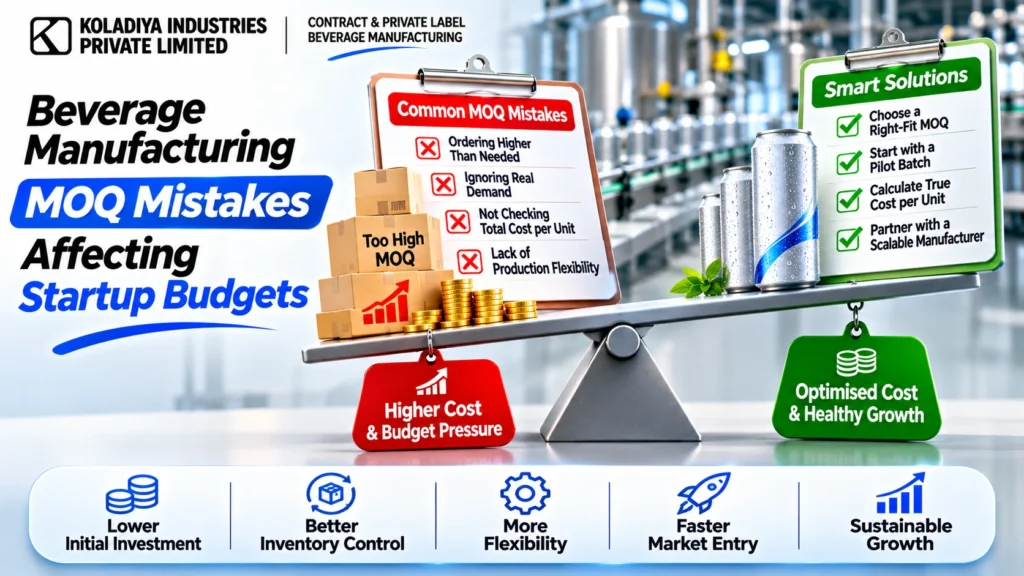
The MOQ offered by soft drink manufacturers in India is particularly important for startups.
A small MOQ can be useful for market testing, regional launches, or new-product validation. However, very small runs can result in higher per-unit costs because setup, packaging procurement, testing, and production preparation still require resources.
Higher-volume production can normally improve economies of scale.
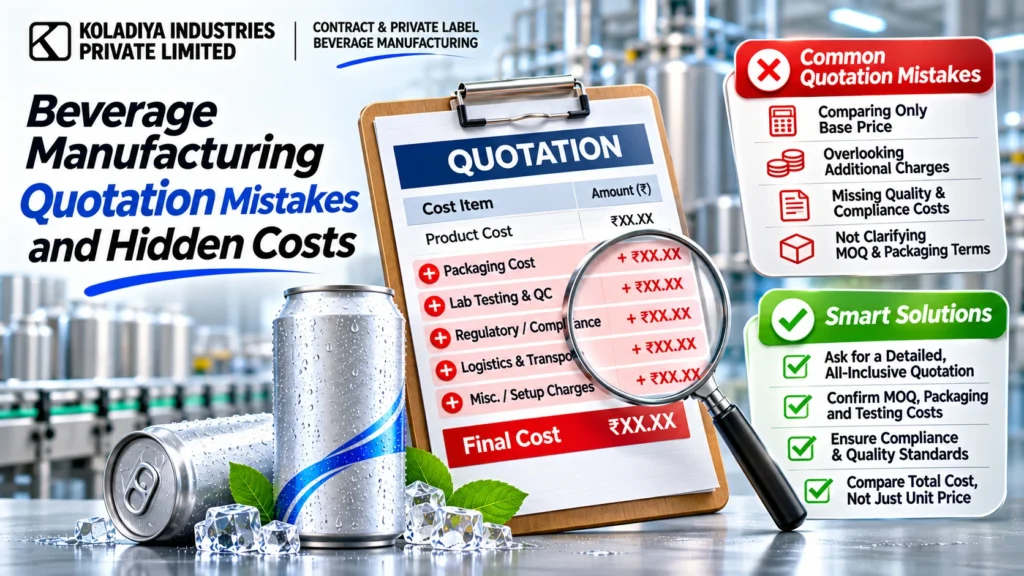
Therefore, do not evaluate a manufacturer only by the lowest quoted unit price. Compare the full commercial structure, including MOQ, packaging, setup costs, testing, logistics, and payment terms.
Production Capacity: What Should You Look For?
Production capacity should match your current demand while leaving room for future growth.
A manufacturer may have the equipment to support small, medium, or large production runs. However, the headline machine capacity is not always the same as practical output.
Actual production can be affected by:
- Product type
- Bottle or can size
- Filling speed
- Changeover time
- Packaging availability
- Cleaning and sanitation cycles
- Production scheduling
- Quality checks
- Maintenance downtime
When evaluating soft drink manufacturers in India, ask for practical production capacity rather than only the maximum machine speed.
For example, a manufacturer may be technically capable of high-speed production, but your actual output depends on the chosen SKU, packaging format, batch size, and scheduling.
Private-Label Soft Drink Manufacturing: What Buyers Should Know
Private-label manufacturing is attractive to entrepreneurs because the product is manufactured by a third party while being sold under the buyer’s own brand.
The process can include:
Brand concept → formulation → product sampling → packaging selection → artwork approval → commercial quotation → production → testing → packing → dispatch
Before production begins, make sure the specifications are clearly documented.
Important commercial and technical details include:
- Product name
- Approved formulation
- Pack size
- Packaging material
- Label specifications
- Shelf-life target
- Batch size
- MOQ
- Quality parameters
- Delivery schedule
- Payment terms
- Testing requirements
Written specifications help reduce misunderstandings and maintain batch-to-batch consistency.
Quality and Food-Safety Compliance
Compliance should never be treated as a final-stage activity. It should be considered during product development, manufacturing, packaging, and labelling.
In India, food businesses are required to obtain the applicable FSSAI registration or licence under the country’s food-safety framework. FSSAI states that food business operators are required to be licensed or registered, with the applicable category depending on the business and its operations.
FSSAI also maintains product standards and regulations covering areas such as food products, additives, contaminants, packaging, and labelling.
For carbonated beverages, FSSAI’s food standards include provisions relating to carbonated water, permitted ingredients, additives, and relevant product requirements.
Labelling is equally important. FSSAI’s Labelling and Display Regulations prescribe requirements for pre-packaged foods and related mandatory information.
BIS also lists standards relevant to carbonated beverages and hygienic conditions for soft drink manufacturing units, including IS 2346 and IS 5837.
Because regulations and applicable requirements can change, businesses should verify the current requirements applicable to their specific beverage and packaging before launch.
How to Choose the Best Soft Drink Manufacturer in India
Selecting the cheapest manufacturer may look attractive at first, but it can create problems later.
Use these criteria when comparing potential manufacturing partners.
1. Manufacturing Infrastructure
Check whether the facility has appropriate processing, filling, packaging, storage, and quality-control infrastructure for your product.
2. Product Development Capability
A strong manufacturer should be able to support formulation trials and product refinement when required.
This is especially important for brands that are developing a new flavour or positioning.
3. Production Capacity
Confirm that the manufacturer can handle both your initial MOQ and your expected future volumes.
4. Packaging Options
Ask about available PET, can, glass, and other packaging formats. Packaging flexibility can help you launch different SKUs as your brand grows.
5. Quality Control
Ask how raw materials, water, in-process production, finished products, and packaging are controlled.
A dependable quality system should be built into manufacturing rather than added at the end.
6. Compliance and Documentation
Review relevant licences, certificates, product specifications, test reports, and documentation before placing a commercial order.
7. MOQ and Commercial Flexibility
For startups, MOQ can have a major effect on working capital. Choose a manufacturing partner whose commercial model fits your realistic sales forecast.
8. Lead Time
Ask for the expected timeline for product development, packaging procurement, production, testing, and dispatch.
An attractive price is less valuable when the launch schedule is repeatedly delayed.
9. Scalability
Your manufacturer should ideally support your growth from initial regional sales to larger multi-market distribution.
10. Communication
Clear communication matters throughout product development, artwork approval, production planning, and dispatch.
A responsive manufacturer can prevent costly delays and specification errors.
Questions to Ask Before You Place an Order
Before selecting a soft drink manufacturer, ask:
What is your MOQ per SKU?
Which bottle, can, and packaging formats do you support?
Can you develop a customized formulation?
How much is your production capacity?
What testing is included in the manufacturing process?
What is the expected production lead time?
Which documents and certifications can you provide?
Can you support recurring production as volumes increase?
Are packaging materials included in the quotation?
What factors can increase the final manufacturing cost?
These questions help you compare suppliers on total value rather than price alone.
Soft Drink Manufacturing Cost: How to Get an Accurate Quote
Online cost estimates can provide an initial idea, but they cannot replace a product-specific quotation.
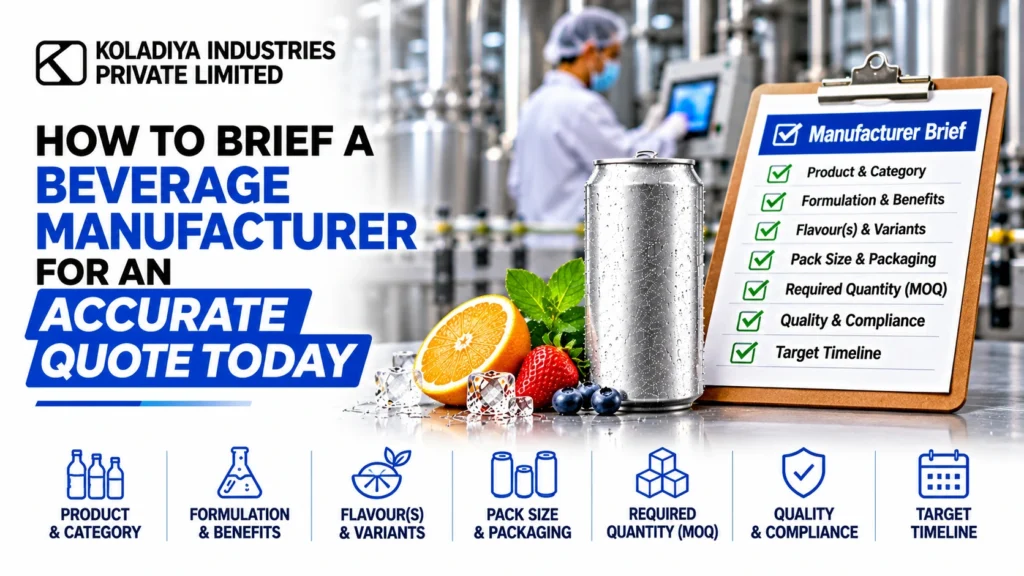
For an accurate manufacturing estimate, a manufacturer normally needs details such as:
- Beverage type
- Formula or product concept
- Pack size
- Packaging format
- Target quantity
- Number of SKUs
- Desired market segment
- Label and packaging requirements
- Delivery location
- Expected launch timeline
For example, a 250 ml PET carbonated beverage and a premium glass-bottle beverage may have very different packaging, production, and logistics economics.
That is why buyers should request a complete quotation based on their exact SKU and order volume.
Why the Right Manufacturing Partner Can Reduce Business Risk
A beverage business depends on consistency.
One poor production batch can affect customer trust. Packaging delays can disrupt retail supply. Incorrect labelling can create compliance issues. Inconsistent taste can weaken repeat purchases.
A capable manufacturing partner helps address these risks by providing controlled production, quality checks, documentation, packaging coordination, and scalable capacity.
For new beverage brands, this can make the difference between simply launching a product and building a sustainable beverage business.
Why Work With an Experienced Soft Drink Manufacturers?
The ideal manufacturing partner should act as more than a production facility.
You should look for a partner that can understand your commercial objective, recommend appropriate packaging, support product development, maintain consistent quality, and scale production as demand increases.
At Koladiya Industries, businesses can explore beverage manufacturing solutions based on their product concept, packaging requirements, and target production volume.
Whether you are preparing a new beverage launch, expanding an existing brand, or looking for a private-label manufacturing partner, the first step is to discuss your exact requirements.
Final Takeaway: Soft Drink Manufacturers
Choosing among soft drink manufacturers in India is a strategic decision because manufacturing affects your product quality, cost structure, MOQ, packaging, launch timeline, and ability to scale. Do not select a supplier only because of the lowest quotation. Evaluate manufacturing infrastructure, formulation support, quality systems, production capacity, packaging capabilities, compliance, MOQ, lead time, and long-term scalability. Most importantly, calculate your real manufacturing cost using your actual product specifications rather than relying on generic online estimates. The right manufacturing partner can help you move from product idea → formulation → packaging → production → market launch with greater efficiency and fewer operational challenges.
Looking for a Soft Drink Manufacturing Partner in India?
Share your beverage concept, required pack size, quantity, packaging preference, and target launch date to discuss the right manufacturing approach for your brand.
Koladiya Industries
Email: inquiry@koladiyaindustries.com
Phone: +91 99794 02229 / 77790 41333
Website: koladiyaindustries.com
Frequently Asked Questions
What is the minimum order quantity (MOQ) for soft drink production?
Most soft drink manufacturers in India have MOQs between 10,000-50,000 liters per order, depending on the beverage type (carbonated, still, energy drink, etc.). Some experienced ODM partners offer flexible MOQs for established brands, but first-time orders typically follow standard minimums to ensure production efficiency.
How do I choose the right soft drink manufacturer for my brand?
Key selection criteria include: production capacity, quality certifications (ISO, FSSAI), equipment capabilities, turnaround time, pricing flexibility, past experience with your beverage type, and communication responsiveness. Request samples, verify their facility, and check references from existing clients before committing.
What production capacity do soft drink manufacturers in India have?
Leading soft drink manufacturers in India typically operate with capacities ranging from 10,000 to 500,000+ liters per day, depending on facility size and equipment. Capacity affects pricing, lead time, and ability to scale. Verify a manufacturer's available capacity matches your growth projections.
How long does it take to develop and manufacture a custom soft drink?
Development (formulation & trials) typically takes 2-4 weeks; bulk production takes an additional 2-3 weeks depending on order size and complexity. Total time-to-market is usually 4-6 weeks from order confirmation. Express timelines may be available at premium rates.
What types of soft drinks can Indian manufacturers produce?
Indian beverage manufacturers produce: carbonated soft drinks, still/flat beverages, energy drinks, flavored water, sports drinks, RTD tea/coffee, and juice-based drinks. Most offer both private label (white label) and custom formulation (OEM/ODM) options to match your brand requirements.
What certifications and quality standards should a soft drink manufacturer have?
Essential certifications include: FSSAI license, ISO 22000 (food safety), GMP (Good Manufacturing Practice), ISO 9001 (quality), and state-level health approvals. Verify third-party testing capabilities for safety compliance. Ask for audit reports and recent quality test results before partnership.